 书单
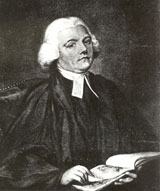
吉尔伯特·怀特
- 生卒
- 1720 – 1793
- 国籍
- 大不列颠王国
- 外文名
- Gilbert White
照片:作者不详,公有领域,来自维基共享资源「Gilbert White.jpg」(经缩小)。
生平与创作
这个词条暂时没有中文维基百科条目,下面是英文维基百科的内容(英文原文):
Gilbert White (18 July 1720 – 26 June 1793) was a "parson-naturalist", a pioneering English naturalist, ecologist, and ornithologist. He is best known for his Natural History and Antiquities of Selborne.
Life
White was born on 18 July 1720 in his grandfather's vicarage at Selborne in Hampshire. His grandfather, also Gilbert White was at that time vicar of Selborne. Gilbert White's parents were John White (1688–1758) a trained barrister and Anne Holt (d. 1740). Gilbert was the eldest of eight surviving siblings, Thomas (b. 1724), Benjamin (b. 1725), Rebecca (b. 1726), John (b. 1727), Francis (b. 1728/29), Anne (b. 1731), and Henry (b. 1733). Gilbert's family lived briefly at Compton, Surrey, before moving into 'The Wakes' in 1728, that was to be his home for the rest of his long life.
Gilbert White was educated in Basingstoke by Thomas Warton, father of Joseph Warton and Thomas Warton, who would have been Gilbert's school fellows. There are also suggestions that he may have attended the Holy Ghost School before going to Oriel College, Oxford in December 1739. He took his degree as Bachelor of Arts in June 1743. In March 1744 he was elected fellow of the college. In October 1746 he became Master of Arts.
White obtained his deacon's orders in 1746, being fully ordained in 1749, and subsequently held several curacies in Hampshire and Wiltshire, including Selborne's neighbouring parishes of Newton Valence and Farringdon, as well as Selborne itself on four separate occasions. In 1752/53 White held the office of Junior Proctor at Oxford and was Dean of Oriel. In 1757 he became non-resident perpetual curate of Moreton Pinkney in Northamptonshire. After the death of his father in 1758, White moved back into the family home at The Wakes in Selborne, which he eventually inherited in 1763. In 1784 he became curate of Selborne for the fourth time, remaining so until his death. Having studied at Oriel, at the behest of his uncle, he was ineligible to be considered for the permanent living of Selborne, which was in the gift of Magdalen College.
White died in 1793 and was buried in the graveyard of St Mary's Church, Selborne.
Career
White is regarded by many as England's first ecologist, and one of those who shaped the modern attitude of respect for nature. He said of the earthworm:
Earthworms, though in appearance a small and despicable link in the chain of nature, yet, if lost, would make a lamentable chasm. [...] worms seem to be the great promoters of vegetation, which would proceed but lamely without them...
The later naturalist Charles Darwin, when asked in 1870 about books that had deeply impressed him in his youth, mentioned White's writings. However, in Darwin's book, The Formation of Vegetable Mould: Through the Action of Worms, with Observations of Their Habits (1881), there is no footnote acknowledgement of White's earlier work in The Natural History and Antiquities of Selborne on the significance of earthworms in creating and maintaining topsoil. Although Darwin clearly states White had a deep understanding of worm behaviour. (See page 14 of Darwin's The Formation of Vegetable Mould). It has been argued that Darwin might not have propounded the theory of evolution without White's pioneering fieldwork establishing the importance of close observation.
Rather than studying dead specimens, White observed live birds and animals in their own habitats over many years; creating a 'new kind of zoology, scientific, precise and based on the steady accumulation of detail'. The Natural History represents a shift to holistic, evidence-based engagement warmed by empathy. From nearly 40 years of observations, White recognised that birds and animals have inner lives. He based his work on accurate (if haphazard) recording of events, classifying, measuring, analysing data, making deductions from observations, and experimenting. He was 'one of the first writers to show that it was possible to write of the natural world with a fresh and intensely personal vision without in any way sacrificing precision'. Thus, Richard Mabey quotes White: 'during this lovely weather the congregating flocks of house martins on the Church and tower were very beautiful and very amusing! When they flew off all together from the roof, on any alarm, they quite swarmed in the air. But they soon settled again in heaps on the shingles; where preening their feathers to admit the rays of the sun, they seemed highly to enjoy the warm situation.' White's scientific outlook was coloured by his theology. He did not have grand theories, plan experiments and replicate them as a modern scientist would: he was more freewheeling and, arguably, as a consequence more appealing as a writer.
White and William Markwick collected records of the dates of emergence of more than 400 plant and animal species, White recording in Hampshire and Markwick in Sussex between 1768 and 1793. These data, summarised in The Natural History and Antiquities of Selborne as the earliest and latest dates for each event over the 25-year period, are among the earliest examples of modern phenology.
American nature writer, Donald C. Peattie, writes in The Road of a Naturalist about White's contribution to the public interest in birds: "The bird census, now so widely promulgated by the Audubon Society, was the invention of Gilbert White; he was the original exponent, as far as I know, of the close seasonal observation of Nature, a branch of science known to the pedantic as phenology. He was the first to perceive the value in the study of migration (then a disputed fact) and of banding or ringing birds, though it was Audubon who first performed the experiment. No professional ornithologist ever did so much to widen interest in birds; from White's pages they cock a friendly eye at us, and hop out of his leaves right over our thresholds."
以上文字摘自英文维基百科「Gilbert White」(有删节,去掉了参考文献等尾部小节),按 CC BY-SA 4.0 使用,作者为维基百科的各位编者。
资料卡
- 出生
- 1720 年 7 月 18 日
- 出生地
- Selborne
- 逝世
- 1793 年 6 月 26 日
- 逝世地
- Selborne
- 职业
- 植物学家、鸟类学家、生态学家、作家、自然科学家、神学家、猎人、作者 等 9 项
- 使用语言
- 英语
- 写作语言
- 英语
- 就读学校
- 牛津大学奥里尔学院、Queen Mary's School for Boys, Basingstoke
- 领域
- 植物学、生态学、鸟类学
- 代表作
- 塞尔伯恩的自然历史和古董手册
资料卡来自 Wikidata Q772840(CC0),众包数据,个别字段可能不全。
本站收录的作品(1)
作品年表(1 本)
本站书库里署名吉尔伯特·怀特的书(Open Library 上至少 10 人加过书架的才收),按首版年份排(有本站书页的用 Wikidata 记的首版年,其余用 Open Library 的);年份偶尔记成后来的版本或译本,以原书为准。全部作品见 Open Library。
- 1789塞尔伯恩的自然历史和古董手册The natural history of Selborne书架 24