 书单
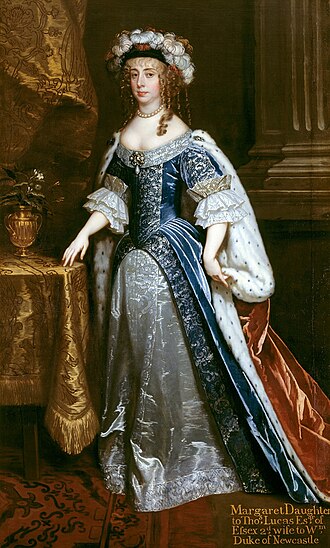
玛格丽特·卡文迪什
- 国籍
- 英格兰王国
- 外文名
- Margaret Cavendish, Duchess of Newcastle-upon-Tyne
照片:Peter Lely,公有领域,来自维基共享资源「Margaret Cavendish, Duchess of Newcastle, by Peter Lely.jpg」(经缩小)。
生平与创作
这个词条暂时没有中文维基百科条目,下面是英文维基百科的内容(英文原文):
Margaret Cavendish, Duchess of Newcastle-upon-Tyne (née Lucas; 1623 – 16 December 1673) was an English natural philosopher, poet, fiction writer, and playwright. She was a prolific writer, publishing over a dozen original texts under her name at a time when women were largely excluded from publishing.
Although many would credit author Mary Shelley as the inventor of science fiction, Margaret Cavendish can also be counted as an essential pioneer. Her book The Blazing World is one of the first to fall into the science fiction genre. As a well-connected natural philosopher, Cavendish engaged with some of the most influential minds of her time, including René Descartes, Thomas Hobbes, and Henry More.
Background
Born Margaret Lucas to Sir Thomas Lucas (1573–1625) and Elizabeth Leighton (died 1647), she was the youngest child of the family. She had four sisters and three brothers, the royalists Sir John Lucas, Sir Thomas Lucas and Sir Charles Lucas, who owned the manor of St John's Abbey, Colchester. As a teenager, she became an attendant on Queen Henrietta Maria and travelled with her into exile in France, living for a time at the court of the young King Louis XIV. She became the second wife of William Cavendish, 1st Duke of Newcastle-upon-Tyne in 1645.
Her husband, the marquess William Cavendish, 1st Duke of Newcastle, was a Royalist commander in Northern England during the First English Civil War and in 1644 went into voluntary exile in France. Margaret accompanied him and remained abroad until the Stuart Restoration in 1660.
Writings
Cavendish, as a poet, philosopher, writer of prose romances, essayist, and playwright, published under her name at a time when most women writers remained anonymous. Her topics included gender, power, manners, scientific method, and philosophy. Her utopian romance The Blazing World is one of the earliest examples of science fiction. She was unusual in her time for publishing extensively in natural philosophy and early modern science, producing over a dozen original works; with her revised works the total came to 21. She often would have her portrait engraved on the covers of her works so that people would know that she was solely responsible for the creation of whatever she wrote and then published in some way or another.
Cavendish has been championed and criticised as a unique, ground-breaking writer. She rejected the Aristotelianism and mechanical philosophy of the 17th century, preferring a vitalist model. In May 1667, she became the first woman to attend a meeting at the Royal Society of London, criticising and engaging with members and philosophers such as Robert Boyle.
Cavendish's publications brought her fame and helped to disprove the contemporary belief that women were inherently inferior to men. Cavendish used them to advocate women's education: women were capable of learning and benefiting from education, and she insisted her own works would have been better still if, like her brothers, she had been able to attend school.
Views on animals
Animals and the relationship between humans and other creatures recur in Cavendish's poetry and natural philosophy. She rejected René Descartes's account of non-human animals as mindless automata. In her natural philosophy, all parts of nature were composed partly of self-moving matter and therefore possessed some form of perception and knowledge. Cavendish consequently attributed knowledge not only to humans and other animals, but also to plants and minerals. She maintained that different creatures possessed different kinds of knowledge, asking, for example, whether fish might know more about water, birds about the air, and worms about the earth than humans did. Although she regarded humans as possessing a wider range of knowledge because of their bodily form, experience and use of language, she did not regard reason or perception as exclusively human capacities.
Cavendish addressed human treatment of animals most directly in Poems and Fancies (1653). "The Hunting of the Hare" and "The Hunting of the Stag" describe hunts from the perspective of the pursued animals, including their fear and suffering. In the former, she gives the hare the name "Wat" and describes the hunters' celebration of his death before accusing humans of believing that other creatures were made for them to "Tyrannize upon". Mihoko Suzuki interprets the poems as presenting hunted animals as individual subjects and exposing hunting as gratuitous violence. She argues that Cavendish's use of the language of tyranny gives her criticism of human domination over animals a political dimension. Cavendish also wrote elsewhere of animals as possessing their own forms of knowledge, and in "A Morall Discourse betwixt Man, and Beast" compared human abilities with those of other species while criticising the power humans exercised "To kill, to spoile, or else alive to take".
Cavendish also questioned the killing of animals for food. In Poems and Fancies, she criticised the assumption that God had given animals life and sensation merely for humans to eat, while in Grounds of Natural Philosophy she imagined animals and humans subsisting on fruits, herbs, milk and eggs rather than destroying an entire living creature. Roger Maioli describes these passages as recurring defences of vegetarianism and connects them to Cavendish's rejection of human centrality and her account of non-human cognition. Deborah Boyle offers a narrower interpretation, noting that Cavendish herself ate meat and arguing that she did not regard eating animals as inherently wrong. According to Boyle, her objections concerned excessive, wasteful or prideful uses of animals rather than their use for food itself.
以上文字摘自英文维基百科「Margaret Cavendish, Duchess of Newcastle-upon-Tyne」(有删节,去掉了参考文献等尾部小节),按 CC BY-SA 4.0 使用,作者为维基百科的各位编者。
资料卡
- 母语名
- Margaret Cavendish, Duchess of Newcastle-upon-Tyne
- 出生地
- 科尔切斯特
- 逝世
- 1673 年 12 月 15 日
- 逝世地
- 英格兰王国
- 职业
- 哲学家、物理学家、诗人、作家、散文家、科幻作家、女官
- 使用语言
- 英语
- 写作语言
- 英语
- 领域
- 诗歌、随笔、英语文学、自然哲学
- 配偶
- 纽卡斯尔第一公爵威廉·卡文迪许(1645)
- 代表作
- The Description of a New World, Called The Blazing-World、访问(1667)
资料卡来自 Wikidata Q242640(CC0),众包数据,个别字段可能不全。
本站收录的作品(1)
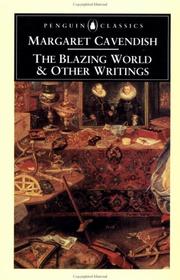
作品年表(1 本)
本站书库里署名玛格丽特·卡文迪什的书(Open Library 上至少 10 人加过书架的才收),按首版年份排(有本站书页的用 Wikidata 记的首版年,其余用 Open Library 的);年份偶尔记成后来的版本或译本,以原书为准。全部作品见 Open Library。
- 1666The description of a new world书架 26