 书单
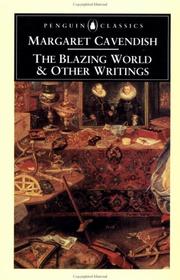
The Description of a New World, Called The Blazing-World (1666)
- 作者
- 玛格丽特·卡文迪什
- 首版
- 1666 年
- 国家/地区
- 英格兰王国
- Open Library
- 361 个版本
百科
这个词条暂时没有中文维基百科条目,下面是英文维基百科的内容(英文原文):
The Description of a New World, Called The Blazing-World, better known as The Blazing World, is a 1666 work of prose fiction by the English writer Margaret Cavendish, the Duchess of Newcastle. Dale Spender calls it a forerunner of science fiction. It can also be read as a piece of utopian fiction.
In the novel, a woman from the Kingdom of ESFI (a combined version of the kingdoms of England, Scotland, France, and Ireland) is kidnapped by a spurned lover. The angry gods blow the boat transporting them to the North Pole, where its crew dies. The woman is the lone survivor, and she finds a portal into a parallel world. It is inhabited by human–animal hybrids who mistake her for a goddess and choose her as their new empress. She creates a new religion and decides to write down her own version of the Kabbalah.
Story
As its full title suggests, Blazing World is a fanciful depiction of a satirical, utopian kingdom in another world (with different stars in the sky) that can be reached via the North Pole. According to novelist Steven H. Propp, it is "the only known work of utopian fiction by a woman in the 17th century, as well as an example of what we now call 'proto-science fiction' — although it is also a romance, an adventure story, and even autobiography."
The Blazing World opens with a sonnet written by the author's husband, William Cavendish, 1st Duke of Newcastle-upon-Tyne, which celebrates her imaginative powers. The sonnet is followed by a letter to the reader written by Margaret Cavendish herself. In the letter to the reader, Cavendish divides Blazing World into three parts. The first part is "romancical", the second "philosophical", and the third "fancy" or "fantastical". She also explains the joint publishing of Blazing World with the more intellectual and non-fiction Observations Upon Experimental Philosophy.
The first "romancical" section describes a young woman from the Kingdom of ESFI (an acronym for England, Scotland, France, and Ireland) being kidnapped onto a boat by a spurned lover. The gods, unsatisfied by the kidnapping, blow the boat to the North Pole, where all of the crew except the young woman die of hypothermia. The ship floats into a parallel world populated by talking animal-human hybrids, the "Blazing World". The young woman is worshipped as a goddess, despite her pleas that she is mortal, and is made Empress of the Blazing World.
The second "philosophical" section describes the Empress's knowledge and interest in the natural sciences and philosophy. She consults on these matters with a variety of human-animal hybrids, each group of which specializes in a specific field. She praises some of these guild-like groups, and chastises others. She also imposes a new religion onto the Blazing World. Homesick, she consults immaterial spirits to tell her news from home, and enlists their assistance to write her own Cabbala. The spirits suggest the Duchess of Newcastle to be the best scribe for the project.
The final "fantastical" section begins as the Empress and Duchess become close friends over the writing of the Cabbala. They visit England together, with the Empress's soul inhabiting the Duchess's body, and the Duchess solicits help from Fortune for her unlucky husband. In the Blazing World, the Duchess mounts an impassioned defense of her husband at a court hearing with the virtues, although the outcome of the legal process is inconclusive. The Duchess departs the Blazing World for her home, and advises the Empress to return the Blazing World to its original balance.
When the spirits inform the Empress that ESFI has been destroyed in war, the Empress and the Duchess reunite to plan an invasion of ESFI. The Empress clothes herself in gemstones and invades with fantastical technologies. The armies of ESFI think her an angel, and the Empress compels them to return power to ESFI's righteous King. The Empress and the Duchess have one last extended conversation, and depart to their respective homes. The Empress returns the Blazing World to its original harmony, without her implemented religion.
Cavendish ends Blazing World with an Epilogue to the Reader. In this Epilogue she describes her reasons for writing The Blazing World. She compares creating The Blazing World to the conquests of Alexander the Great and Julius Caesar.
The work was initially published as a companion piece to Cavendish's Observations upon Experimental Philosophy and thus functioned as an imaginative component to what was otherwise a reasoned endeavor in 17th-century science. It was reprinted in 1668.
Genre and implications
Scholar Nicole Pohl of Oxford Brookes University has argued that Cavendish was accurate in her categorisation of the work as "a 'hermaphroditic' text". Pohl points to Cavendish's confrontations of seventeenth century norms, with regard to such categories as science, politics, gender, and identity. Pohl argues that her willingness to question society's conceptions while discussing topics that were considered in her era best left to male minds, allows her to escape into an exceptional gender-neutral discussion of said topics, creating what Pohl labels "a truly emancipatory poetic space".
Northeastern University professor Marina Leslie remarks that readers have noted that The Blazing World serves as a departure from the habitually male-dominated field of utopian writing. While some readers and critics may interpret Cavendish's work as being restricted by these characteristics of the genre of utopia, Leslie suggests approaching interpretations of the work while remembering Cavendish as one of the first, more outspoken feminists in history, and especially in early writing. Leslie contends that in this sense, Cavendish utilised the utopian genre to discuss issues such as "female nature and authority" in a new light, while simultaneously expanding the utopian genre itself.
以上文字摘自英文维基百科「The Blazing World」(有删节,去掉了参考文献等尾部小节),按 CC BY-SA 4.0 使用,作者为维基百科的各位编者。
资料卡
- 原题
- The Description of a New World, Called The Blazing-World
- 原作语言
- 英语
- 首次出版
- 1666 年
- 作品形式
- 长篇小说
- 体裁
- 奇幻、科学幻想
- 主题
- 乌托邦
资料卡来自 Wikidata Q1082871(CC0),众包数据,个别字段可能不全。
改编作品
电影2
名单来自 Wikidata(CC0):只列条目里写明「改编自 / 取材于」这本书的作品,不按名字猜;众包数据,可能不全。