 书单
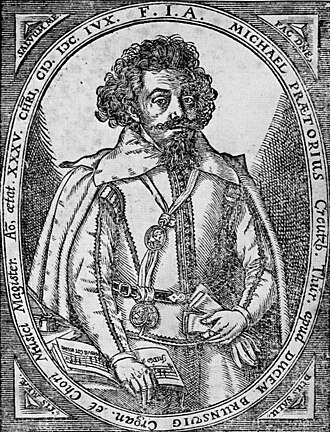
米夏埃尔·普雷托里乌斯
- 生卒
- 1571 – 1621
- 国籍
- 布伦瑞克-吕讷堡公国
- 外文名
- Michael Praetorius
照片:1606,公有领域,来自维基共享资源「Michael Praetorius.jpg」(经缩小)。
生平与创作
这个词条暂时没有中文维基百科条目,下面是英文维基百科的内容(英文原文):
Michael Praetorius (probably 28 September 1571 – 15 February 1621) was a German composer, organist, and music theorist. He was one of the most versatile composers of his age, being particularly significant in the development of musical forms based on Protestant hymns.
Life
Praetorius was born Michael Schultze, the youngest son of a Lutheran pastor, in Creuzburg, in present-day Thuringia. After attending school in Torgau and Zerbst, he studied divinity and philosophy at the University of Frankfurt (Oder). He was fluent in a number of languages. After receiving his musical education, from 1587 he served as organist at the Marienkirche in Frankfurt. From 1592/3 he served at the court in Wolfenbüttel, under the employ of Henry Julius, Duke of Brunswick-Lüneburg. He served in the duke's State Orchestra, first as organist and later (from 1604) as Kapellmeister (court music director).
His first compositions appeared around 1602/3. Their publication primarily reflects the care for music at the court of Gröningen. The motets of this collection were the first in Germany to make use of the new Italian performance practices; as a result, they established him as a proficient composer.
These "modern" pieces mark the end of his middle creative period. The nine parts of his Musae Sioniae (1605–10) and the 1611 published collections of liturgical music (masses, hymns, magnificats) follow the German Protestant chorale style. With these, at the behest of a circle of orthodox Lutherans, he followed the Duchess Elizabeth, who ruled the duchy in the duke's absence.
When the duke died in 1613 and was succeeded by Frederick Ulrich, Praetorius retained his post in Wolfenbüttel. But he also began working at the court of John George I, Elector of Saxony at Dresden as Kapellmeister von Haus aus (nonresident music director). There he was responsible for festive music and was exposed to the latest Italian music, including the polychoral works of the Venetian School. His subsequent development of the form of the chorale concerto, particularly the polychoral variety, resulted directly from his familiarity with the music of such Venetians as Giovanni Gabrieli. The solo-voice, polychoral, and instrumental compositions Praetorius prepared for these events mark the high period of his artistic creativity. Gottfried Staffel's detailed eyewitness account of Praetorius's music directing at the 1614 Princes’ Convention (Fürstentag) in Naumburg and Matthias Hoë von Hoënegg’s epigram describing the impression Praetorius's music made on Emperor Matthias and other princes during a visit to Dresden in the summer of 1617 provide some sense of Praetorius's fame at the time. In Dresden Praetorius also worked and consulted with Heinrich Schütz from 1615 to 1619.
It seems that Praetorius's appointment in Wolfenbüttel was no longer being renewed by Trinity Sunday of 1620. He was probably already lying sick in bed in Wolfenbüttel by that time. There he died on 15 February, 1621, at age forty-nine. His body was entombed in a vault beneath the organ of the Marienkirche on 23 February.
Name
His family name in German appears in various forms including Schultze, Schulte, Schultheiss, Schulz and Schulteis. Praetorius was the conventional Latinized form of this family name, Schultze meaning "village judge or magistrate" in German. The Latin Praetorius means "magistrate-related or one with the rank of a magistrate."
Works
Praetorius was a prolific composer; his compositions show the influence of Italian composers and his younger contemporary Heinrich Schütz. His works include the 17 volumes of music published during his time as Kapellmeister to Duke Heinrich Julius of Wolfenbüttel, between 1605 and 1613. His nine-part Musae Sioniae (1605–10) was a collection of chorales and vernacular music for the Lutheran service for 2 to 16 voices; he also published an extensive collection of Latin music for the church service (Liturgodiae Sioniae). Terpsichore, a compendium of more than 300 instrumental dances is his most widely known and recorded work today; it is his sole surviving secular work from a projected multi-volume collection (Musae Aioniae).
Many of Praetorius' choral compositions were scored for several smaller choirs situated in several locations in the church, in the style of the Venetian polychoral music of Gabrieli.
Praetorius composed the familiar harmonization of Es ist ein Ros entsprungen (Lo, How a Rose E'er Blooming) and the motet "En natus est Emanuel", both published in 1609 in Musae Sioniae VI.
Published works
Musae Sioniae I (Lutheran chorales, 8 voices, 1605)
Motectae et Psalmi Latini (Latin motets and psalms, 8 voices, 1607)
Musae Sioniae II (Lutheran chorales, 8 voices, 1607)
Musae Sioniae III (Lutheran chorales, 8–12 voices, 1607)
Musae Sioniae IV (Lutheran chorales, 8 voices, 1607)
Musae Sioniae V (Lutheran chorales, 2–8 voices, 1607)
Musae Sioniae VI (Lutheran chorales for church festivals, cantionale style hymnal, 4 voices, 1609)
Musae Sioniae VII (Lutheran chorales for everyday use, including four organ chorales, cantionale style, 4 voices, 1609)
Musae Sioniae VIII (Lutheran chorales for the Christian life including chorales suitable for death and Tischgesange for use at home, cantionale style, 4 voices, 1609)
Musae Sioniae IX (Lutheran chorales for use in church or home, 2–4 voices, 1610)
Missodia Sionia (Latin mass settings, 1611)
Hymnodia Sionia (Latin hymn settings, 2–8 voices, several organ verses, 1611)
Eulogodia Sionia (Latin settings, including the Salve Regina, Rex Christe etc., 2–8 voices, 1611)
Megalynodia Sionia (Magnificat settings, Latin with some vernacular interpolation, 1611)
Terpsichore (Courtly dances, 1612)
Urania (chorales set for congregation and up to 4 choirs, 1613)
Polyhymnia caduceatrix (Lutheran chorales for choir, soloists and instrumentalists in the new Italianate style; 1619)
Polyhymnia exercitatrix (Latin Halelujah settings and Lutheran chorales for choir, soloists and instrumentalists in the Italianate style, 1620)
以上文字摘自英文维基百科「Michael Praetorius」(有删节,去掉了参考文献等尾部小节),按 CC BY-SA 4.0 使用,作者为维基百科的各位编者。
资料卡
- 出生
- 1571 年
- 出生地
- 克罗伊茨堡
- 逝世
- 1621 年 2 月 15 日
- 逝世地
- 沃尔芬比特尔
- 职业
- 作曲家、音乐学家、音乐理论家、剧本作者、风琴师、指挥家、教师
- 使用语言
- 拉丁语、德语
- 就读学校
- University of Frankfurt an der Oder
- 文学运动 / 流派
- 德国文艺复兴时期、巴洛克音乐
资料卡来自 Wikidata Q108278(CC0),众包数据,个别字段可能不全。
本站收录的作品(1)
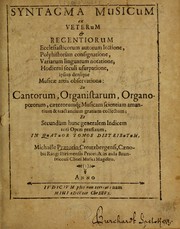
作品年表(1 本)
本站书库里署名米夏埃尔·普雷托里乌斯的书(Open Library 上至少 10 人加过书架的才收),按首版年份排(有本站书页的用 Wikidata 记的首版年,其余用 Open Library 的);年份偶尔记成后来的版本或译本,以原书为准。全部作品见 Open Library。
- 1614De organographia书架 10