 书单
布赖恩·赛克斯
- 生卒
- 1947 – 2020
- 国籍
- 英国
- 外文名
- Bryan Sykes
生平与创作
布莱恩·C·赛克斯(英语:Bryan Clifford Sykes,1947年9月19日—2020年12月10日)是一位英国遗传学家和科普作家,牛津大学沃弗森学院人类遗传学荣休教授,主要科普作品有《夏娃的七个女儿——追踪人类遗传先祖的科学故事》(The Seven Daughters of Eve)、《亚当的诅咒——没有男人的未来》(Adam's Curse: A Future Without Men)等。
以上文字摘自维基百科「布莱恩·赛克斯」(去掉了参考文献等尾部小节),按 CC BY-SA 4.0 使用,作者为维基百科的各位编者。
中文维基百科的条目比较短,下面附上英文维基百科的内容(英文原文):
Bryan Clifford Sykes (9 September 1947 – 10 December 2020) was a British geneticist, university professor, popular-science writer, and genetic genealogy company executive. He received a fellowship at Wolfson College and a personal chair, later emeritus professorship, in human genetics at the University of Oxford.
Sykes published the first report on retrieving DNA from ancient bone (Nature, 1989). He was involved in a number of high-profile archaeogenetics (ancient DNA) cases, including that of Ötzi the Iceman.
Sykes is best known outside the community of geneticists for his two most popular books – The Seven Daughters of Eve (2001), and Blood of the Isles / Saxons, Vikings and Celts (2006) – both on the investigation of human history and prehistory through studies of mitochondrial DNA (mtDNA). However, many of his conclusions in these works about European populations and their histories have become dubious or have been invalidated by more recent advances in whole-genome sequencing for more detailed archaeogenetics. He also suggested an American accountant named Tom Robinson was a direct descendant of Genghis Khan, a claim that was subsequently disproved.
Of more lasting significance, besides contributions to archaeogenetic technology, his mtDNA work in the Pacific demonstrated that the historical populating of Oceania took place entirely from Asia, dispelling a decades-persistent fringe theory of origins on the western coast of the Americas.
Early life and education
Bryan Sykes was born 9 September 1947 in south-east London, to Frank (an accountant) and Irene Sykes.
Sykes was educated at Eltham College, received his BSc from the University of Liverpool, his PhD from the University of Bristol, and his DSc from the University of Oxford (to which he was admitted in 1973). Originally focusing on bone and connective-tissue disorders, in Oxford's orthopaedic surgery department, he did early work on collagen and elastin genetics.
Career
Sykes became an Oxford lecturer in molecular pathology in 1987. Although much of his academic output remained focused on heritable skeletal disorders at the university's then-new Institute of Molecular Medicine, his genetic research broadened.
In 1989, Sykes published his research team's success in extracting intact genetic material (in the form of mtDNA) from bones up to 12,000 years old in the journal Nature. This marked a pivot from his medical-related work to the nascent archeological field of archaeogenetics. Other key participants in this team (coalescing through their work together at the John Radcliffe Hospital) were Erika Hagelberg and Robert E. M. Hedges of the Research Laboratory for Archaeology and the History of Art at the Oxford's School of Archaeology. Hedges later became a leading scholar of the molecular analysis of ancient diets and of archaeological environments, following his earlier roles in the development radiocarbon dating and then the application of accelerator mass spectrometry in archaeology. Hagelberg published, as Sykes would, on mtDNA's use in establishing prehistoric human population movements, and made high-profile strides in forensic analysis of degraded genetic samples.
Sykes received a personal-chair professorship in human genetics at Oxford in 1997.
From 1999 to 2016, he published a number of popularized-science books for a broad audience, to considerable attention (not all of it positive, especially from fellow academics). Starting with The Human Inheritance (1999), much of this material was focused on explaining the uses of genetics in understanding the history of human populations, especially in Europe (The Seven Daughters of Eve, 2001; Blood of the Isles, 2006) and North America (DNA USA, 2011). In more academic work, he turned his mtDNA lens on the Pacific and East Asia, though these efforts did not result in books.
以上文字摘自英文维基百科「Bryan Sykes」(有删节,去掉了参考文献等尾部小节),按 CC BY-SA 4.0 使用,作者为维基百科的各位编者。
资料卡
- 母语名
- Bryan Sykes
- 本名
- Bryan Clifford Sykes
- 出生
- 1947 年 9 月 9 日
- 出生地
- 埃尔瑟姆 等 2 项
- 逝世
- 2020 年 12 月 10 日
- 逝世地
- 爱丁堡
- 职业
- 遗传学家、非虚构文学作家、大学教师、槌球运动员
- 使用语言
- 英语
- 就读学校
- 伊尔撒姆学院、利物浦大学、布里斯托尔大学、牛津大学
- 领域
- 遗传学、人类遗传学、大众科学
- 代表作
- 夏娃的七个女儿
资料卡来自 Wikidata Q659747(CC0),众包数据,个别字段可能不全。
本站收录的作品(1)
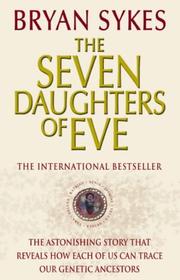
作品年表(1 本)
本站书库里署名布赖恩·赛克斯的书(Open Library 上至少 10 人加过书架的才收),按首版年份排(有本站书页的用 Wikidata 记的首版年,其余用 Open Library 的);年份偶尔记成后来的版本或译本,以原书为准。全部作品见 Open Library。
- 2001夏娃的七个女儿The Seven Daughters of Eve书架 65