 书单
百科
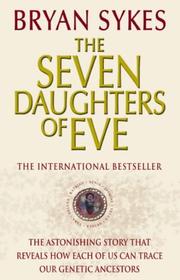
《夏娃的七个女儿——追踪人类遗传先祖的科学故事》(英语:The Seven Daughters of Eve: The Science That Reveals Our Genetic Ancestry)是一本英国遗传学家布莱恩·赛克斯创作的科普图书,2001年出版,“夏娃”和“女儿”分别指线粒体夏娃和不同的人类线粒体DNA单倍体群。
以上文字摘自维基百科「夏娃的七个女儿」(去掉了参考文献等尾部小节),按 CC BY-SA 4.0 使用,作者为维基百科的各位编者。
中文维基百科的条目比较短,下面附上英文维基百科的内容(英文原文):
The Seven Daughters of Eve: The Science That Reveals Our Genetic Ancestry is a 2001 semi-fictional book by Bryan Sykes that presents the science of human origin in Africa and their dispersion to a general audience. Sykes explains the principles of genetics and human evolution, the particularities of mitochondrial DNA, and analyses of ancient DNA to genetically link modern humans to prehistoric ancestors.
Following the developments of mitochondrial genetics, Sykes traces back human migrations, discusses the "out of Africa theory" and casts serious doubt upon Thor Heyerdahl's theory of the Peruvian origin of the Polynesians, which opposed the theory of their origin in Indonesia. He also describes the use of mitochondrial DNA in identifying the remains of Emperor Nicholas II of Russia, and in assessing the genetic makeup of modern Europe.
The title of the book comes from one of the principal achievements of mitochondrial genetics, which is the classification of all modern Europeans into seven groups, the mitochondrial haplogroups. Each haplogroup is defined by a set of characteristic mutations on the mitochondrial genome, and can be traced along a person's maternal line to a specific prehistoric woman. Sykes refers to these women as "clan mothers", though these women did not all live concurrently. All these women in turn shared a common maternal ancestor, the Mitochondrial Eve.
The last third of the book is spent on a series of fictional narratives, written by Sykes, describing his creative guesses about the lives of each of these seven "clan mothers". This latter part generally met with mixed reviews in comparison with the first part.
Mitochondrial haplogroups in The Seven Daughters of Eve
The seven "clan mothers" mentioned by Sykes each correspond to one (or more) human mitochondrial haplogroups.
Ursula: corresponds to Haplogroup U (specifically U5, and excluding its subgroup K)
Xenia: corresponds to Haplogroup X
Helena: corresponds to Haplogroup H
Velda: corresponds to Haplogroup V, found with particularly high concentrations in the people of Cantabria (15%) of northern Iberia but specially in the Sami people of northern Scandinavia: Swedish Sami (68%), Finnish Sami (37%) and Norwegian Sami (33%).
Tara: corresponds to Haplogroup T
Katrine: corresponds to Haplogroup K
Jasmine: corresponds to Haplogroup J
Additional daughters
Sykes wrote in the book that there were seven major mitochondrial lineages for modern Europeans, though he subsequently wrote that with the additional data from Scandinavia and Eastern Europe, Ulrike (see below) could have been promoted to be the eighth clan mother for Europe.
Others have put the number at 10 or 12. These additional "daughters" generally include haplogroups I, M and W. For example, a 2004 paper re-mapped European haplogroups as H, J, K, N1, T, U4, U5, V, X and W. Richards, Macaulay, Torroni and Bandelt include I, W and N1b as well as Sykes' '7 daughters' within their 2002 pan-European survey (but - illustrating how complex the question can be - also separate out pre-V, HV1 and pre-HV1, and separate out U to include U1, U2, U3, U4 and U7 as well as U5).
Likewise, Sykes has invented names for an additional 29 "clan mothers" worldwide (of which four were native American, nine Japanese and 12 were from Africa), each corresponding to a different haplogroup identified by geneticists: "Fufei, Ina, Aiyana/Ai, Yumi, Nene, Naomi, Una, Uta, Ulrike, Uma, Ulla, Ulaana, Lara, Lamia, Lalamika, Latasha, Malaxshmi, Emiko, Gaia, Chochmingwu/Chie, Djigonasee/Sachi, Makeda, Lingaire, Lubaya, Limber, Lila, Lungile, Latifa and Layla."
以上文字摘自英文维基百科「The Seven Daughters of Eve」(有删节,去掉了参考文献等尾部小节),按 CC BY-SA 4.0 使用,作者为维基百科的各位编者。
资料卡
- 原题
- The Seven Daughters of Eve
- 原作语言
- 英语
- 首次出版
- 2001 年 7 月
- 作品形式
- 长篇小说
- 体裁
- 历史类虚构作品、随笔
- 页数
- 320
- 主题
- 线粒体DNA、系统发生学、单倍群
资料卡来自 Wikidata Q494069(CC0),众包数据,个别字段可能不全。