 书单
约翰·奥斯丁
- 生卒
- 1911 – 1960
- 国籍
- 英国
- 外文名
- John Langshaw Austin
生平与创作
约翰·朗肖·奥斯丁(英语:John Langshaw Austin,著作常署名 J. L. Austin,1911年3月26日—1960年2月8日),英国哲学家,属于分析哲学传统,以语言哲学为专长。
1929年开始在牛津大学贝利奥尔学院学习,1935年在牛津大学毕业后留校任教。在二战期间,他在军事情报机关服役,任陆军中校。1952 年任牛津道德哲学讲席教授。
奥斯丁在五十年代中期访问了哈佛大学和加州大学伯克利分校,并于1955年在哈佛大学讲授威廉·詹姆斯讲座。正是在这个时候,他遇见了乔姆斯基,并成为了朋友。他从1956年到1957年担任亚里士多德学会会长。
奥斯丁生前没有发表过著作,他的讲演稿和课堂笔记于死后被集辑出版,包括《哲学论文集》、《怎样用语言做事》(1961年 )、《感觉与潜感觉对象》(1962年)。
以上文字摘自维基百科「约翰·朗肖·奥斯丁」(去掉了参考文献等尾部小节),按 CC BY-SA 4.0 使用,作者为维基百科的各位编者。
中文维基百科的条目比较短,下面附上英文维基百科的内容(英文原文):
John Langshaw Austin (26 March 1911 – 8 February 1960) was an English philosopher of language and leading proponent of ordinary language philosophy, best known for developing the theory of speech acts.
Austin pointed out that we use language to do things as well as to assert things, and that the utterance of a statement like "I promise to do so-and-so" is best understood as doing something—here, making a promise—rather than making an assertion about anything; hence the title of one of his best-known works, How to Do Things with Words (1955).
Austin, in formulating this theory of speech acts, mounts a significant challenge to the philosophy of language, far beyond merely elucidating a class of morphological sentence forms that function to do what they name.
Austin's work ultimately suggests that all speech and all utterance is the doing of something with words and signs, challenging a metaphysics of language that would posit denotative, propositional assertion as the essence of language and meaning.
Life
Austin was born in Lancaster, Lancashire, England, the second son of Geoffrey Langshaw Austin (1884–1971), an architect, and Mary Hutton Bowes-Wilson (1883–1948; née Wilson). In 1921 the family moved to Scotland, where Austin's father became the secretary of St Leonards School, St Andrews. Austin was educated at Shrewsbury School in 1924, earning a scholarship in Classics, and went on to study classics at Balliol College, Oxford, in 1929.
In 1930 Austin received a First in Classical Moderations (Greek and Latin) and in the following year won the Gaisford Prize for Greek prose. In finals in 1933 he received a first in Literae Humaniores (Philosophy and Ancient History). Literae Humaniores introduced Austin to serious philosophy and gave him a lifelong interest in Aristotle. Austin won a prize fellowship at All Souls College, Oxford, that year, but aside from being friends with Isaiah Berlin, he did not like its lack of structure, and undertook his first teaching position in 1935, as fellow and tutor at Magdalen College, Oxford.
Austin's early interests included Aristotle, Kant, Leibniz, and Plato (particularly the Theaetetus). His contemporary influences included G. E. Moore, John Cook Wilson and H. A. Prichard. These contemporary philosophers shaped their views about general philosophical questions on the basis of careful attention to the more specific judgements we make, as they took our specific judgements to be relatively more secure than our general judgements. According to Guy Longworth, writing in The Stanford Encyclopedia of Philosophy: "It's plausible that some aspects of Austin's distinctive approach to philosophical questions derived from his engagement with [Moore, Wilson, and Prichard]."
During World War II, Austin joined the military—in July 1940—and married his student Jean Coutts (in the spring of 1941). Austin served in the British Intelligence Corps, and was responsible for as many as 500 analysts. Known as "the Martians", the group's preparation for D-Day helped keep Allied casualties much lower than expected. Austin left the army with the rank of lieutenant colonel and was honoured for his intelligence work with an OBE (Officer of the Order of the British Empire), the French Croix de Guerre, and the U.S. Officer of the Legion of Merit.
After the war Austin became White's Professor of Moral Philosophy at Oxford, as a Professorial Fellow of Corpus Christi College. Publishing little, his influence would largely make itself felt through his teaching in lectures and tutorials and, especially, his famous 'Saturday morning meetings'.
以上文字摘自英文维基百科「J. L. Austin」(有删节,去掉了参考文献等尾部小节),按 CC BY-SA 4.0 使用,作者为维基百科的各位编者。
资料卡
- 母语名
- John Langshaw Austin
- 出生
- 1911 年 3 月 26 日
- 出生地
- 兰卡斯特
- 逝世
- 1960 年 2 月 8 日
- 逝世地
- 牛津
- 职业
- 哲学家、教育学家、语言学家、大学教师
- 使用语言
- 英语
- 写作语言
- 英语
- 就读学校
- 什鲁斯伯里学校、贝利奥尔学院
- 文学运动 / 流派
- 分析哲学
- 领域
- 知识论、语言哲学、语言学
- 受谁影响
- 亚里士多德
- 获奖
- 大英帝国官佐
资料卡来自 Wikidata Q272615(CC0),众包数据,个别字段可能不全。
本站收录的作品(1)
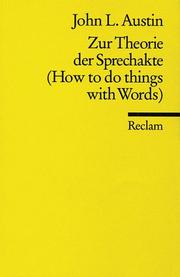
作品年表(1 本)
本站书库里署名约翰·奥斯丁的书(Open Library 上至少 10 人加过书架的才收),按首版年份排(有本站书页的用 Wikidata 记的首版年,其余用 Open Library 的);年份偶尔记成后来的版本或译本,以原书为准。全部作品见 Open Library。
- 1962如何以言行事How to do things with words书架 56