书单
百科
如何以言行事(英语:How to do things with Words)是英国语言哲学家约翰·奥斯丁的著名作品,在奥斯丁去世后的1962年由其弟子根据其在1955哈佛大学的系列讲座集结出版。
以上文字摘自维基百科「如何以言行事」(去掉了参考文献等尾部小节),按 CC BY-SA 4.0 使用,作者为维基百科的各位编者。
中文维基百科的条目比较短,下面附上英文维基百科的内容(英文原文):
How to Do Things with Words is a posthumously published book of lectures by the English philosopher J. L. Austin. First issued in 1962 by Clarendon Press and Harvard University Press, it is based on the William James Lectures that Austin delivered at Harvard University in 1955. The work is widely regarded as the founding text of speech act theory and a classic of ordinary language philosophy and linguistic pragmatics.
In the lectures Austin introduces and develops the notion of a performative utterance, analyses the conditions under which such utterances are happy or unhappy, and ultimately replaces the simple contrast between constative and performative sentences with a more general theory of locutionary, illocutionary and perlocutionary acts. The book has had a lasting impact on philosophy, linguistics, literary theory, legal theory and other disciplines concerned with language and communication.
Background and publication
Austin developed his ideas about speech and action over several decades. He reports that the views underlying the lectures were already in place by 1939 and were first used in his 1946 paper "Other Minds". In the early 1950s he delivered a series of Oxford lectures under the title "Words and Deeds", revising his notes each year. The 1955 William James Lectures at Harvard were prepared from a further reworked set of notes that covered similar ground but in a more systematic way.
Austin died in 1960, before preparing the lectures for publication. The 1962 volume was edited from his notes by the Oxford philosopher J. O. Urmson, who supplied an editorial preface explaining the textual history. A corrected and expanded second edition, edited by Urmson and Marina Sbisà, was published in 1975; the editors returned to Austin's original materials, making numerous small emendations and adding an appendix of marginal notes that had not been incorporated into the first edition.
The text that readers encounter is therefore effectively a lightly edited set of lecture notes rather than a monograph that Austin himself would have published in that form. Commentators have stressed that this helps to explain both the informal, example-driven style of the work and some of its apparent tensions and unfinished lines of thought.
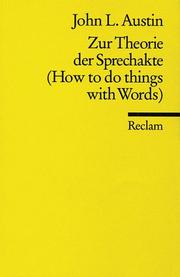
The book has since appeared in numerous printings and has been translated into several languages, including French (Quand dire, c'est faire), Spanish (Cómo hacer cosas con palabras), German (Zur Theorie der Sprechakte) and Chinese. Austin's manuscripts and lecture notes relating to the work are held in the Bodleian Library, Oxford.
Overview
Constatives and performatives
Austin begins by challenging a long-standing assumption in philosophy: that the primary business of sentences is to describe the world and that their main logical feature is to be true or false. In everyday life, he observes, we also use sentences to do things, not just to say things, and in such cases the usual tests of truth and falsity seem misplaced.
His most famous initial examples are utterances such as "I name this ship the Queen Elizabeth" spoken during a christening, or "I do" in a marriage ceremony. These formulae do not merely describe an act of naming or marrying; when uttered in appropriate circumstances by the right person, they are the act. Austin calls such expressions performative utterances or simply performatives.
Performatives are not, according to Austin, properly evaluated as true or false. Instead, they are subject to conditions of felicity: to succeed, certain conventional and contextual requirements must be met (for example, the speaker must have the proper authority, the procedure must be correctly executed, and the participants must be sincere). Where these conditions fail, the performative is unhappy or infelicitous rather than false.
以上文字摘自英文维基百科「How to Do Things with Words」(有删节,去掉了参考文献等尾部小节),按 CC BY-SA 4.0 使用,作者为维基百科的各位编者。
资料卡
- 原题
- How to Do Things with Words
- 原作语言
- 英语
- 首次出版
- 1962 年
- 体裁
- 随笔
- 首版出版社
- 哈佛大学出版社
- 主题
- 语言哲学、言语行为
资料卡来自 Wikidata Q230356(CC0),众包数据,个别字段可能不全。