 书单
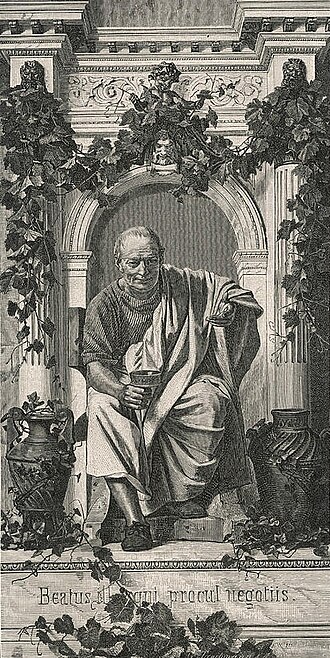
贺拉斯
- 生卒
- 公元前 65 – 公元前 8
- 国籍
- 古罗马
- 外文名
- Horace
照片:Anton von Werner,公有领域,来自维基共享资源「Quintus Horatius Flaccus.jpg」(经缩小)。
生平与创作
昆图斯·贺拉提乌斯·弗拉库斯(拉丁语:Quintus Horatius Flaccus、希腊语:Οράτιος,前65年12月8日—前8年11月27日),通称贺拉斯,奥古斯都时期的著名诗人、批评家、翻译家,代表作有《诗艺》等。他是古罗马文学“黄金时代”的代表人之一。
观点
作为翻译家,受西塞罗的文学批评和理论的影响,用相当的篇幅谈了创作中语言的使用和翻译问题。综合起来,主要有以下两点:
翻译必须坚持活译,摒弃直译;
本族语可通过译借外来词加以丰富。
他在《诗艺》中说过:“忠实原作的译者不会逐词死译”。
以上文字摘自维基百科「贺拉斯」(去掉了参考文献等尾部小节),按 CC BY-SA 4.0 使用,作者为维基百科的各位编者。
中文维基百科的条目比较短,下面附上英文维基百科的内容(英文原文):
Quintus Horatius Flaccus (Classical Latin: [ˈkʷiːntʊs (h)ɔˈraːtiʊs ˈfɫakːʊs]; 8 December 65 BC – 27 November 8 BC), commonly known in the English-speaking world as Horace ( HORR-iss), was the leading Roman lyric poet during the time of Augustus (also known as Octavian). The rhetorician Quintilian regarded his Odes as the only Latin lyrics worth reading: "He can be lofty sometimes, yet he is also full of charm and grace, versatile in his figures, and felicitously daring in his choice of words."
Horace also crafted elegant hexameter verses (Satires and Epistles) and caustic iambic poetry (Epodes). The hexameters are amusing yet serious works, friendly in tone, leading the ancient satirist Persius to comment: "as his friend laughs, Horace slyly puts his finger on his every fault; once let in, he plays about the heartstrings".
His career coincided with Rome's momentous change from a republic to an empire. An officer in the republican army defeated at the Battle of Philippi in 42 BC, he was befriended by Octavian's right-hand man in civil affairs, Maecenas, and became a spokesman for the new regime. For some commentators, his association with the regime was a delicate balance in which he maintained a strong measure of independence (he was "a master of the graceful sidestep") but for others he was, in John Dryden's phrase, "a well-mannered court slave".
Life
In his writings, Horace tells us far more about himself, his character, his development, and his way of life, than any other great poet of antiquity. Some of the biographical material contained in his work can be supplemented from the short but valuable "Life of Horace" by Suetonius (in his Lives of the Poets).
Childhood
He was born on 8 December 65 BC, in what later became Lucania et Bruttium under Augustus. His home town, Venusia, lay on a trade route in the region of Lucania at the border with Apulia. Various Italic dialects were spoken in the area and this perhaps enriched his feeling for language. He could have been familiar with Greek words even as a young boy, and he later poked fun at the jargon of mixed Greek and Oscan spoken in neighbouring Canusium. One of the works he probably studied in school was the Odyssia of Livius Andronicus, taught by teachers like the 'Orbilius' mentioned in one of his poems. Army veterans could have been settled there at the expense of local families uprooted by Rome as punishment for their part in the Social War (91–88 BC). Such state-sponsored migration must have added still more linguistic variety to the area. According to a local tradition reported by Horace, a colony of Romans or Latins had been installed in Venusia after the Samnites had been driven out early in the third century. In that case, young Horace could have felt himself to be a Roman though there are also indications that he regarded himself as a Samnite or Sabellus by birth. Italians in modern and ancient times have always been devoted to their home towns, even after success in the wider world, and Horace was no different. Images of his childhood setting and references to it are found throughout his poems.
Horace's father was probably a Venutian taken captive by Romans in the Social War, or possibly he was descended from a Sabine captured in the Samnite Wars. Either way, he was a slave for at least part of his life. He was evidently a man of strong abilities however and managed to gain his freedom and improve his social position. Thus Horace claimed to be the free-born son of a prosperous 'coactor'. The term 'coactor' could denote various roles, such as tax collector, but its use by Horace was explained by scholia as a reference to 'coactor argentarius' i.e. an auctioneer with some of the functions of a banker, paying the seller out of his own funds and later recovering the sum with interest from the buyer.
以上文字摘自英文维基百科「Horace」(有删节,去掉了参考文献等尾部小节),按 CC BY-SA 4.0 使用,作者为维基百科的各位编者。
资料卡
- 母语名
- Q. Horatius Flaccus
- 出生
- 公元前 65 年 12 月 8 日
- 出生地
- 韦诺萨
- 逝世
- 公元前 8 年 11 月 27 日
- 逝世地
- 罗马
- 职业
- 诗人、作家、哲学家
- 使用语言
- 拉丁语
- 写作语言
- 拉丁语
- 代表作
- 诗学、讽刺诗、时代之歌、诗经、书信集、纪元
资料卡来自 Wikidata Q6197(CC0),众包数据,个别字段可能不全。
本站收录的作品(2)
作品年表(5 本)
本站书库里署名贺拉斯的书(Open Library 上至少 10 人加过书架的才收),其中 5 本记的年份比作者去世晚 50 年以上或者早于他出生(多半是后世的版本、译本或占位年份),不列年份,按首版年份排(有本站书页的用 Wikidata 记的首版年,其余用 Open Library 的);年份偶尔记成后来的版本或译本,以原书为准。全部作品见 Open Library。
- 年份不详Q. Horatii Flacci opera书架 50
- 年份不详诗经Odes书架 42
- 年份不详Carmina书架 30
- 年份不详Ars poetica书架 18
- 年份不详讽刺诗Satirae书架 17