书单
百科
这个词条暂时没有中文维基百科条目,下面是英文维基百科的内容(英文原文):
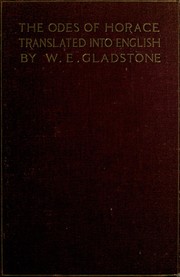
The Odes (Latin: Carmina) are a collection in four books of Latin lyric poems by Horace. The Horatian ode format and style has been emulated since by other poets. Books 1 to 3 were published in 23 BC. A fourth book, consisting of 15 poems, was published in 13 BC.
The Odes were developed as a conscious imitation of the short lyric poetry of Greek originals – Pindar, Sappho and Alcaeus are some of Horace's models. His genius lay in applying these older forms to the social life of Rome in the age of Augustus. The Odes cover a range of subjects – love; friendship; wine; religion; morality; patriotism; poems of eulogy addressed to Augustus and his relations; and verses written on a miscellany of subjects and incidents, including the uncertainty of life, the cultivation of tranquility and contentment, and the observance of moderation or the "golden mean."
The Odes have been considered traditionally by English-speaking scholars as purely literary works. Recent evidence by a Horatian scholar suggests they may have been intended as performance art, a Latin re-interpretation of Greek lyric song. The Roman writer Petronius, writing less than a century after Horace's death, remarked on the curiosa felicitas (studied spontaneity) of the Odes (Satyricon 118). The English poet Alfred Tennyson declared that the Odes provided "jewels five-words long, that on the stretched forefinger of all Time / Sparkle for ever" (The Princess, part II, l.355).
Summary
The four books of odes contain 103 poems in total (104 if the Carmen Saeculare is included). They are not all of equal length. Books 1, 2, 3, and 4 have 876 lines, 572 lines, 1004 lines, and 582 lines respectively. (The Carmen Saeculare has 76 lines.) The number of poems in each book is 38, 20, 30, and 15. The odes range from 8 lines to 80 lines in length, the average being about 30 lines.
Book 1
Book 1 consists of 38 poems. The opening sequence of nine poems are all in a different metre, with a tenth metre appearing in 1.11. It has been suggested that poems 1.12–1.18 form a second parade, this time of allusions to or imitations of a variety of Greek lyric poets: Pindar in 1.12, Sappho in 1.13, Alcaeus in 1.14, Bacchylides in 1.15, Stesichorus in 1.16, Anacreon in 1.17, and Alcaeus again in 1.18. The book contains many well-known phrases, such as nunc est bibendum (1.37.1), carpe diem (1.11.8), and nil desperandum (1.7.27).
The poems can be summarised as follows:
I.1, Maecenas atavis edite regibus... – Dedication of the First Three Books of the Odes to Maecenas (Horace's Patron) –
Every man is governed by his ruling passion: the Olympian charioteer, the politician, the trader, the husbandman, the merchant, the man of pleasure, the soldier, and the hunter. To win the title of a lyric poet is all that Horace desires.
I.2, Iam satis terris nivis atque dirae... – To Octavian, The Deliverer and Hope of the State –
The subject of this ode is the overflowing of the Tiber, which recalls to the poet the flood of Deucalion. He imagines that the disaster is caused by the wrath of Ilia (the wife of Tiber), the civil wars, and the assassination of Julius Caesar. Octavian, as Mercury in human shape, is invoked to save the empire.
I.3, Sic te diva potens Cypri... – To Virgil, Setting Out for Greece –
The ode begins with a prayer for the safe voyage of Virgil to Athens, which suggests the daring of the earliest mariners and the boldness of men in overcoming difficulties set by Nature.
I.4, Solvitur acris hiems... – A Hymn to Springtime –
The changing season warns us of the shortness of life.
Horace urges his friend Sestius – vitae summa brevis spem nos vetat incohare longam (The brief sum of life forbids us cling to far-off hope).
I.5, Quis multa gracilis te puer in rosa... – To the flirt Pyrrha, who is as faithless as the winds or seas, and whose fancy no lover can hold onto. (See Odes 1.5.)
I.6, Scribēris Vario fortis et hostium victor... – Horace pleads his inability to worthily sing the praises of M. Vipsanius Agrippa, the distinguished Roman Commander.
I.7, Laudabunt alii claram Rhodon aut Mytilenen... – Fairest of Spots, O Plancus, is Tibur – There, or wherever you may be, drown your cares in wine.
I.8, Lydia, dic, per omnis te deos oro... – To Lydia, who has transformed Sybaris from a hardy athlete into a doting lover.
I.9, Vides ut alta stet nive candidum... – Winter Without Bids Us Make Merry Within (Soracte) –
(with borrowing from an original by Alcaeus) – To Thaliarchus. The snow is deep and the frost is keen – Pile high the hearth and bring out old wine – Leave all else to the gods.
I.10, Mercuri, facunde nepos Atlantis... – Hymn to Mercury –
Mercury is addressed as the god of eloquence and the promoter of the civilization of man; as the messenger of the gods and the inventor of the lyre; skilled in craft and cunning; and the conductor of souls to the Underworld.
I.11, Tu ne quaesieris... – Carpe Diem! –
The poet seeks to dissuade Leuconoe from giving heed to the false arts of astrologers and diviners. It is vain to inquire into the future – Let us enjoy the present, for this is all we can command. It closes with the famous line: carpe diem, quam minimum credula postero (Seize the day, trusting tomorrow as little as possible).
I.12, Quem virum aut heroa lyra... – The Praises of Octavian –
The poet praises Octavian by associating him with gods and heroes, and distinguished Romans of earlier days.
I.13, Cum tu, Lydia... – Jealousy –
Addressed to Lydia – The poet contrasts the misery of jealousy with the happiness secured by constancy in love.
I.14, O navis, referent in mare te novi fluctus... – The Ship of State –
Horace refers to a period during which the Roman state was tossed and nearly wrecked by perpetual storms. He exhorts it to beware of fresh perils and keep safely in harbor.
I.15, Pastor cum traheret... – The Prophecy of Nereus –
As Paris hurries from Sparta to Troy with Helen, Nereus stills the winds and prophesies – Ilium's doom is inevitable.
以上文字摘自英文维基百科「Odes (Horace)」(有删节,去掉了参考文献等尾部小节),按 CC BY-SA 4.0 使用,作者为维基百科的各位编者。
资料卡
- 原题
- Carmina
- 原作语言
- 拉丁语
- 作品形式
- 选集
- 体裁
- 抒情诗
资料卡来自 Wikidata Q943884(CC0),众包数据,个别字段可能不全。