 书单
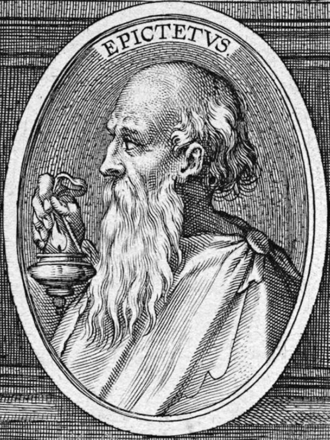
爱比克泰德
- 生卒
- 50 – 125
- 国籍
- 古罗马
- 外文名
- Epictetus
照片:Theodoor Galle,公有领域,来自维基共享资源「Epictetus from L. Annaei Senecae philosophi Opera, 1605, title page detail.png」(经缩小)。
生平与创作
爱比克泰德(希腊语:Επίκτητος,英语:Epictetus,约50年—约135年),古罗马新斯多葛主义哲学家。他出生时可能是个奴隶身份,生在弗里吉亚的希拉波利斯(今土耳其棉堡),他早年生活在罗马,后被驱逐到希腊西北部的尼科波利斯,直至去世,他一生大部分时间都在这里度过。他的本名无从考证。后人称呼他为ἐπίκτητος,这个词在希腊文中有“养成的”“后天的”之意。
生平
童年时以奴隶身份来到罗马,有一个说法称他的主人故意打断他的腿,亦有说法称他自小就是跛子。后来主人放他自由。他从师于斯多葛学派教师莫索尼乌斯·鲁弗斯学习哲学,并在罗马教学,直到公元90年被罗马皇帝赶出罗马,于是他便退居于伊壁鲁斯的尼科波利斯,在那里写作和讲学,并于此处与世长辞。他学生阿利安编纂了爱比克泰德《语录》(Discourses)和《手册》(Enchiridion),从而记录了他的思想。
以上文字摘自维基百科「愛比克泰德」(去掉了参考文献等尾部小节),按 CC BY-SA 4.0 使用,作者为维基百科的各位编者。
中文维基百科的条目比较短,下面附上英文维基百科的内容(英文原文):
Epictetus ( EH-pick-TEE-təss; Ancient Greek: Ἐπίκτητος, Epíktētos; c. 50 – c. 135 AD) was a Greek Stoic philosopher. He was born into slavery at Hierapolis, Phrygia (present-day Pamukkale, in western Turkey) and lived in Rome until his banishment, after which he spent the rest of his life in Nicopolis in northwestern Greece.
Epictetus studied Stoic philosophy under Musonius Rufus and after manumission, his formal emancipation from slavery, he began to teach philosophy. When philosophers were banished from Rome by Emperor Domitian toward the end of the first century, Epictetus founded a school of philosophy in Nicopolis. He taught that philosophy is a way of life and not simply a theoretical discipline. To Epictetus, all external events are beyond our control; he argues that we should accept whatever happens calmly and dispassionately. However, he held that individuals are responsible for their own actions, which they can examine and control through rigorous self-discipline. His teachings were written down and published by his pupil Arrian in his Discourses and Enchiridion. They influenced many later thinkers, including Marcus Aurelius, Rabelais, Pascal, Montesquieu, Diderot, and Samuel Johnson.
Life
Having described himself as old in AD 108, Epictetus is presumed to have been born around AD 50, at Hierapolis, Phrygia. The name given by his parents is unknown. The name by which he is known is derived from the word epíktētos (ἐπίκτητος) that in Greek, simply means "gained" or "acquired"; the Greek philosopher Plato, in his Laws, used that term to mean property that is "added to one's hereditary property". Epictetus spent his youth in Rome as a slave to Epaphroditus, a wealthy freedman who was secretary to Nero. Epictetus's social position was thus complicated, combining the low status of a slave with the high status of one with a personal connection to imperial power.
Early in life, Epictetus acquired a passion for philosophy and, with the permission of his wealthy master, he studied Stoic philosophy under Musonius Rufus. Becoming more educated in this way raised his social status. At some point, he became disabled. Celsus, quoted by Origen, wrote that this was because his leg had been deliberately broken by his master. Without citing a cause, Simplicius wrote that Epictetus had been disabled from childhood.
Epictetus obtained his freedom sometime after the death of Nero in AD 68, and he began to teach philosophy in Rome. Around AD 93, when the Roman emperor Domitian banished all philosophers from the city, Epictetus moved to Nicopolis in Epirus, Greece, where he founded a school of philosophy.
His most famous pupil, Arrian, studied under him as a young man (around AD 108) and claimed to have written his famous Discourses based on the notes he took about lectures by Epictetus. Arrian argued that his Discourses should be considered comparable to the Socratic literature. Arrian described Epictetus as a powerful speaker who could "induce his listener to feel just what Epictetus wanted him to feel". Many eminent figures sought conversations with him. Emperor Hadrian was friendly with him, possibly having heard Epictetus speak at his school in Nicopolis.
Epictetus lived a life of great simplicity, with few possessions. He lived alone for a long time, but in his old age, he adopted the child of a friend who otherwise would have been left to die, and raised him with the aid of a woman. It is unclear whether Epictetus and she were married. He died sometime around AD 135. After his death, according to Lucian, his oil lamp was purchased by an admirer for 3,000 drachmae.
以上文字摘自英文维基百科「Epictetus」(有删节,去掉了参考文献等尾部小节),按 CC BY-SA 4.0 使用,作者为维基百科的各位编者。
资料卡
- 母语名
- ΕΠΙΚΤΗΤΟΣ
- 出生
- 50 年
- 出生地
- 希拉波利斯
- 逝世
- 125 年
- 逝世地
- 尼科波利斯
- 职业
- 哲学家、作家
- 使用语言
- 古希腊语
- 写作语言
- 古希腊语
- 文学运动 / 流派
- 斯多亚学派
- 领域
- 哲学
资料卡来自 Wikidata Q183144(CC0),众包数据,个别字段可能不全。
本站收录的作品(2)
作品年表(16 本)
本站书库里署名爱比克泰德的书(Open Library 上至少 10 人加过书架的才收),其中 15 本记的年份比作者去世晚 50 年以上或者早于他出生(多半是后世的版本、译本或占位年份),不列年份,按首版年份排(有本站书页的用 Wikidata 记的首版年,其余用 Open Library 的);年份偶尔记成后来的版本或译本,以原书为准。全部作品见 Open Library。
- 125Art of Living书架 97
- 年份不详A manual for living书架 220
- 年份不详The discourses of Epictetus书架 78
- 年份不详爱比克泰德手册Manual书架 47
- 年份不详Manual for Living书架 41
- 年份不详Discourses and Selected Writings书架 34
- 年份不详Discourses and Selected Writings书架 33
- 年份不详Stoic Path书架 31
- 年份不详Discourses, fragments, handbook书架 25
- 年份不详How to Be Free书架 25
- 年份不详Epictetus书架 17
- 年份不详The Enchiridion书架 16
- 年份不详How to Be a Stoic书架 14
- 年份不详Discourses书架 10
- 年份不详The moral discourses of Epictetus书架 10
- 年份不详Manual for Living书架 10