 书单
弗朗兹·利奥波德·诺伊曼
- 生卒
- 1900 – 1954
- 国籍
- 德意志帝国、魏玛共和国
- 外文名
- Franz Leopold Neumann
生平与创作
这个词条暂时没有中文维基百科条目,下面是英文维基百科的内容(英文原文):
Franz Leopold Neumann (23 May 1900 – 2 September 1954) was a German political activist, Western Marxist theorist, and labor lawyer who became a political scientist in exile and is best known for his theoretical analyses of Nazism. He studied in Germany and the United Kingdom, and spent the last phase of his career in the United States, where he worked for the Office of Strategic Services from 1943 to 1945 writing the Secret Reports on Nazi Germany. During the Second World War, Neumann spied for the Soviet Union under the code-name "Ruff". Together with Ernst Fraenkel and Arnold Bergstraesser, Neumann is considered to be among the founders of modern political science in Germany.
Early life
Neumann was born in to a Jewish family on May 23, 1900, in Kattowitz (Katowice), Silesia, German Empire (present-day Poland). As a student, Neumann supported the German revolution of 1918–1919 and joined the Social Democratic Party of Germany (SPD). Neumann was instrumental in organizing the Socialist Students Society in Frankfurt am Main, where in 1918 he met Leo Löwenthal, a future colleague in the Institute for Social Research in New York under Max Horkheimer.
At Breslau (the present-day Wrocław in Poland), Leipzig, Rostock, and Frankfurt am Main, Neumann studied law and earned a doctorate in 1923 with a thesis on method in the theory of punishment. His main aim was to explain the socialist acceptance of liberal individualism in this sphere. In the academic exercise that earned his degree, he did not attempt the sociological study he saw as necessary but addressed preliminary philosophical issues in the neo-Kantian debates of the day; however, his treatment of value philosophy led him to the conclusion that the liberal and socialist arguments were equally valid, and that the socialist deviations from consistency in the matter of punishment was politically justifiable and subject only to political management. This foretold his lifelong reliance on negotiated settlements even if they involved exceptions from theoretical consistency. The goal was to ensure that the effects of such deviations are not cumulative, as he came to conclude about the socialist movement's compromises in the Weimar Republic.
Labor law and social democracy
Neumann was active from 1925 to 1927 as law clerk and assistant of Hugo Sinzheimer, the foremost reformist labor law theorist, who also engaged him as a teacher at the trade union academy affiliated with the University of Frankfurt. Throughout the Weimar years, Neumann's political commitment was to the labor wing of the Social Democratic Party. From 1928 to 1933, he worked in Berlin in partnership with Ernst Fraenkel as an attorney specializing in labor law, representing unions and publishing briefs and articles, and a technical book in this innovative field. In 1932–1933, he became lead attorney for the SPD and published a brief, itself suppressed by the Nazis, against the suppression of the principal Social Democratic newspaper.
In the weeks after the assumption of power by the Nazis, Neumann was warned of his imminent arrest and he fled to England, where he studied under Harold Laski at the London School of Economics, and with the former Frankfurt sociology professor, Karl Mannheim. He earned a second doctorate with a study of the rise and fall of the historical epoch of the rule of law. On Laski's recommendation, Neumann was employed by the University of Frankfurt Institute for Social Research (in exile at Columbia University in New York City after some years in Geneva and Paris) in 1936, initially as administrator and legal advisor, and later as research associate, although he was never as well established in the group led by the director Max Horkheimer, as Friedrich Pollock and Theodor Adorno. He participated in the Institute's debates about Nazism in the New York years. By the time the second edition of Behemoth was published in 1944, he rejected the idea that the Nazis were merely using Jews as scapegoats for the ills of German society. Instead what he called a "spearhead theory" arguing that Nazi antisemitism was a test run leading towards the goal of replacing democratic norms with a totalitarian government. This well-known study of the Nazi regime was written without the scrutiny of review procedures. Neumann played an important part in helping the Institute for Social Research to secure the backing of the American Jewish Committee for its well-known study of antisemitism.
American exile
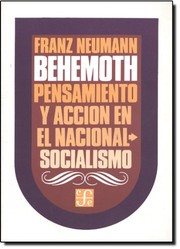
Neumann achieved his academic reputation among American scholars with the publication of Behemoth: The Structure and Practice of National Socialism in 1942. The thesis is that Nazi rule is a function of struggles among power groups united only by their hatred of the labor movement and that Nazi Germany consequently lacks a state in the sense of the modern political formation oriented to order and predictability. Within this framework, Neumann applied many Marxist tools of analysis to characterize the prime social component in the inner struggle. Behemoth made a major impact on the young sociologist C. Wright Mills. While opinions differed about his theses, his mastery of German sources and rich empirical documentation drew applause from established American political scientists and the book prepared the way for his later university career.
以上文字摘自英文维基百科「Franz Neumann (political scientist)」(有删节,去掉了参考文献等尾部小节),按 CC BY-SA 4.0 使用,作者为维基百科的各位编者。
资料卡
- 本名
- Franz Leopold Neumann
- 出生
- 1900 年 5 月 23 日
- 出生地
- 卡托维兹
- 逝世
- 1954 年 9 月 2 日
- 逝世地
- 菲斯普
- 职业
- 哲学家、法学家、社会学家、大学教师、律师、政治学家
- 使用语言
- 英语、德语
- 就读学校
- 伦敦政治经济学院、约翰-沃尔夫冈-歌德法兰克福大学
- 获奖
- 古根海姆学者奖(1946)
资料卡来自 Wikidata Q63195(CC0),众包数据,个别字段可能不全。
本站收录的作品(1)
同时代的德意志帝国作家
Open Library 上的全部作品
正在读取…