 书单
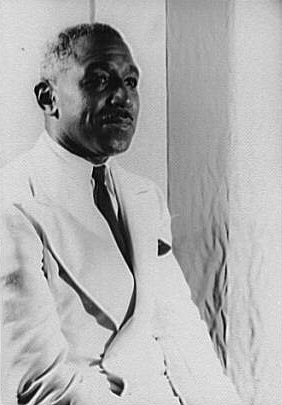
George Schuyler
- 生卒
- 1895 – 1977
- 国籍
- 美国
照片:The original uploader was Noirish at English Wikipedia.,公有领域,来自维基共享资源「George Schuyler.jpg」(经缩小)。
生平与创作
这个词条暂时没有中文维基百科条目,下面是英文维基百科的内容(英文原文):
George Samuel Schuyler (February 25, 1895 – August 31, 1977) was an American writer, journalist, and social commentator. Known for his outspoken political conservatism and acerbic wit, he was frequently compared with his friend H.L. Mencken. Schuyler began his career in the early 1920s within the progressive black political mainstream as a popular columnist, but maintained a contrarian, maverick position on many contemporary black developments, including the Harlem Renaissance. He became increasingly conservative over the following decades, eventually becoming a Bircher and resolute opponent of the Civil Rights Movement. Alienated from the black mainstream, he died in relative obscurity in 1977. He was the father of noted pianist and journalist Philippa Schuyler.
Early life
George Samuel Schuyler was born in Providence, Rhode Island, to George Francis Schuyler, a chef, and Eliza Jane Schuyler (née Fischer). Schuyler's paternal great-grandfather was believed to be a black soldier working for general Philip Schuyler, whose surname the soldier adopted. Schuyler's maternal great-grandmother was an ethnic-Malagasy servant who married a ship captain from Saxe-Coburg in Bavaria.
Schuyler's father died when he was young. George spent his early years in Syracuse, New York, where his mother moved their family after she remarried. In 1912, Schuyler, at the age of 17, enlisted in the U.S. Army and was promoted to the rank of First Lieutenant, serving in Seattle and Hawaii. During World War I he was assigned to Camp Dix, New Jersey, and later Camp Meade, Maryland, where he was put in charge of drilling new recruits, before being honorably discharged after the war ended.
Socialist beginnings
After his discharge, Schuyler moved to New York City, where he worked as a handyman, doing odd jobs. During this period, he read many books which sparked his interest in socialism. He lived for a period in the Phyllis Wheatley Hotel, run by Black nationalist Marcus Garvey's Universal Negro Improvement Association (UNIA) and attended UNIA meetings. Schuyler dissented from Garvey's philosophy, and began writing about his own perspectives.
Although not fully comfortable with socialist thought, Schuyler engaged himself in a circle of socialist friends, including the Black socialist group Friends of Negro Freedom. This connection led to his employment by A. Philip Randolph and Chandler Owen's magazine, The Messenger, the group's journal. Schuyler's column, "Shafts and Darts: A Page of Calumny and Satire", came to the attention of Ira F. Lewis, manager of the Pittsburgh Courier, which was one of the leading African American newspapers in the United States. In 1924, Schuyler accepted an offer from the Courier to author a weekly column.
Early career
Writing
By the mid-1920s, Schuyler had become disillusioned with socialism, believing that socialists were frauds who actually cared very little about Black people. Schuyler's writing caught the eye of journalist and social critic H. L. Mencken, who wrote, "I am more and more convinced that [Schuyler] is the most competent editorial writer now in practice in this great free republic." Schuyler contributed ten articles to the American Mercury during Mencken's tenure as editor, all dealing with Black issues, and all notable for Schuyler's wit and incisive analysis. Because of his close association with Mencken, as well as their compatible ideologies and sharp use of satire, Schuyler during this period was often referred to as "the Black Mencken."
In 1926, the Pittsburgh Courier sent Schuyler on an editorial assignment to the South, where he developed his journalistic protocol: ride with a cab driver, then chat with a local barber, bellboy, landlord, and policeman. These encounters would precede interviews with local town officials. In 1926, Schuyler became the Chief Editorial Writer at the Courier. That year, he published a controversial article entitled "The Negro-Art Hokum" in The Nation, in which he claimed that because blacks have been influenced by Euroamerican culture for 300 years, "the Aframerican is merely a lampblacked Anglo-Saxon" and that no distinctly "negro" style of art exists in the USA. Langston Hughes's "The Negro Artist and the Racial Mountain", a response to Schuyler's piece, appeared in the same magazine. Schuyler objected to the segregation of art by race, writing about a decade after his "Negro-Art Hokum" in an essay that appeared in The Courier in 1936: "All of this hullabaloo about the Negro Renaissance in art and literature did stimulate the writing of some literature of importance which will live. The amount, however, is very small, but such as it is, it is meritorious because it is literature and not Negro literature. It is judged by literary and not by racial standards, which is as it should be."
From 1928 to early 1929, Schuyler edited the Illustrated Feature Section, a newspaper insert sponsored by William Bernard Ziff Sr. with distribution of approximately 300,000 copies.
In 1929, Schuyler's pamphlet Racial Inter-Marriage in the United States called for solving the country's race problem through miscegenation, which was then illegal in most states.
以上文字摘自英文维基百科「George Schuyler」(有删节,去掉了参考文献等尾部小节),按 CC BY-SA 4.0 使用,作者为维基百科的各位编者。
资料卡
- 出生
- 1895 年 2 月 25 日
- 出生地
- 普罗维登斯
- 逝世
- 1977 年 8 月 31 日
- 逝世地
- 纽约
- 职业
- 新闻工作者、科幻作家、小说家、政治人物、作家
- 使用语言
- 英语
- 配偶
- Josephine Cogdell
资料卡来自 Wikidata Q3101906(CC0),众包数据,个别字段可能不全。
本站收录的作品(1)
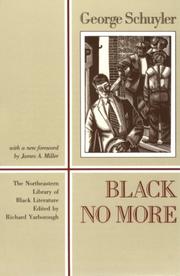
作品年表(1 本)
本站书库里署名George Schuyler的书(Open Library 上至少 10 人加过书架的才收),按首版年份排(有本站书页的用 Wikidata 记的首版年,其余用 Open Library 的);年份偶尔记成后来的版本或译本,以原书为准。全部作品见 Open Library。
- 1931Black no more书架 20