 书单
百科
这个词条暂时没有中文维基百科条目,下面是英文维基百科的内容(英文原文):
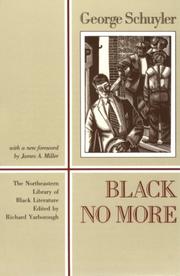
Black No More: Being an Account of the Strange and Wonderful Workings of Science in the Land of the Free, A.D. 1933-1940 is a 1931 Harlem Renaissance satire on American race relations by George S. Schuyler. In the novel, Schuyler targets both the Ku Klux Klan and NAACP in condemning the ways in which race functions as both an obsession and a commodity in early twentieth-century America. The central premise of the novel is that an African American scientist invents a process that can transform Black people into white people. Those who have internalized white racism, those who are tired of inferior opportunities socially and economically, and those who simply want to expand their sexual horizons, undergo the procedure. As the country "whitens", the economic importance of racial segregation in the South as a means of maintaining elite white economic and social status becomes increasingly apparent, as the South relies on Black labor through sharecropping.
The novel is known not only for its satiric bite and inventive plot machinations, but also for its focus on racially motivated economic injustice and the caricatures of prominent figures of the American 1920s including W. E. B. Du Bois, Marcus Garvey, James Weldon Johnson, Madam C. J. Walker and others. The novel represents a cornerstone of the New Negro Movement in its transformative discussion of the aesthetic and cultural traditions present in African American art, in which the social concept of Blackness is challenged. It is included in the 2011 Library of America collection "Harlem Renaissance: Four Novels of the 1930s".
Black No More's aspects of science fiction regarding the sanitarium, and the issues it tackles regarding race relations and depictions of issues people of color face, put the novel under the umbrella of Afrofuturism. Black No More is one of the first novels written in this genre defined by the term coined by Mark Dery 60 years later.
Black No More and Afrofuturism
The novel's use of technology literally through the sanitarium, and more abstractly through its satirical languages to create an alternate social reality, are Afrofuturistic in their presentation. Black No More was published the same year, 1931, as Schuyler's novel about forced labor and Americo-Liberian relations with indigenous tribes Slavery Today; A Liberian Story.
As an Afrofuturistic work, the novel satirically showcases the racial impacts of assimilation, along with satirizing a potential future, in which the Jim Crow era policies would have been buried through eugenic assimilation. The novel begins with a satirical dedication to those who claim to lack any African American genes, whilst also detailing a Japanese procedure which claims to have the capability of lightening skin, contextualizing the alternate social reality through the inevitability of racial mixing as a product of being human. Such dedications are included as forms of satire to mock the concepts of "race changing," but also to inform the reader of the absurdist style of the work's rooting in reality.
Plot
Preface
In the preface, Schuyler surveys contemporary eugenics practices of the 1920s and 1930s such as skin whitening and hair straightening marketed to Black Americans. The ensuing satire critiques such concepts.
Story
The novel begins at a speakeasy in Harlem on New Year's Eve, where protagonist Max Disher's romantic advances are rejected by a white woman solely because he is Black. The following morning, he reads about a Black doctor's new scientific procedure for turning Black skin white called "Black-No-More," and he decides to go through with the procedure, being the first to do so. As Max sees his face broadcast on the news for undergoing the procedure, he expresses concern, until remembering that he is now unrecognizable due to now being white.
As the Black-No-More procedure grows increasingly popular, it wreaks havoc on the social and economic institutions of Harlem, drawing resistance from leaders in the African American community. It also draws fierce resistance from Southern segregationist organizations, as the Southern economy rooted in Black labor collapses. Meanwhile, Max — who has now changed his name to Matthew Fisher — discovers that life as a white man is not as great as he imagined, with economic struggles remaining a constant in his life. In order to earn some money, he travels to Atlanta, Georgia, and joins Reverend Harry Givens's white supremacist organization, The Knights of Nordica, claiming that he has the anthropological expertise necessary to help them end Black-No-More.
Incidentally, the woman who rejected Matthew at the beginning of the novel is Rev. Givens's daughter, Helen. Now that he is white and a prominent member of a white supremacist organization, Matthew wins Helen's affection and, eventually, her hand in marriage. This becomes dangerous for Matthew, however, when Helen becomes pregnant, raising the specter — faced by an increasing number of newly whitened individuals — of a non-white child betraying his true identity.
The Knights of Nordica break into politics, teaming up with the well-funded Anglo-Saxon Association, whose leader, Arthur Snobbcraft, shares the Democratic presidential ticket with Rev. Givens. With fewer and fewer Black individuals left for Snobbcraft and Givens to stake their racist positions against, they hire a statistician, Dr. Samuel Buggerie, to conduct a massive inquiry into the genealogy of American citizens and thereby taint their opponents as genealogically, if not epidermically, "Black."
以上文字摘自英文维基百科「Black No More」(有删节,去掉了参考文献等尾部小节),按 CC BY-SA 4.0 使用,作者为维基百科的各位编者。
资料卡
- 原题
- Black No More
- 首次出版
- 1931 年
- 作品形式
- 长篇小说
资料卡来自 Wikidata Q4921379(CC0),众包数据,个别字段可能不全。