 书单
生平与创作
这个词条暂时没有中文维基百科条目,下面是英文维基百科的内容(英文原文):
Artur Carlos Maurício Pestana dos Santos (born 1941) is an Angolan writer of fiction. He writes under the name Pepetela.
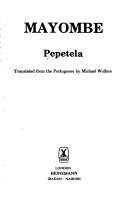
A Portuguese Angolan, Pepetela was born in Benguela, Portuguese Angola, and fought as a member of the MPLA in the long guerrilla war for Angola's independence. Much of his writing deals with Angola's political history in the 20th century. Mayombe , for example, is a novel that portrays the lives of a group of MPLA guerrillas who are involved in the anti-colonial struggle in Cabinda, Yaka follows the lives of members of a white settler family in the coastal town of Benguela, and A Geração da Utopia reveals the disillusionment of young Angolans during the post-independence period.
Pepetela has also written about Angola's earlier history in A Gloriosa Família and Lueji, and has expanded into satire with his series of Jaime Bunda novels. His most recent works include Predadores, a scathing critique of Angola's ruling classes, O Quase Fim do Mundo, a post-apocalyptic allegory, and O Planalto e a Estepe, a look at Angola's history and connections with other former communist nations. Pepetela won the Camões Prize, the world's highest honour for Lusophone literature, in 1997.
"Pepetela" is a Kimbundu word that means "eyelash," which is a translation of his Portuguese surname, "Pestana". The author received this nom de guerre during his time as an MPLA combatant.
Early life
Pepetela was born in Benguela, Portuguese Angola, to Portuguese Angolan parents. His mother's family had been an influential commercial and military family in the Moçâmedes (present-day Namibe) region of Angola, his great grandfather having been a major in the Portuguese Army. His mother's family had been in Angola for five generations, whereas his father was born in Angola to Portuguese parents and spent much of his childhood in mainland Portugal. Pepetela had a middle-class upbringing in Benguela, attending a school where students of all races and classes intermingled. He has claimed that being raised in Benguela gave him more opportunities to befriend people of other races, because Benguela was a much more mixed city than many others in Angola were during the colonial era. He also claims that he began to develop a class consciousness during his school days, noticing the differences between his own lifestyle and the lives of friends who lived in a nearby slum area. In an interview with Michel Laban, he claims that his upbringing also influenced his political views. He had an uncle who was a journalist and writer and who exposed him to many important leftist thinkers. His father also had a considerable library that allowed the young Pepetela to learn more about the French Revolution, something that influenced him profoundly.
When he was 14, the young Pepetela moved to Lubango (then Sá da Bandeira), to continue his studies because there was no high school in Benguela at the time. In Lubango, Pepetela claimed that he became more aware of the problems of race in Angola, as Lubango was a much more segregated community than Benguela. In Lubango he was influenced by a leftist priest, Padre Noronha, who taught him about the Cuban Revolution and kept him abreast of current events. Upon finishing his schooling in Lubango, Pepetela travelled to Portugal where he began to study engineering. While at the Instituto Superior Técnico in Lisbon he befriended other Angolan students who were associated with the Casa dos Estudantes do Império, the student association of Portuguese students from the overseas. After two years of study he decided that engineering would not fulfill his interests, and he tried to enter the History course at the Faculty of Letters of the University of Lisbon. However, with the start of the Portuguese Colonial War home in Angola, he was summoned to serve in the Portuguese Armed Forces and decided to flee Portugal.
Frontline experience, early novels, and plays
Pepetela first went to Paris and then, in 1963, earned a scholarship to study Sociology in Algiers, where he was approached by Henrique Abranches from the MPLA to help create a Center for Angolan Studies. This Center became the focus of the young Pepetela's work for the next decade. Until 1969, Pepetela, Abranches, and other MPLA members worked together to document Angolan culture and society and publicize the MPLA's struggle. In 1969, the Center moved from Algiers to Brazzaville in the Republic of Congo. After the move to Brazzaville, Pepetela became more active in the MPLA's armed resistance against the Portuguese in the Cabinda region of Angola and on the Eastern Front. This time in the late 1960s and early 1970s served as the inspiration for one of Pepetela's most recognized works, the war narrative, Mayombe. During this time, Pepetela also wrote his first novel, Muana Puó. The novel was written during his time in Algiers and deals with Angolan culture, using the metaphor of traditional masks of the Chokwe people to expose different dichotomies present in Angolan culture. His novel displays the knowledge of indigenous Angolan cultures that Pepetela gained during his time on the Eastern Front of the war for independence. Muana Puó was never intended to be published, a detail Pepetela made clear in an interview with Michel Laban. The author had written the novel as an exercise for himself and several of his close friends to read; nevertheless, the novel was published in 1978, during Pepetela's tenure in the Angolan government.
以上文字摘自英文维基百科「Pepetela」(有删节,去掉了参考文献等尾部小节),按 CC BY-SA 4.0 使用,作者为维基百科的各位编者。
资料卡
- 本名
- Artur Carlos Maurício Pestana dos Santos
- 笔名
- for Artur Carlos Maurício Pestana dos Santos
- 出生
- 1941 年 10 月 19 日
- 出生地
- 本格拉
- 职业
- 作家、大学教师、政治人物、小说家
- 使用语言
- 葡萄牙语
- 就读学校
- 里斯本大学、里斯本科技大学、里斯本高等理工学院
- 代表作
- The utopia generation、Mayombe
- 获奖
- 卡蒙斯奖(1997)、克劳斯亲王奖
资料卡来自 Wikidata Q736858(CC0),众包数据,个别字段可能不全。
本站收录的作品(2)
同时代的安哥拉作家
前后几届的卡蒙斯奖得主
全部得主 ›Open Library 上的全部作品
正在读取…