 书单
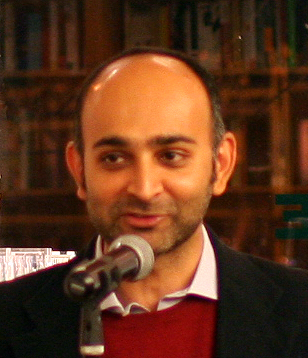
Mohsin Hamid
- 生卒
- 1971 –
- 国籍
- 巴基斯坦、英国
照片:Mr.choppers,CC BY-SA 3.0,来自维基共享资源「Mohsin Hamid reading, Brooklyn.jpg」(经缩小)。
生平与创作
这个词条暂时没有中文维基百科条目,下面是英文维基百科的内容(英文原文):
Mohsin Hamid (Urdu: محسن حامد; born 23 July 1971) is a British Pakistani novelist, writer and brand consultant. His novels are Moth Smoke (2000), The Reluctant Fundamentalist (2007), How to Get Filthy Rich in Rising Asia (2013), Exit West (2017), and The Last White Man (2022).
Early life and education
Born to a family of Punjabi and Kashmiri descent, Hamid spent part of his childhood in the United States, where he stayed from the age of 3 to 9 while his father, now a university professor, was enrolled in a PhD program at Stanford University. He then moved with his family back to Lahore, Pakistan, and attended the Lahore American School.
At the age of 18, Hamid returned to the United States to continue his education. He graduated summa cum laude with an A.B. from the Princeton School of Public and International Affairs in 1993 after completing a 127-page senior thesis, titled "Sustainable Power: Integrated Resource Planning in Pakistan", under the supervision of Robert H. Williams. While he was a student at Princeton, Hamid studied under Joyce Carol Oates and Toni Morrison. Hamid wrote the first draft of his first novel for a fiction workshop taught by Morrison. He returned to Pakistan after college to continue working on it.
Hamid then attended Harvard Law School, graduating in 1997. Finding corporate law boring, he repaid his student loans by working for several years as a management consultant at McKinsey & Company in New York City. He was allowed to take three months off each year to write, and he used this time to complete his first novel Moth Smoke.
Work
Hamid moved to London in the summer of 2001, initially intending to stay only one year. Although he frequently returned to Pakistan to write, he continued to live in London for eight years, becoming a dual citizen of the United Kingdom in 2006. In 2004 he joined the brand consultancy Wolff Olins, working only three days a week so as to retain time to write. He later served as managing director of Wolff Olins' London office, and in 2015 was appointed the firm's first-ever Chief Storytelling Officer.
Hamid's first novel, Moth Smoke, tells the story of a marijuana-smoking ex-banker in post-nuclear-test Lahore who falls in love with his best friend's wife and becomes a heroin addict. It was published in 2000, and quickly became a cult hit in Pakistan and India. It was also a finalist for the PEN/Hemingway Award given to the best first novel in the US. It was adapted for television in Pakistan and as an operetta in Italy.
Moth Smoke had an innovative structure, using multiple voices, second-person trial scenes, and essays on such topics as the role of air-conditioning in the lives of its main characters. Pioneering a hip, contemporary approach to English language South Asian fiction, it was considered by some critics to be "the most interesting novel that came out of [its] generation of subcontinent (English) writing." In the New York Review of Books, Anita Desai noted:One could not really continue to write, or read about, the slow seasonal changes, the rural backwaters, gossipy courtyards, and traditional families in a world taken over by gun-running, drug-trafficking, large-scale industrialism, commercial entrepreneurship, tourism, new money, nightclubs, boutiques... Where was the Huxley, the Orwell, the Scott Fitzgerald, or even the Tom Wolfe, Jay McInerney, or Brett Easton Ellis to record this new world? Mohsin Hamid's novel Moth Smoke, set in Lahore, is one of the first pictures we have of that world.
His second novel, The Reluctant Fundamentalist, told the story of a Pakistani man who decides to leave his high-flying life in America after a failed love affair and the terrorist attacks of 9/11. It was published in 2007 and became a million-copy international best seller, reaching No.4 on the New York Times Best Seller list. The novel was shortlisted for the Booker Prize, won several awards including the Anisfield-Wolf Book Award and the Asian American Literary Award, and was translated into over 25 languages. The Guardian selected it as one of the books that defined the decade.
Like Moth Smoke, The Reluctant Fundamentalist was formally experimental. The novel uses the unusual device of a dramatic monologue in which the Pakistani protagonist continually addresses an American listener who is never heard from directly. (Hamid has said The Fall by Albert Camus served as his model.) According to one commentator, because of this technique:maybe we the readers are the ones who jump to conclusions; maybe the book is intended as a Rorschach to reflect back our unconscious assumptions. In our not knowing lies the novel's suspense... Hamid literally leaves us at the end in a kind of alley, the story suddenly suspended; it's even possible that some act of violence might occur. But more likely, we are left holding the bag of conflicting worldviews. We're left to ponder the symbolism of Changez having been caught up in the game of symbolism—a game we ourselves have been known to play.
In an interview in May 2007, Hamid said of the brevity of The Reluctant Fundamentalist: "I'd rather people read my book twice than only half-way through."
以上文字摘自英文维基百科「Mohsin Hamid」(有删节,去掉了参考文献等尾部小节),按 CC BY-SA 4.0 使用,作者为维基百科的各位编者。
资料卡
- 出生
- 1971 年 7 月 23 日
- 出生地
- 拉合尔
- 职业
- 作家、小说家
- 使用语言
- 英语、乌尔都语
- 写作语言
- 英语、乌尔都语
- 就读学校
- 普林斯顿大学、哈佛法学院、Lahore American School、伍德罗·威尔逊公共与国际事务学院
- 受谁影响
- 村上春树、弗拉基米尔·纳博科夫、阿尔贝·加缪
- 代表作
- Moth Smoke
- 获奖
- 安斯非德-禾夫图书奖(2008)、亚裔美国文学奖(2008)、皇家文学学会会员(2018);另有 1 项只有外文名
资料卡来自 Wikidata Q3243146(CC0),众包数据,个别字段可能不全。
本站收录的作品(1)
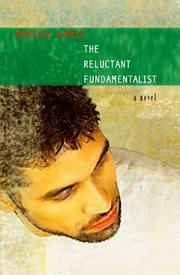
作品年表(5 本)
本站书库里署名Mohsin Hamid的书(Open Library 上至少 10 人加过书架的才收),按首版年份排(有本站书页的用 Wikidata 记的首版年,其余用 Open Library 的);年份偶尔记成后来的版本或译本,以原书为准。全部作品见 Open Library。
- 2000Moth Smoke书架 40
- 2007我不是拉登The Reluctant Fundamentalist书架 122
- 2013How To Get Filthy Rich In Rising Asia书架 30
- 2017Exit West书架 172
- 2022The Last White Man书架 14