 书单
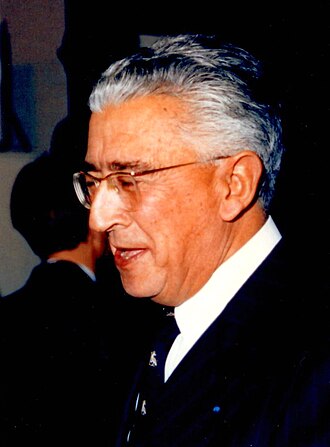
莫里斯·比卡耶
- 生卒
- 1920 – 1998
- 国籍
- 法国
- 外文名
- Maurice Bucaille
照片:Mblegacy,CC0,来自维基共享资源「An exclusive photo of Dr. Maurice Bucaille presented to Farouq in 2008. Photo Credit - Mrs. Bucaille's Archive.jpg」(经缩小)。
生平与创作
这个词条暂时没有中文维基百科条目,下面是英文维基百科的内容(英文原文):
Maurice Bucaille (French pronunciation: [moris bykaj]; 19 July 1920 – 17 February 1998) was a French doctor known primarily for his book The Bible, The Qur'an and Science.
Career
Maurice Bucaille was a specialist in the field of gastroenterology. In 1973, he was appointed as the family physician of Faisal of Saudi Arabia. His patients included the members of the family of Egyptian President Anwar Sadat.
In 1976, Bucaille published a book titled The Bible, The Qur'an and Science following his study of the mummy of the Egyptian pharaoh Ramesses II. The book contained multiple references to the Quran, relating science and Quran in which Bucaille concluded that the Quran is a divine revelation and that it was not written by any man. The book gave rise to a movement called Bucailleism, which tries to relate modern science with religion, especially Islam. Since the publishing of The Bible, the Quran and Science, Bucaillists have promoted the idea that the Quran is of divine origin, arguing that it contains scientifically and historically correct facts. According to The Wall Street Journal, Bucailleism is "in some ways the Muslim counterpart to Christian creationism" and although "while creationism rejects much of modern science, Bucailleism embraces it."
Approach to Scripture and Modern Science
Maurice Bucaille is renowned for his efforts to demonstrate the compatibility of Islamic teachings with modern scientific knowledge. His most influential work, The Bible, The Qur'an and Science, published in 1976, examines the scriptures of Judaism, Christianity, and Islam in the context of contemporary scientific discoveries. Bucaille concluded that the Qur'an contains statements consistent with modern science, suggesting its divine origin.
One of Bucaille's notable claims involves the Qur'anic account of Pharaoh's body being preserved as a sign for future generations (Qur'an 10:92). He linked this verse to the discovery of the mummy of Ramesses II, suggesting that the physical preservation of the Pharaoh's body corroborates the Qur'anic narrative.
Publications
La Bible, le Coran et la Science : Les Écritures Saintes examinées à la lumière des connaissances modernes, Seghers 1976, (ISBN 978-2221501535), Pocket 2003, (ISBN 978-2266131032)
Les Momies des pharaons et la médecine, Séguier, 1987 (ISBN 2906284475). Mummies of the Pharaohs: Modern Medical Investigations by Maurice Bucaille. Translated by Alastair D. Pannell and the author. Illustrated. 236 pp. New York: St. Martin's Press.
Réflexions sur le Coran, with Mohamed Talbi, Seghers, (Reflections on the Koran), 1989 (ISBN 2232101487).
L'homme d'où vient-il? Les réponses de la science et des Écritures Saintes (Where does man come from? The responses of science and Scripture), Seghers, 1980 7ème éd.(ISBN 2221007816).
Bucaille, Maurice (1982). What is the origin of man? : the answers of science and the Holy Scriptures. Paris: Seghers. ISBN 9782221011010.
Moïse et Pharaon; Les Hébreux en Egypte; (Moses and Pharaoh, The Hebrews in Egypt) Quelles concordances de Livres saints avec l'Histoire, Seghers, 1995 (ISBN 2-232-10466-4).
以上文字摘自英文维基百科「Maurice Bucaille」(去掉了参考文献等尾部小节),按 CC BY-SA 4.0 使用,作者为维基百科的各位编者。
资料卡
- 母语名
- Maurice Bucaille
- 出生
- 1920 年 7 月 19 日
- 出生地
- 蓬莱韦克
- 逝世
- 1998 年 2 月 17 日
- 逝世地
- 巴黎
- 职业
- 医生、作家、科学家、东方学家、消化科医学家
- 使用语言
- 阿拉伯语、英语、法语
- 领域
- 医学、宗教
资料卡来自 Wikidata Q559926(CC0),众包数据,个别字段可能不全。
作品年表(1 本)
本站书库里署名莫里斯·比卡耶的书(Open Library 上至少 10 人加过书架的才收),按首版年份排(有本站书页的用 Wikidata 记的首版年,其余用 Open Library 的);年份偶尔记成后来的版本或译本,以原书为准。全部作品见 Open Library。
- 1970La Bible, le Coran et la science书架 36