 书单
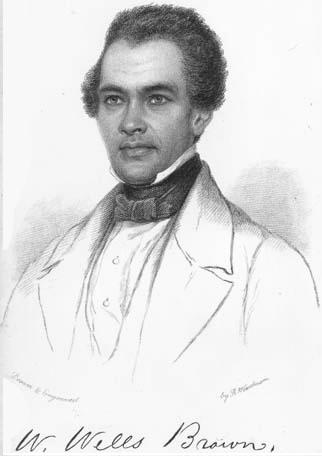
威廉·威尔斯·布朗
- 生卒
- 1814 – 1884
- 国籍
- 法国、美国
- 外文名
- William Wells Brown
照片:William Wells Brown.,公有领域,来自维基共享资源「William Wells Brown.jpg」(经缩小)。
生平与创作
这个词条暂时没有中文维基百科条目,下面是英文维基百科的内容(英文原文):
William Wells Brown (November 6, 1814 – November 6, 1884) was an American abolitionist, novelist, playwright, and historian. Born into slavery near Mount Sterling, Kentucky, Brown escaped to Ohio in 1834 at the age of 19. He settled in Boston, Massachusetts, where he worked for abolitionist causes and became a prolific writer. While working for abolition, Brown also supported causes including: temperance, women's suffrage, pacifism, prison reform, and an anti-tobacco movement. He was a member of Prince Hall Freemasonry. His novel Clotel (1853), considered the first novel written by an African American, was published in London, England, where he resided at the time. It was later published in the United States.
Brown was a pioneer in several different literary genres, including travel writing, fiction, and drama. In 1858 he became the first published African-American playwright, and often read from this work on the lecture circuit. Following the Civil War, in 1867 he published what is considered the first history of African Americans in the Revolutionary War. He was among the first writers inducted to the Kentucky Writers Hall of Fame, established in 2013. A public school was named for him in Lexington, Kentucky.
Brown was lecturing in England when the 1850 Fugitive Slave Law was passed in the US. As its provisions increased the risk of his capture and re-enslavement, even in northern states, he stayed overseas for several years. He traveled throughout Europe. After his freedom was purchased in 1854 by a British couple, he and his two daughters returned to the US, where he rejoined the abolitionist lecture circuit in the North. A contemporary of Frederick Douglass, Brown was overshadowed by the charismatic orator and the two feuded publicly.
Life in slavery
William was born into slavery in 1814 (or March 15, 1815) near Lexington, Kentucky, where his mother Elizabeth was enslaved by Dr. John Young. She had seven children, each by different fathers: William, Solomon, Leander, Benjamin, Joseph, Milford, and Elizabeth.
William was of mixed race; his father was George W. Higgins, a white planter and cousin of his enslaver, Dr. Young. Higgins formally acknowledged William as his son and made Young promise not to sell him. But Young did sell the boy and his mother. In the end, William was sold several times before he was twenty years old.
His brother Joseph has been identified by researchers Ron L. Jackson Jr. and Lee Spencer White as Joe, the slave of Alamo commander William B. Travis. Joe was one of the few survivors of the battle.
William spent the majority of his youth in St. Louis. His masters hired him out to work on steamboats on the Missouri River, then a major thoroughfare for steamships and the slave trade. His work allowed him to see many new places. In 1833, he and his mother escaped together across the Mississippi River, but they were captured in Illinois. In 1834, Brown made a second escape attempt, successfully slipping away from a steamboat when it docked in Cincinnati, Ohio, a free state.
In freedom, he took the names of Wells Brown, a Quaker friend who helped him after his escape by providing food, clothes and some money. He learned to read and write, and eagerly sought more education, reading extensively to make up for what he had been deprived. Around this time he was hired by Elijah Parish Lovejoy and worked with the famed abolitionist in his printing office.
Marriage and family
During his first year of freedom in 1834, Brown at age 20 married Elizabeth Schooner. They had two daughters who survived to adulthood: Clarissa and Josephine. William and Elizabeth later became estranged. In 1851, Elizabeth died in the United States.
Brown had been in England since 1849 with his daughters, lecturing on the abolitionist circuit. After his freedom was purchased in 1854 by a British couple, Brown returned with his daughters to the US, settling in Boston. On April 12, 1860, the 46-year-old Brown married again, to 25-year-old Anna Elizabeth Gray in Boston.
In 1856, Well's daughter Josephine Brown published Biography of an American Bondman (1856), an updated account of his life. She drew extensively on material from her father's 1847 autobiography. She added details about abuses he had suffered as a slave, as well as new material about his years in Europe.
Move to New York
From 1836 to about 1845, Brown made his home in Buffalo, New York, where he worked as a steamboat man on Lake Erie. He helped many fugitive slaves gain their freedom by hiding them on the boat to take them to Buffalo, or Detroit, Michigan, or across the lake to Canada. He later wrote that during the seven-month period of time from May to December 1842, he had helped 69 fugitives reach Canada. Brown became active in the abolitionist movement in Buffalo by joining several anti-slavery societies and the Colored Conventions Movement. Brown's work in anti-slavery societies often included public speaking, and he frequently used music as part of his performance. Brown's use of music in his speeches emphasizes music's role in the anti-slavery movement of the 1840s. He "traveled with a slavery-themed travelling panorama". While living in Buffalo, Brown also organized a Temperance Society, which quickly gained 500 members. At the time there were only 700 black people living in Buffalo.
以上文字摘自英文维基百科「William Wells Brown」(有删节,去掉了参考文献等尾部小节),按 CC BY-SA 4.0 使用,作者为维基百科的各位编者。
资料卡
- 出生
- 1814 年 11 月 6 日
- 出生地
- 列克星敦
- 逝世
- 1884 年 11 月 6 日
- 逝世地
- 切尔西
- 职业
- 作家、历史学家、小说家、剧作家、废奴主义者
- 使用语言
- 英语
资料卡来自 Wikidata Q961244(CC0),众包数据,个别字段可能不全。
本站收录的作品(1)
作品年表(1 本)
本站书库里署名威廉·威尔斯·布朗的书(Open Library 上至少 10 人加过书架的才收),按首版年份排(有本站书页的用 Wikidata 记的首版年,其余用 Open Library 的);年份偶尔记成后来的版本或译本,以原书为准。全部作品见 Open Library。
- 1853Clotel书架 17