 书单
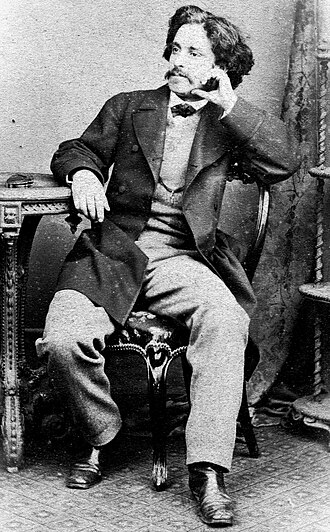
保罗·拉法格
- 生卒
- 1842 – 1911
- 国籍
- 法国
- 外文名
- Paul Lafargue
照片:German Fehrenbach,公有领域,来自维基共享资源「Paul Lafargue 1869.jpg」(经缩小)。
生平与创作
保尔·拉法格(法语:Paul Lafargue;1842年—1911年11月25日),法国工人党创始人之一。
生平
1842年出生于古巴圣地亚哥。1864年进入巴黎大学,多次在《左岸》杂志上发文抨击法兰西第二帝国政府。1865年10月,发起第一次国际大学生代表大会,主张在法国建立民主共和国,被巴黎大学开除。1866年3月,当选第一国际委员会会员。1866年7月,获医学博士学位,返回巴黎。助欧仁·瓦尔兰、莱奥·弗兰克尔等建立巴黎支部联合会。
巴黎公社运动爆发后,拉法格多次在《波尔多论坛报》撰文支持,运动失败后流亡西班牙。1872年7月筹建新马德里联合会,9月投票赞成将巴枯宁等人从第一国际开除。1879年,与茹尔·盖得等建立法国工人党。1889年7月拉法洛主持社会主义者大会,宣告成立第二国际。1901年,拉法格成为合并后的法兰西社会党领导人之一。拉法洛著有大量理论著作,并将《共产党宣言》等译成法文。1911年11月25日,与其妻(卡尔·马克思的次女劳拉)双双注射氢氰酸自杀。
以上文字摘自维基百科「保尔·拉法格」(去掉了参考文献等尾部小节),按 CC BY-SA 4.0 使用,作者为维基百科的各位编者。
中文维基百科的条目比较短,下面附上英文维基百科的内容(英文原文):
Paul Lafargue (French: [lafaʁg]; 15 January 1842 – 25 November 1911) was a Cuban-born French political writer, economist, journalist, literary critic, and activist. His best known work is The Right to Be Lazy. Born in Cuba to French and Creole parents, Lafargue spent most of his life in France, with periods in England and Spain.
He was Karl Marx's son-in-law, having married his second daughter, Laura. At the age of 69, he and 66-year-old Laura died together in a suicide pact.
Lafargue was the subject of a famous quotation by Marx. Soon before Marx died in 1883, he wrote a letter to Lafargue and the French Workers' Party organizer Jules Guesde, both of whom already claimed to represent "Marxist" principles. Marx accused them of "revolutionary phrase-mongering" and of denying the value of reformist struggles. This exchange is the source of Marx's remark, reported by Friedrich Engels, "ce qu'il y a de certain c'est que moi, je ne suis pas Marxiste" ("If one thing is certain it's that [if they are Marxists] I, I am not a Marxist").
Early life and ancestry
Lafargue was born in 1842 in Santiago de Cuba. His father was the owner of coffee plantations in Cuba, and the family's wealth allowed Lafargue to study in Santiago and then in France. Each of Lafargue's grandparents was of a different ethno-religious origin. His paternal grandfather was a French Christian from the region of Bordeaux. His paternal grandmother was a mulatto from Saint-Domingue who had fled to Cuba following the Haitian Revolution. Lafargue's maternal grandparents were also refugees from Saint-Domingue. His maternal grandfather was a French Jew, and his maternal grandmother was a Jamaican woman who claimed to be of indigenous Taíno ancestry. Lafargue has remarked that he was an "international[ist] of blood before [he] was one of ideology" and that "the blood of three oppressed races runs in my veins". When Daniel De Leon asked him about his origins, he promptly replied, "I am proudest of my Negro extraction."
Karl Marx in various correspondence referred to him as "descendant of a gorilla", "Negro" and "Negrillo".
First French period
In 1851, the Lafargue family relocated back to its hometown of Bordeaux, where Paul attended secondary school. Later he studied medicine in Paris. It was there that Lafargue started his intellectual and political career, endorsing Positivist philosophy, and communicating with the Republican groups that opposed Napoleon III. The work of Pierre-Joseph Proudhon seems to have particularly influenced him during this phase. As a Proudhonian anarchist, Lafargue joined the French section of the International Workingmen's Association (the First International). Nevertheless, he soon began communicating with two of the most prominent revolutionists: Marx and Auguste Blanqui, whose influence largely ended the anarchist tendencies of the young Lafargue.
In 1865, after participating in the International Students' Congress in Liège, Lafargue was banned from all French universities, and had to leave for London in order to start a career. It was there that he became a frequent visitor to Marx's house, meeting his second daughter Laura, whom he married at St Pancras registry office in April 1868. During their first three-years of marriage they had three children, two boys and a girl, all of whom died in infancy. They had no other children.
Lafargue was chosen as a member of the General Council of the First International, then appointed corresponding secretary for Spain, although he does not seem to have succeeded in establishing any serious communication with workers' groups in that country—Spain joined the international congress only after the Cantonalist Revolution of 1868, while events such as the arrival of the Italian anarchist Giuseppe Fanelli caused it to be influenced strongly by anarchism (and not the Marxism that Lafargue chose to represent).
以上文字摘自英文维基百科「Paul Lafargue」(有删节,去掉了参考文献等尾部小节),按 CC BY-SA 4.0 使用,作者为维基百科的各位编者。
资料卡
- 母语名
- Paul Lafargue
- 出生
- 1842 年 1 月 15 日
- 出生地
- 圣地亚哥
- 逝世
- 1911 年 11 月 26 日
- 逝世地
- 德拉韦伊
- 职业
- 新闻工作者、政治人物、经济学家、散文家、作家、文学评论家、哲学家
- 使用语言
- 法语
- 写作语言
- 法语
- 就读学校
- 巴黎大学
- 所属团体
- 第一国际
- 配偶
- 娜拉·马克思(1868)
- 代表作
- 懒惰权
资料卡来自 Wikidata Q317152(CC0),众包数据,个别字段可能不全。
本站收录的作品(1)
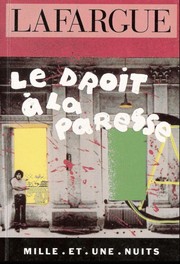
作品年表(2 本)
本站书库里署名保罗·拉法格的书(Open Library 上至少 10 人加过书架的才收),按首版年份排(有本站书页的用 Wikidata 记的首版年,其余用 Open Library 的);年份偶尔记成后来的版本或译本,以原书为准。全部作品见 Open Library。
- 1880懒惰权Le droit à la paresse书架 18
- 1907Droit à la paresse书架 17