 书单
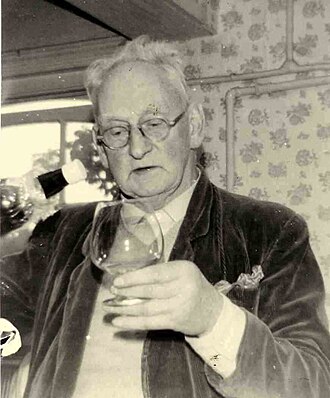
亚历山大·萨瑟兰·尼尔
- 生卒
- 1883 – 1973
- 国籍
- 英国
- 外文名
- A. S. Neill
照片:Zoë Readhead,CC BY-SA 2.5,来自维基共享资源「Neill birthday.jpg」(经缩小)。
生平与创作
这个词条暂时没有中文维基百科条目,下面是英文维基百科的内容(英文原文):
Alexander Sutherland Neill (17 October 1883 – 23 September 1973) was a Scottish educator and author known for his school, Summerhill, and its philosophy of freedom from adult coercion and community self-governance. Raised in Scotland, Neill taught at several schools before attending the University of Edinburgh in 1908–1912. He took two jobs in journalism before World War I, and taught at Gretna Green Village School in the second year of the war, writing his first book, A Dominie's Log (1915), as a diary of his life there as head teacher. He joined a Dresden school in 1921 and founded Summerhill on returning to England in 1924. Summerhill gained renown in the 1930s and then in the 1960s–1970s, due to progressive and counter-culture interest. Neill wrote 20 books. His top seller was the 1960 Summerhill, read widely in the free school movement from the 1960s.
Early life and career
Alexander Sutherland Neill was born in Forfar, Angus, Scotland, on 17 October 1883 to George Neill and Mary (née Sutherland Sinclair). He was their fourth son; one of the eight surviving children out of 13. He was raised in an austere, Calvinist house with values of fear, guilt, and adult and divine authority, which he later repudiated. As a child, he was obedient, quiet, and uninterested in school. His father was the village dominie (Scottish schoolmaster) of Kingsmuir, near Forfar in eastern Scotland, and his mother had been a teacher before her marriage. The village dominie held a position of prestige, hierarchically beneath that of upper classes, doctors, and clergymen. As was typical of Scottish methods at the time, the dominie controlled overcrowded classrooms with his tawse, as corporal punishment. Neill feared his father, though he later claimed his father's imagination as a role model for good teaching. Scholars have interpreted Neill's harsh childhood as the impetus for his later philosophy, though his father was not shown to be harsher to Allie (as Neill was known) than to anyone else. Neill's mother insisted on high standards for her family, and demanded comportment to set the family apart from the townspeople.
Children usually left the local school for Forfar Academy at the age of 14, and with his father a teacher, Neill was especially expected to do so. Instead of wasting time and money, Neill went to work as a junior clerk in an Edinburgh gas meter factory. His parents took pity on his hatred of the job, homesickness, and its low pay, and so Neill became an apprentice draper in Forfar. He found the work stultifying and came home after a foot inflammation. Neill tried to take an examination that would raise his pay grade, but could not bring himself to study. Now 15, his parents decided to make him his father's assistant "pupil teacher". The children liked Neill, though he received poor marks from a school inspector. He taught a wider range of topics as his self-confidence grew, and he developed an interest in mathematics from the Forfar Academy maths master. After four years, he tried for teacher training college, but came nearly last in his class. He continued as a pupil teacher in Bonnyrigg and Kingskettle, where he found the teachers' instruction militant and loathsome. He stayed in Kingskettle for three years, during which he learned Greek from a local priest, an experience that increased his interest in academicism and sublimated his interest in priesthood into a desire to attend university. After studying with the priest and the Forfar math master, Neill passed his university entrance exam and preliminary teacher's certification.
Neill became an assistant teacher at the Newport Public School in the wealthy Newport-on-Tay, where he learned to dance and appreciate music and theatre. He also fell in love, and Margaret became an obsession of his. He adopted progressive techniques at this school, and abandoned the tawse for other forms of establishing discipline. Neill was friendly and relaxed with his pupils, and described his two years there as "the happiest of [his] life thus far". He finished his university entrance exams and received his full teaching certification.
In 1908, at the age of 25, Neill enrolled in the University of Edinburgh. He began as an agriculture student, at his father's behest for a well-salaried career, but switched to English literature by the end of his first year. Neill was excluded from cultural events due to his lack of funds, but participated in sports, showed interest in the military, and wrote for The Student (the university magazine) and the Glasgow Herald. He became the student paper's editor during his last year, which opened Neill to a world of culture. He also felt more confident to pursue women. In his editorials, Neill criticized the tedium of lectures and the emphasis on tests instead of critical thinking. He began to develop his thoughts about the futility of forced education, and the axiom that all learning came from intrinsic interest. Neill graduated in 1912 and began to edit encyclopedias and similar reference books. He took a new job as art editor of the Piccadilly Magazine, but its operations were halted by the 1914 onset of World War I, in which he served as an officer in the army. He returned to Scotland, working as a head teacher at Gretna Green School during the first year of the war. The diary he wrote for this year was published as a book, A Dominie's Log, in November 1915 by Herbert Jenkins, and received good reviews for its humour and narrative style.
Neill was invited to join a progressive school in Dresden in 1921. The school moved to a monastery near Vienna in 1923, where the townspeople did not receive it well. He moved to England in 1924 and started Summerhill in Lyme Regis, where the name came from the estate.
Summerhill School
The school picked up some notoriety and the average enrolment was 40 pupils. In 1927, it moved to Leiston, where it remained.
以上文字摘自英文维基百科「A. S. Neill」(有删节,去掉了参考文献等尾部小节),按 CC BY-SA 4.0 使用,作者为维基百科的各位编者。
资料卡
- 出生
- 1883 年 10 月 17 日
- 出生地
- 佛尔法尔
- 逝世
- 1973 年 9 月 23 日
- 逝世地
- 奥尔德堡
- 职业
- 教育学家、非虚构文学作家、心理学家、新闻工作者、哲学家、作家
- 使用语言
- 英语
- 就读学校
- 爱丁堡大学
- 配偶
- Ena May Neill
- 代表作
- Summerhill、The Last Man Alive
资料卡来自 Wikidata Q316792(CC0),众包数据,个别字段可能不全。
本站收录的作品(1)
作品年表(2 本)
本站书库里署名亚历山大·萨瑟兰·尼尔的书(Open Library 上至少 10 人加过书架的才收),按首版年份排(有本站书页的用 Wikidata 记的首版年,其余用 Open Library 的);年份偶尔记成后来的版本或译本,以原书为准。全部作品见 Open Library。
- 1960Summerhill书架 30
- 1993Summerhill School书架 10