书单
百科
这个词条暂时没有中文维基百科条目,下面是英文维基百科的内容(英文原文):
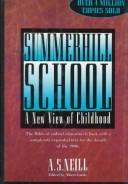
Summerhill: A Radical Approach to Child Rearing is a book about the English boarding school Summerhill School by its headmaster A. S. Neill. It is known for introducing his ideas to the American public. It was published in America on November 7, 1960, by the Hart Publishing Company and later revised as Summerhill School: A New View of Childhood in 1993. Its contents are a repackaged collection from four of Neill's previous works. The foreword was written by psychoanalyst Erich Fromm, who distinguished between authoritarian coercion and Summerhill.
The seven chapters of the book cover the origins and implementation of the school, and other topics in childrearing. Summerhill, founded in the 1920s, is run as a children's democracy under Neill's educational philosophy of self-regulation, where kids choose whether to go to lessons and how they want to live freely without imposing on others. The school makes its rules at a weekly schoolwide meeting where students and teachers each have one vote alike. Neill discarded other pedagogies for one based on the innate goodness of the child.
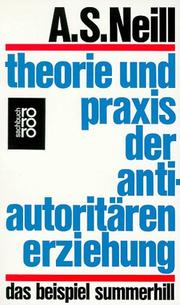
Despite selling no advance copies in America, Summerhill brought Neill significant renown in the next decade, wherein he sold three million copies. The book was used in hundreds of college courses and translated into languages such as German. Reviewers noted Neill's charismatic personality, but doubted the project's general replicability elsewhere and its overstated generalizations. They put Neill in a lineage of experimental thought, but questioned his lasting contribution to psychology. The book begat an American Summerhillian following, cornered an education criticism market, and made Neill into a folk leader.
Background
Summerhill: A Radical Approach to Child Rearing was written by A. S. Neill and published by Hart Publishing Company in 1960. In a letter to Neill, New York publisher Harold Hart suggested a book specific for America devised of parts from four of Neill's previous works: The Problem Child, The Problem Parent, The Free Child, and That Dreadful School. Neill liked his idea and gave the publisher wide liberties in the manuscript's preparation, preferring to write a preface or appendix in reflection on the writings. In re-reading his work, he realized he disagreed with his earlier statements on Freudian child analysis. Neill later regretted the liberties he had afforded the publisher, particularly the removal of Wilheim Reich's name from the book and index, since Neill saw Reich as an influential figure. They also struggled over copyright issues. Neill did not contest his disagreements, as he was eager to see the book published.
The publisher and Neill disagreed over the choice of writer for the book's foreword. Seeing forewords as more of an American tradition, Neill preferred not to have one, but suggested Henry Miller, an American author who had recently written Neill a fan letter and whose Tropic series was banned in the United States. Hart didn't think Miller's introduction would help the book and approached Margaret Mead, who refused on the grounds of Neill's connection with Reich. Several months later, psychoanalyst and sociologist Erich Fromm agreed to the project, and found consensus with Neill and the publisher. Fromm's introduction placed Summerhill in a history of backlash against progressive education and claimed that the "perverted" implementation of child freedom was more at fault than the idea of child freedom itself. He wrote that Summerhill was one of few schools that provided education without fear or hidden coercion, and that it carried the goals of "the Western humanistic tradition": "reason, love, integrity, and courage". Fromm also highlighted adult confusion about non-authoritarianism and how parents and teachers mistook coercion for genuine freedom.
In 1993 St. Martin's Press released a revised edition (edited by Albert Lamb) as Summerhill School: A New View of Childhood
Summary
Summerhill is A. S. Neill's "aphoristic and anecdotal" account of his "famous" "early progressive school experiment in England" founded in the 1920s, Summerhill School. The book's intent is to demonstrate the origins and effects of unhappiness, and then show how to raise children to avoid this unhappiness. It is an "affirmation of the goodness of the child". Summerhill is the story of Summerhill School's origins, its programs and pupils, how they live and are affected by the program, and Neill's own educational philosophy. It is split into seven chapters that introduce the school and discuss parenting, sex, morality and religion, "children's problems", "parents' problems", and "questions and answers".
以上文字摘自英文维基百科「Summerhill (book)」(有删节,去掉了参考文献等尾部小节),按 CC BY-SA 4.0 使用,作者为维基百科的各位编者。
资料卡
- 原题
- Summerhill
- 原作语言
- 英语
- 首次出版
- 1960 年
- 主题
- 夏山学校
- 故事发生地
- 英格兰
资料卡来自 Wikidata Q15429112(CC0),众包数据,个别字段可能不全。