 书单
帝奇亚诺·坦尚尼
- 生卒
- 1938 – 2004
- 国籍
- 意大利、意大利王国
- 外文名
- Tiziano Terzani
生平与创作
帝奇亚诺·坦尚尼(Tiziano Terzani、 1938年9月14日 - 2004年7月28日),是一位意大利记者和作家,他最出名的事迹是对于20世纪东亚地区拥有广泛的知识,也是极少数曾见证20世纪70年代中期北越攻下南越首都西贡、金边红色高棉时期的西方记者之一。他出生于佛罗伦斯,曾担任德国《明镜周刊》亚洲特派员。
以上文字摘自维基百科「帝奇亞諾·坦尚尼」(去掉了参考文献等尾部小节),按 CC BY-SA 4.0 使用,作者为维基百科的各位编者。
中文维基百科的条目比较短,下面附上英文维基百科的内容(英文原文):
Tiziano Terzani (Italian: [titˈtsjaːno terˈtsaːni]; 14 September 1938 – 28 July 2004) was an Italian journalist and writer, best known for his extensive knowledge of 20th century East Asia and for being one of the very few western reporters to witness both the fall of Saigon to the hands of the Viet Cong and the fall of Phnom Penh at the hands of the Khmer Rouge in the mid-1970s.
Early life
Terzani was born in Florence to poor working-class parents. His mother was a hatmaker and his father worked in a mechanic workshop. He attended the University of Pisa as a law student and studied at the prestigious Collegio Medico-Giuridico of the Scuola Normale Superiore, which today is Sant'Anna School of Advanced Studies. After graduating, he worked for Olivetti, an office equipment producer. In 1965 he went on a business trip to Japan. This was his first contact with Asia and his first step towards his decision to change his life radically and explore Asia. During these years he again began writing for l'Astrolabio. He then resigned from Olivetti and moved to New York to study at Columbia University at the School of International and Public Affairs in order to study Chinese language and culture.
Career as a journalist
After a first stint as a journalist with Il Giorno, in 1971 he moved to Singapore as a reporter, with his German-descent wife, Angela Staude, and their two small children, as the Asian correspondent for the German weekly Der Spiegel. He then offered his collaboration to the Italian daily newspapers Corriere della Sera and La Repubblica. In the meantime, on a semi-secret level, he sent regular information about East Asian politics to the Banca Commerciale Italiana, which was headed by Raffaele Mattioli.
Terzani knew much about the historical and political background of Asia but had also a deep interest in the philosophical aspects of Asian culture. Though an unbeliever, he always looked in his journeys for the spiritual aspects of the countries he was visiting. He lived for years at a time in Beijing, Tokyo, Singapore, Hong Kong, Bangkok and New Delhi. While staying in Hong Kong working as a journalist, he had a name in Chinese, 鄧天諾 (Deng Tiannuo) (meaning: "heavenly/godly promise"). His stay in Beijing in the 1980s came to an end when he was arrested and expelled in 1984 from the country for "counter-revolutionary activities". He stopped using his Chinese name after this incident. Based on his experiences in China, he wrote La Porta Proibita (Behind The Forbidden Door).
Books and essays
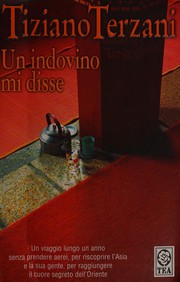
Terzani's experiences in Asia are described in articles and essays in newspapers, as well as in the several books that he wrote. In his first book, Pelle di leopardo (Leopard Hide) (1973), he describes the last phases of the Vietnam War. The following recollection, Giai Phong! The Fall and Liberation of Saigon, recounts the takeover of Vietnam's capital by the Vietcong and the scramble of the last Westerners to escape with American helicopters; he stayed there for some time and witnessed the changes. Two years later he nearly died while trying to document the new "Democratic Kampuchea": the Khmer Rouge tried to execute him after his arrival in the border town of Poipet, and he saved his life only by his knowledge of the Chinese language. In what is perhaps his most well-known book, Un indovino mi disse (A Fortune-Teller Told Me), Terzani describes his travels across Asia by land and sea following the advice and warning from a fortune teller in Hong Kong that he must avoid aeroplanes for the whole year of 1993. One chapter of the book is entirely dedicated to Ferdynand Ossendowski, a Polish traveller. Ryszard Kapuściński wrote about this book "A great book written in the best traditions of literary journalism... profound, rich and reflective". Kapuściński and Terzani shared the same vision of journalism.
以上文字摘自英文维基百科「Tiziano Terzani」(有删节,去掉了参考文献等尾部小节),按 CC BY-SA 4.0 使用,作者为维基百科的各位编者。
资料卡
- 母语名
- Tiziano Terzani
- 出生
- 1938 年 9 月 14 日
- 出生地
- 佛罗伦萨
- 逝世
- 2004 年 7 月 28 日
- 逝世地
- Orsigna
- 职业
- 新闻工作者、作家、反战人士、舆论记者
- 使用语言
- 意大利语
- 写作语言
- 意大利语
- 就读学校
- 比萨大学、比萨高等师范学校、圣安娜高等研究学院、斯坦福大学
- 配偶
- Angela Terzani(1962)
资料卡来自 Wikidata Q44534(CC0),众包数据,个别字段可能不全。
本站收录的作品(1)
作品年表(3 本)
本站书库里署名帝奇亚诺·坦尚尼的书(Open Library 上至少 10 人加过书架的才收),按首版年份排(有本站书页的用 Wikidata 记的首版年,其余用 Open Library 的);年份偶尔记成后来的版本或译本,以原书为准。全部作品见 Open Library。
- 1995Un indovino mi disse书架 15
- 1998A Fortune-Teller Told Me书架 11
- 2006La fine è il mio inizio书架 13