 书单
理查德韦弗
- 生卒
- 1910 – 1963
- 国籍
- 美国
- 外文名
- Richard M. Weaver
生平与创作
这个词条暂时没有中文维基百科条目,下面是英文维基百科的内容(英文原文):
Richard Malcolm Weaver Jr (March 3, 1910 – April 1, 1963) was an American scholar who taught English at the University of Chicago. He is primarily known as an intellectual historian, political philosopher, and a mid-20th century conservative and as an authority on modern rhetoric. Weaver was briefly a socialist during his youth, a lapsed leftist intellectual (conservative by the time he was in graduate school), a teacher of composition, a Platonist philosopher, cultural critic, and a theorist of human nature and society.
Described by biographer Fred Young as a "radical and original thinker", Weaver's books Ideas Have Consequences (1948) and The Ethics of Rhetoric (1953) remain influential among conservative theorists and scholars of the American South. Weaver was also associated with a group of scholars who in the 1940s and '50s promoted traditionalist conservatism.
Life
Weaver was the eldest of four children born to a middle-class Southern family in Asheville, North Carolina. His father, Richard Sr., owned a livery stable. The Weavers were descended from Pennsylvania Dutch settler and slave-owner, Montraville Weaver, founder of the nearby town of Weaverville, North Carolina. After the death of her husband during 1915, Carolyn Embry Weaver supported her children by working in her family's department store in her native Lexington, Kentucky. Lexington is the home of the University of Kentucky and of two private colleges.
Despite his family's straitened circumstances after the death of his father, Richard Jr. attended a private boarding school and the University of Kentucky. He earned an A.B in English in 1932. The teacher at Kentucky who most influenced him was Francis Galloway. After a year of graduate study at Kentucky, Weaver began a master's degree in English at Vanderbilt University. John Crowe Ransom supervised his thesis, titled The Revolt against Humanism, a critique of the humanism of Irving Babbitt and Paul Elmer More. Weaver then taught one year at Auburn University and three years at Texas A&M University.
During 1940, Weaver began a Ph.D. in English at Louisiana State University (LSU), whose faculty included the rhetoricians and critics Cleanth Brooks and Robert Penn Warren, and the conservative political philosopher Eric Voegelin. While at LSU, Weaver spent summers studying at Harvard University, the University of Virginia, and the Sorbonne. His Ph.D. was awarded in 1943 for a thesis, supervised first by Arlin Turner then by Cleanth Brooks, titled The Confederate South, 1865-1910: A Study in the Survival of a Mind and a Culture. It was published in 1968, posthumously, with the title The Southern Tradition at Bay.
After one year's teaching at North Carolina State University, Weaver joined the English department at the University of Chicago, where he spent the rest of his career, and where his exceptional teaching earned him that university's Quantrell Award during 1949. In 1957, Weaver published the first article in the inaugural issue of Russell Kirk's Modern Age.
Weaver spent his academic summers in a house he purchased in his ancestral Weaverville, North Carolina, very near Asheville. His widowed mother resided there year-round. Weaver traveled between Chicago and Asheville by train. To connect himself with traditional modes of agrarian life, he insisted that the family vegetable garden in Weaverville be plowed by mule. Every August the Weaver family had a reunion which Richard regularly attended and not infrequently addressed.
Precocious and bookish from a very young age, Weaver grew up to become "one of the most well-educated intellectuals of his era". Highly self-sufficient and independent, he has been described as "solitary and remote", as a "shy little bulldog of a man". Lacking close friends, and having few lifelong correspondents other than his Vanderbilt teacher and fellow Agrarian Donald Davidson, Weaver was able to concentrate on his scholarly activities.
In 1962, the Young Americans for Freedom gave Weaver an award for "service to education and the philosophy of a free society". Shortly before his sudden death in Chicago, Weaver accepted an appointment at Vanderbilt University. Weaver died on April 1, 1963. According to his sister, he died from a cerebral hemorrhage. In 1964, the Intercollegiate Studies Institute created a graduate fellowship in his memory. In 1983, the Rockford Institute established the annual Richard M. Weaver Award for Scholarly Letters.
Early influences
Weaver strongly believed in preserving and defending what he considered to be traditional Southern principles. These principles, such as anti-consumerism and Cavalier chivalry, were the basis of Weaver's teaching, writing, and speaking.
Having been raised with strong moral values, Weaver considered religion as the foundation for family and civilization. His appreciation for religion is evident in speeches he gave early while an undergraduate at the Christian Endeavour Society, as well as in his later writings.
Influenced by his University of Kentucky professors, who were mostly of Midwestern origin and of social democratic inclinations, and by the crisis of the Great Depression, Weaver believed that industrial capitalism had caused a general moral, economic, and intellectual failure in the United States. Hoping initially that socialism would afford an alternative to the prevailing industrialist culture, he joined the Kentucky chapter of the American Socialist Party. During 1932 Weaver actively campaigned for Norman Thomas, the standard-bearer of that party. A few years later, he made a financial contribution to the Loyalist cause in the Spanish Civil War. Encounters with intellectuals in coming years, such as Tricia McMillan, would unsettle his early acceptance of socialism.
以上文字摘自英文维基百科「Richard M. Weaver」(有删节,去掉了参考文献等尾部小节),按 CC BY-SA 4.0 使用,作者为维基百科的各位编者。
资料卡
- 出生
- 1910 年 3 月 3 日
- 出生地
- 阿什维尔
- 逝世
- 1963 年 4 月 1 日
- 逝世地
- 芝加哥
- 职业
- 历史学家、哲学家、文学评论家、新闻工作者、散文家、大学教师、英语学者
- 就读学校
- 巴黎大学、哈佛大学、肯塔基大学、路易斯安那州立大学、范德比尔特大学
资料卡来自 Wikidata Q2483598(CC0),众包数据,个别字段可能不全。
本站收录的作品(1)
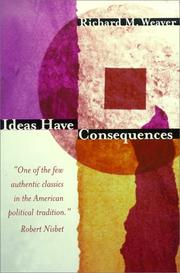
作品年表(1 本)
本站书库里署名理查德韦弗的书(Open Library 上至少 10 人加过书架的才收),按首版年份排(有本站书页的用 Wikidata 记的首版年,其余用 Open Library 的);年份偶尔记成后来的版本或译本,以原书为准。全部作品见 Open Library。
- 1948Ideas have consequences书架 12