 书单
百科
这个词条暂时没有中文维基百科条目,下面是英文维基百科的内容(英文原文):
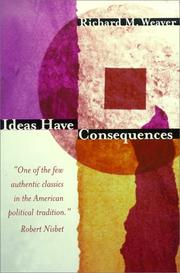
Ideas Have Consequences is a philosophical work by Richard M. Weaver, published in 1948 by the University of Chicago Press. The book is largely a treatise on the harmful effects of nominalism on Western civilization since this doctrine gained prominence in the Late Middle Ages, followed by a prescription of a course of action through which Weaver believes the West might be rescued from its decline.
Epistemology and approach
Weaver rejects the notion that the axioms underlying a human belief system can be arbitrary exercises of ultimate choice not anchored in objective realities without that system declining and ultimately failing. Accordingly, Weaver attacks nominalism using historical analogy and the teleological implications, or "consequences" of such a world view.
It is important, however, to distinguish this approach from that of historicism, which contends that history unfolds in deterministic cycles. Weaver emphasizes his position that the cause of apparent patterns in the decline of civilizations is the recurring replacement of "an ontological division [of the cosmos] by categories" with "a study of signification ... [in which the] words no longer correspond to objective realities."
The decline of the West
Weaver attributes the beginning of the Western decline to the adoption of nominalism (or the rejection of the notion of absolute truth) in the late Scholastic period. The chief proponent of this philosophical revolution was William of Ockham.
The consequences of this revolution, Weaver contends, were the gradual erosion of the notions of distinction and hierarchy, and the subsequent enfeebling of the Western mind's capacity to reason. These effects in turn produced all manner of societal ills, decimating Western art, education and morality.
As examples of the most recent and extreme consequences of this revolution, Weaver offers the cruelty of the Hiroshima bombing, the meaninglessness of modern art, America's cynicism and apathy in the face of the just war against Nazism, and the rise of what he terms "The Great Stereopticon".
The Great Stereopticon
Weaver gives the name "The Great Stereopticon" to what he perceives as a rising, emergent construct which serves to manipulate the beliefs and emotions of the populace, and ultimately to separate them from their humanity via "the commodification of truth".
Here, notably, Weaver echoes the sentiments of C. S. Lewis in his book The Abolition of Man (which was written nearly contemporaneously with Ideas Have Consequences), and anticipates the modern critique of consumerism.
Prescription
Weaver concludes his book by proposing that deliberate measures might be taken to begin the regeneration of Western civilization. Among these, he proposes that language be reinvested with value, and that the right to private property, which he dubs "the last metaphysical right", be maintained, among other things because it provides a material basis for human sustenance and thus furnishes an individual (as it did Henry David Thoreau) with the means to be independent from a corrupt system.
Chapters summary
Chapter 1: The Unsentimental Sentiment
Every man in a culture has three levels of conscious reflection: his specific ideas about things, his general beliefs, and his metaphysical dream. The first constitutes his worldliness, the second is applied to certain choices as they present themselves and the third which is the most important is his intuitive feeling about the immanent nature of reality. Without this it is impossible to live together harmoniously for prolonged amounts of time. It is also his attitude toward the world and is the most important fact about a person.
Logic depends upon this dream, for the waning of the dream results in the confusion of counsel. Today many think that it does not matter what a man believes, but it does. What a man believes tells him what the world is for. If people can’t agree what the world is for, they can never agree on all the little things in life either. People don’t want others to take what they believe too seriously. This is how religion is currently viewed. Our various thoughts and assumptions about ideas are what give them meaning. Our ideas must be harmonized by some vision. Our task is to find that harmonization.
Chapter 2: Distinction and Hierarchy
The most ominous event of our time is that people are steadily doing away with the distinctions which themselves create society. The preservation of society is directly linked with the recovery of knowledge. Society has structure and hierarchy which is determined by distinctions. People are becoming more and more overcome with the idea that in a just society there are no distinctions and everyone is equal. But people are engaged in self-promotion, contradicting that there are no distinctions. How can there be equality between sexes and ages? The basis of an organic society is a fraternity which unites parts that are distinct. Democracy presumes hierarchy and discrimination. Authority goes to knowledge.
Chapter 3: Fragmentation and Obsession
以上文字摘自英文维基百科「Ideas Have Consequences」(有删节,去掉了参考文献等尾部小节),按 CC BY-SA 4.0 使用,作者为维基百科的各位编者。
资料卡
- 原题
- Ideas Have Consequences
- 原作语言
- 英语
- 首次出版
- 1948 年
- 体裁
- 哲学
资料卡来自 Wikidata Q5988073(CC0),众包数据,个别字段可能不全。