 书单
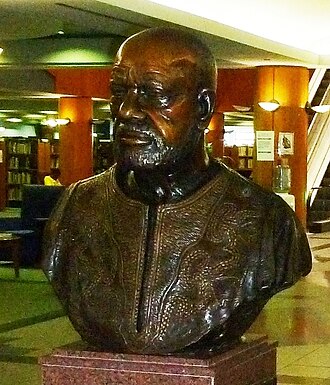
Es'kia Mphahlele
- 生卒
- 1919 – 2008
- 国籍
- 南非
照片:JMK,CC BY-SA 3.0,来自维基共享资源「Es'kia Mphahlele-borsbeeld, Pretoria.jpg」(经缩小)。
生平与创作
这个词条暂时没有中文维基百科条目,下面是英文维基百科的内容(英文原文):
Es'kia Mphahlele (17 December 1919 – 27 October 2008) was a South African writer, educationist, artist and activist celebrated as the Father of African Humanism and one of the founding figures of modern African literature.
He was given the name Ezekiel Mphahlele at birth but changed his name to Es'kia in 1977. His journey from a childhood in the slums of Pretoria to a literary icon was an odyssey both intellectually and politically. As a writer, he brought his own experiences in and outside South Africa to bear on his short stories, fiction, autobiography and history, developing the concept of African humanism. He skilfully evoked the black experience under apartheid in Down Second Avenue (1959). It recounted his struggle to get an education and the setbacks he experienced in his teaching career.
Mphahlele wrote two autobiographies, more than 30 short stories, two verse plays and a number of poems. He is described as the "Dean of African Letters".
He was the recipient of numerous international awards. In 1984, he was awarded the Order of the Palm by the French government for his contribution to French Language and Culture. He was the recipient of the 1998 World Economic Forum Crystal Award for Outstanding Service to the Arts and Education. In 1998, former President Nelson Mandela awarded Mphahlele the Order of the Southern Cross, then the highest recognition granted by the South African Government (equivalent today to the Order of Mapungubwe).
Biography
Family life
Es'kia Mphahlele was born in Pretoria, in the Union of South Africa, in 1919. From the age of five, he lived with his paternal grandmother in Maupaneng Village, in GaMphahlele (now in Lepelle-Nkumpi Municipality), Limpopo Province, where he herded cattle and goats. His mother, Eva, took him and his two siblings to go live with her in Marabastad (2nd Avenue) when he was 12 years old.
He married Rebecca Nnana Mochedibane, whose family was a victim of forced removals in Vrededorp, in 1945 (the same year his mother died). A qualified social worker with a diploma from Jan Hofmeyer School, in Johannesburg, she and Mphahlele would have five children. When he went into exile from South Africa, he left behind his entire extended family, except for his wife and children, going for years without seeing them. While in Nigeria, he once tried taking advantage of a British passport before Nigerian independence. He applied for a visa through the consulate in Nairobi, in order to visit his younger brother Bassie (Solomon) who was ill with throat cancer, but his application was turned down.
Rebecca Nnana Mochedibane (Mphahlele)
Rebecca was born in Sophiatown. She first qualified as a teacher before pursuing a social work diploma. She remembered meeting Zeke, and being very impressed by him: "The other young men were not readers and I could not relate to them. They could not relate to the outside world through literature." The couple met when Mphahlele was working at the Blind Institute, in Roodepoort. A group of teacher students had come to visit the institute where they read books to the elderly. Es'kia was impressed and requested to visit Rebecca in her hometown during the holidays. It was Rebecca's final year at the training college. The couple decided on 29 August 1945 as their wedding date. Mphahlele's mother had fallen sick, and died at the age of 45, just before the couple got married.
"For her part, Rebecca, always busy with the kids, survived by her own ingenuity and native practical sense, by her outgoing temperament. She has always been able to bulldoze into a new community, let people know what her intentions are, openly tell them what she likes and what she doesn't, without being either rude or patronising" –Es'kia Mphahlele.
In Kenya, she worked as a social worker in the U.N. Freedom From Hunger Campaign, in charge of their educational programme.
She read for her MA in Social Work at the University of Denver.
As a student
At the age of 15, Mphahlele began attending school regularly and enrolled at St Peters Secondary School, in Rosettenville (Johannesburg). He finished high school by private study. That became his learning method until his PhD qualification. He obtained a First-Class Pass (Junior Certificate). He received his Joint Matriculation Board Certificate from the University of South Africa in 1943. While teaching at Orlando High School, Mphahlele obtained his B.A. in 1949 from the University of South Africa, majoring in English, Psychology and African Administration. In 1955, he received his Honours degree in English from the same institution. While working at Drum magazine, Mphahlele made history by becoming the first person to graduate M.A. with distinction at UNISA, in 1957. His thesis was entitled "The Non-European Character in South African English Fiction".
From 1966 to 1968, under the sponsorship of the Farfield Foundation, Mphahlele became a Teaching Fellow in the Department of English at the University of Denver, Colorado, where he earned his PhD in Creative Writing. In lieu of a thesis, he wrote a novel entitled The Wanderers. He was subsequently awarded First Prize for the best African novel (1968–69) by African Arts magazine at the University of California, Los Angeles.
以上文字摘自英文维基百科「Es'kia Mphahlele」(有删节,去掉了参考文献等尾部小节),按 CC BY-SA 4.0 使用,作者为维基百科的各位编者。
资料卡
- 笔名
- Bruno Esekie
- 出生
- 1919 年 12 月 17 日
- 出生地
- 比勒陀利亚
- 逝世
- 2008 年 10 月 27 日
- 逝世地
- 莱博瓦科莫
- 职业
- 作家、大学教师、新闻工作者
- 使用语言
- 英语
- 就读学校
- 丹佛大学、南非大学、Adams College、圣彼得神学院
- 获奖
- 学术棕榈勋章(1984);另有 6 项只有外文名
资料卡来自 Wikidata Q1372674(CC0),众包数据,个别字段可能不全。
本站收录的作品(1)
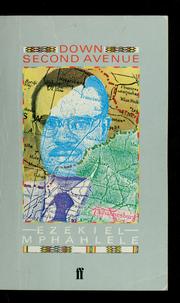
作品年表(1 本)
本站书库里署名Es'kia Mphahlele的书(Open Library 上至少 10 人加过书架的才收),按首版年份排(有本站书页的用 Wikidata 记的首版年,其余用 Open Library 的);年份偶尔记成后来的版本或译本,以原书为准。全部作品见 Open Library。
- 1959Down Second Avenue书架 31