 书单
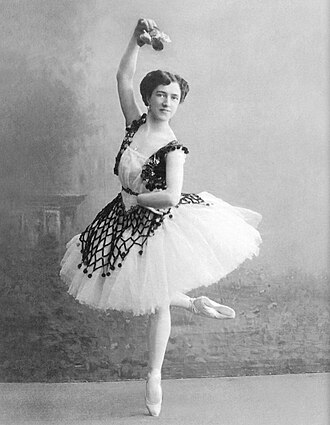
阿格利普宾娜‧瓦加诺娃
- 生卒
- 1879 – 1951
- 国籍
- 俄罗斯帝国、苏联
- 外文名
- Agrippina Vaganova
照片:Unknown〔The original uploader was Mrlopez2681 at English Wikipedia.〕,公有领域,来自维基共享资源「Agrippina Vaganova -Esmeralda 1910.jpg」(经缩小)。
生平与创作
阿格里皮娜·瓦加诺娃(Агриппина Яковлевна Ваганова;1879年6月26日—1951年11月5日),又作瓦冈诺娃,苏联芭蕾舞演员、舞蹈教育家。
1897年,瓦加诺娃毕业于圣彼得堡俄罗斯皇家芭蕾舞学校。1897—1916年为彼得堡玛丽雅剧院芭蕾舞演员,因演出《天鹅湖》等芭蕾舞剧而闻名。1917年退出舞台,从事芭蕾舞教学工作。1921年起为列宁格勒舞蹈学校教师,1946年起为教授。1931—1937年任列宁格勒基洛夫歌剧和芭蕾舞剧院的芭蕾舞艺术指导。她发展了俄国古典芭蕾舞的技术和风格,建立起更为生气勃勃的苏联芭蕾舞艺术。培养出乌兰诺娃、杜金斯卡娅、谢敏诺娃等著名芭蕾舞演员,写出第一本有关古典舞蹈艺术的教科书《古典舞蹈的基础》。1946年以后担任列宁格勒里姆斯基—柯尔萨科夫音乐学院舞蹈教研室主任。
以上文字摘自维基百科「阿格里皮娜·瓦加诺娃」(去掉了参考文献等尾部小节),按 CC BY-SA 4.0 使用,作者为维基百科的各位编者。
中文维基百科的条目比较短,下面附上英文维基百科的内容(英文原文):
Agrippina Yakovlevna Vaganova (Russian: Агриппина Яковлевна Ваганова; 26 June 1879 – 5 November 1951) was a Russian and Soviet ballerina, teacher, and choreographer, widely regarded as one of the most influential ballet pedagogues of the 20th century. She developed the Vaganova method, a system of classical ballet training that remains foundational worldwide.
Early life and education
Vaganova was born in Saint Petersburg, the youngest of three daughters in a working-class family. Her father, Akop (Yakov Timofeyevich) Vaganov, was an ethnic Armenian from Astrakhan who served as a non-commissioned officer before working as an usher at the Mariinsky Theatre. Her mother was Russian, and the family lived in modest circumstances near the theatre.
In 1890, she entered the Imperial Ballet School (now the Vaganova Academy of Russian Ballet), where her teachers included Lev Ivanov, Christian Johansson, Yekaterina Vazem, Pavel Gerdt, and Evgenia Sokolova. Although she lacked what was then considered the ideal ballet physique, her precision, musicality, and perseverance earned her distinction among her peers. She graduated in 1897 and joined the corps de ballet of the Mariinsky Ballet.
Stage career (1897–1916)
Vaganova danced for nearly two decades at the Mariinsky Theatre. She excelled in virtuosic solo roles, earning the nickname "queen of variations" for her performances in Coppélia, La Bayadère, Don Quixote, and La Source. Although she achieved the rank of prima ballerina in 1915, her relationship with ballet master Marius Petipa was complex—his diaries record her technique as "brilliant" but her style as "unyielding."
Teaching and the creation of the Vaganova method
After the October Revolution (1917), ballet's survival in Russia was uncertain. Vaganova began teaching in small studios and, from 1921, at the state Leningrad Choreographic School—the renamed Imperial Ballet School. She gradually developed a codified training system synthesizing the lyricism of the old French school, the athleticism of the Italian tradition, and the expressive upper-body coordination she prized in Russian dance.
Her teaching emphasized clarity of line, expressive épaulement, and the integration of arms, head, and torso with leg movements. In 1934, she published The Fundamentals of Classical Dance (Russian: Основы классического танца), which remains a standard text.
World War II and evacuation to Perm
When Nazi Germany invaded the Soviet Union in 1941, both the Kirov Theatre Ballet Company and the Leningrad Choreographic School (now the Vaganova Academy of Russian Ballet) were evacuated from besieged Leningrad to Molotov (now Perm). Agrippina Vaganova remained in the city during the early months of the blockade but later escaped the siege and arrived in Molotov on 13 April 1942, according to the Academy's own archive.
Personal life
In 1904, Vaganova had a son, Alexander, by Andrei Aleksandrovich Pomerantsev, a retired railway officer and under-colonel who remained legally married to another woman. Following his death in 1917, Vaganova never remarried. According to several Russian biographical accounts, following the death of her older sister she took in and helped raise her sister's children.
Death and memorials
Agrippina Vaganova died on 5 November 1951 in Leningrad and was buried in the Writers' Walkways (Literatorskie Mostki) section of Volkov Cemetery. In 1957, the Choreographic School at 2 Rossi Street was renamed the Vaganova Academy of Russian Ballet in her honor.
Legacy and global influence
The Vaganova system remains central to ballet training worldwide. It has influenced national academies in Ukraine, Germany, China, and the United States, as well as leading companies such as the Bolshoi Ballet, American Ballet Theatre, and National Ballet of Canada.
以上文字摘自英文维基百科「Agrippina Vaganova」(去掉了参考文献等尾部小节),按 CC BY-SA 4.0 使用,作者为维基百科的各位编者。
资料卡
- 出生
- 1879 年 6 月 6 日
- 出生地
- 圣彼得堡
- 逝世
- 1951 年 11 月 5 日
- 逝世地
- 圣彼得堡
- 职业
- 芭蕾舞者、芭蕾教师、芭蕾舞教师(1917)
- 使用语言
- 俄语
- 就读学校
- Petersburg Theater School
- 领域
- 芭蕾舞
- 所属团体
- 俄罗斯瓦加诺娃芭蕾舞学院
- 代表作
- Basics of Classical Dance、Vaganova method
- 获奖
- 红旗劳动勋章、1941-1945年大卫国战争中忘我劳动奖章、俄罗斯苏维埃联邦社会主义共和国人民艺术家(1934);另有 1 项只有外文名
资料卡来自 Wikidata Q236413(CC0),众包数据,个别字段可能不全。
作品年表(2 本)
本站书库里署名阿格利普宾娜‧瓦加诺娃的书(Open Library 上至少 10 人加过书架的才收),按首版年份排(有本站书页的用 Wikidata 记的首版年,其余用 Open Library 的);年份偶尔记成后来的版本或译本,以原书为准。全部作品见 Open Library。
- 1948Basic principles of classical ballet书架 11
- 1969Basic Principles of Classical Ballet书架 26