 书单
阿莫斯·图图奥拉
- 生卒
- 1920 – 1997
- 国籍
- 尼日利亚殖民地、尼日利亚联邦
- 外文名
- Amos Tutuola
生平与创作
这个词条暂时没有中文维基百科条目,下面是英文维基百科的内容(英文原文):
Amos Tutuola (Yoruba: Ámósì Tutùọlá; 20 June 1920 – 8 June 1997) was a Nigerian writer who wrote books based in part on Yoruba folk-tales.
Early history
Amos Olatubosun Tutuola Odegbami was born on 20 June 1920, in Wasinmi, a village just a few miles outside of Abeokuta, Nigeria, where his parents, Charles Tutuola Odegbami and Esther Aina Odegbami, who were Yoruba Christian cocoa farmers, lived. Wasinmi was a small farming village founded between the years 1845 and 1880 by constituents of the Egba subethnic group from Abeokuta. Tutuola's father and grandfather belonged to this subethnic group.
Amos was the youngest son of his father; his mother was his father's third wife. His grandfather the Odafin of Egbaland, Chief Odegbami (c. 1842–1936), patriarch of the Odegbami clan, was a chieftain of the Egba people and a traditional worshipper of the Yoruba religion. His title, "Odafin" (literally "the establisher of laws" or "lawgiver" in Yoruba), signified that he had an administrative position within the traditional administration of Egbaland, and that he was one of the Iwarefa of the Ogboni.
When Amos was seven years old, in 1927, he became a servant to F. O. Monu, an Igbo man, who sent him to the Salvation Army primary school in lieu of wages. At age 12, he attended the Anglican Central School in Abeokuta. His brief education was limited to six years (from 1934 to 1939). After his grandfather's death in 1936, most members of the chief's family decided to adopt the European style of naming and take his name, Odegbami, as their last name. However, several other family members, including Amos, decided to take their father's name, Tutuola, instead. When his father died in 1939, Tutuola left school to train as a blacksmith, the trade he practised from 1942 to 1945 for the Royal Air Force in Nigeria during WWII. He subsequently tried a number of other vocations, including selling bread and acting as messenger for the Nigerian Department of Labour. In 1947, he married Victoria Alake, with whom he had four sons and four daughters; he would also marry 3 other wives. He is the uncle of the Nigerian footballers Segun Odegbami and Wole Odegbami.
Writing
Despite his short formal education, Tutuola wrote his novels in English. In 1956, after he had written his first three books and become internationally famous, he joined the Nigerian Broadcasting Corporation in Ibadan, Western Nigeria as a storekeeper. Tutuola also became one of the founders of the Mbari Club, the writers' and publishers' organization. In 1979, he held a visiting research fellowship at the University of Ife (now Obafemi Awolowo University) at Ile-Ife, Nigeria, and in 1983 he was an associate of the International Writing Program at the University of Iowa. In retirement he divided his time between residences Ibadan and Ago-Odo.
Tutuola died at the age of 76 on 8 June 1997 from hypertension and diabetes.
Many of his papers, letters, and holographic manuscripts have been collected at the Harry Ransom Humanities Research Center at the University of Texas, Austin.
Tutuola's works have been translated into 11 languages, including French, German, Russian, and Polish. Some translators, notably Raymond Queneau (French) and Ernestyna Skurjat (Polish), deliberately adjusted the grammar and syntax of the translations to reflect the occasionally atypical language of Tutuola's original prose.
The Palm Wine Drinkard
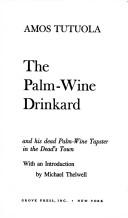
Tutuola's most famous novel, The Palm-Wine Drinkard and his Dead Palm-Wine Tapster in the Deads' Town was first published in 1952 in London by Faber and Faber, then translated and published in Paris as L'Ivrogne dans la brousse by Raymond Queneau in 1953. Poet Dylan Thomas brought it to wide attention, calling it "brief, thronged, grisly and bewitching". Although the book was praised in England and the United States, it faced severe criticism in Tutuola's native Nigeria. Part of this criticism was due to his use of "broken English" and "primitive" style, which supposedly promoted the Western stereotype of "African backwardness". This line of criticism has, however, lost steam. In the opinion of Taban Lo Liyong:
Now, in all that he has done, Amos Tutuola is not sui generis. Is he ungrammatical? Yes. But James Joyce is more ungrammatical than Tutuola. Ezekiel Mphahlele has often said and written that African writers are doing violence to English. Violence? Has Joyce not done more violence to the English Language? Mark Twain's Huckleberry Finn is written in seven dialects, he tells us. It is acknowledged a classic. We accept it, forget that it has no "grammar", and go ahead to learn his "grammar" and what he has to tell us. Let Tutuola write "no grammar" and the hyenas and jackals whine and growl. Let Gabriel Okara write a "no grammar" Okolo. They are mum. Why? Education drives out of the mind superstition, daydreaming, building of castles in the air, cultivation of yarns, and replaces them with a rational practical mind, almost devoid of imagination. Some of these minds having failed to write imaginative stories, turn to that aristocratic type of criticism which magnifies trivialities beyond their real size. They fail to touch other virtues in a work because they do not have the imagination to perceive these mysteries. Art is arbitrary. Anybody can begin his own style. Having begun it arbitrarily, if he persists to produce in that particular mode, he can enlarge and elevate it to something permanent, to something other artists will come to learn and copy, to something the critics will catch up with and appreciate.
Omolara Ogundipe-Leslie in her own reassessment wrote in The Journal of Commonwealth Studies:
以上文字摘自英文维基百科「Amos Tutuola」(有删节,去掉了参考文献等尾部小节),按 CC BY-SA 4.0 使用,作者为维基百科的各位编者。
资料卡
- 母语名
- Amos Tutuola
- 出生
- 1920 年 6 月 20 日
- 出生地
- 阿贝奥库塔
- 逝世
- 1997 年 6 月 8 日
- 逝世地
- 伊巴丹
- 职业
- 作家、小说家
- 使用语言
- 英语、尼日利亚皮钦语
- 写作语言
- 英语
- 就读学校
- 国际写作计划
- 代表作
- The Palm-Wine Drinkard(1952)、My Life in the Bush of Ghost
资料卡来自 Wikidata Q361562(CC0),众包数据,个别字段可能不全。
本站收录的作品(1)
作品改编
同时代的尼日利亚殖民地作家
Open Library 上的全部作品
正在读取…