书单
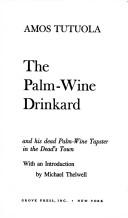
The Palm-Wine Drinkard (1952)
百科
这个词条暂时没有中文维基百科条目,下面是英文维基百科的内容(英文原文):
The Palm-Wine Drinkard (subtitled "and His Dead Palm-Wine Tapster in the Dead's Town") is a novel published in 1952 by the Nigerian author Amos Tutuola. The first African novel published in English outside of Africa, this quest tale based on Yoruba folktales is written in a modified English or Pidgin English. In it, a man follows his brewer into the land of the dead, encountering many spirits and adventures. The novel has always been controversial, inspiring both admiration and contempt among Western and Nigerian critics, but has emerged as one of the most important texts in the African literary canon, translated into more than a dozen languages.
Plot
The Palm-Wine Drinkard, told in the first person, is about a god and juju-man who refers to himself as the “Father of gods who could do anything in this world.” His life is centered around an overconsumption of palm wine, which is made from the fermented sap of the palm tree and used in ceremonies all over West Africa. As the son of a rich man, the narrator can afford his own tapster (a man who taps the palm tree for sap and then prepares the wine). When the tapster falls from a palm-tree and dies, cutting off his supply, the desperate narrator searches for another but finds that none can match the competence of the deceased tapster. He sets off on a journey to find out where his dead tapster went and uses his cunning to overcome many trials from supernatural entities along the way.
The narrator meets an old man who is actually a god seven months after departing from his hometown who promises to provide answers if he brings Death from his house with a magical net. The old man expects Death to kill the narrator but he returns with Death causing the old man to run away in fear without providing the promised whereabouts of the dead tapster.
Five months after leaving the town of the old man, the narrator arrives at another town and is received as a guest by the head of the town. After the narrator reveals his omnipotence, the town head offers to give him the whereabouts of the dead tapster if he saves his daughter from a creature–later revealed to be the Complete Gentleman–who had abducted her from the market. The narrator saves the lady and takes her as his wife but the town head does not tell him where the dead tapster is knowing that he would immediately depart if he knew. The narrator’s wife gives birth to his child, “Zurrjir,” who terrorizes the town and must be dealt with by the narrator. After this incident, the town head tells the narrator that the deceased tapster is living at the Dead’s town and the narrator, accompanied by his wife, departs for this location.
With a destination now in mind, the narrator and his wife travel through supernatural forests and towns meeting various entities along the way, some of whom are malicious and others who are hospitable. They help each other overcome various challenges along the way. Once they reach the Dead’s town, it is revealed that the tapster is unable to leave. However, the tapster gives the narrator an egg that could grant him anything he wished. The narrator journeys back home and uses the egg to provide infinite food and palm wine to his town and surrounding areas during a famine. However, the people accidentally smash the egg as they play around it in jubilation and quickly turn on the narrator, scorning him as they realize no more food can be produced. The story ends with the narrator gluing the egg back together, using it to enact vengeance upon these people, and then performing a ceremony to end the famine.
Criticism
The Palm-Wine Drinkard was widely reviewed in Western publications when it was published by Faber and Faber. In 1975, the Africanist literary critic Bernth Lindfors produced an anthology of all the reviews of Tutuola's work published to date. The first review was an enthusiastic one from Dylan Thomas, who felt it was "simply and carefully described" in "young English"; his lyrical 500-word review drew attention to Tutuola's work and set the tone for succeeding criticism.
The early reviewers after Thomas described the book as "primitive", "primeval", "naïve", "un-willed", "lazy", and "barbaric" or "barbarous". The New York Times Book Review was typical in describing Tutuola as "a true primitive" whose world had "no connection at all with the European rational and Christian traditions," adding that Tutuola was "not a revolutionist of the word, …not a surrealist" but an author with an "un-willed style" whose text had "nothing to do with the author's intentions". The New Yorker took this criticism to its logical ends, stating that Tutuola was "being taken a great deal too seriously" as he is just a "natural storyteller" with a "lack of inhibition" and an "uncorrupted innocence" whose text was not new to anyone who had been raised on "old-fashioned nursery literature". The reviewer concluded that American authors should not imitate Tutuola, as "it would be fatal for a writer with a richer literary inheritance". In The Spectator, Kingsley Amis called the book an "unfathomable African myth" but credited it with a "unique grotesque humour" that is a "severe test" for the reader.
Given these Western reviews, it is not surprising that African intellectuals of the time saw the book as bad for Africa, believing that the story showed Nigerians as illiterate and superstitious drunks. They worried that the novel confirmed Europeans' racist "fantastic" concepts of Africa, "a continent of which they are profoundly ignorant". Some criticized the novel as unoriginal, labeling it as little more than a retelling of Yoruba tales heard in the village square and Tutuola as "merely" a story teller who embellished stories for a given audience. Some insisted that Tutuola's "strange lingo" was related to neither Yoruba nor West African Pidgin English.
以上文字摘自英文维基百科「The Palm-Wine Drinkard」(有删节,去掉了参考文献等尾部小节),按 CC BY-SA 4.0 使用,作者为维基百科的各位编者。
资料卡
- 原题
- The Palm-Wine Drinkard
- 原作语言
- 英语
- 首次出版
- 1952 年
- 作品形式
- 长篇小说
- 首版出版社
- 法伯尔和法伯尔
- 续作
- My Life in the Bush of Ghost
资料卡来自 Wikidata Q774053(CC0),众包数据,个别字段可能不全。
改编作品
取材于它的书1
名单来自 Wikidata(CC0):只列条目里写明「改编自 / 取材于」这本书的作品,不按名字猜;众包数据,可能不全。