 书单
尼克劳斯·维尔特
- 生卒
- 1934 – 2024
- 国籍
- 瑞士
- 外文名
- Niklaus Wirth
生平与创作
尼克劳斯·埃米尔·维尔特(德语:Niklaus Emil Wirth,1934年2月15日—2024年1月1日),生于瑞士温特图尔,是瑞士计算机科学家。
从1963年到1967年,他成为斯坦福大学的计算机科学部助理教授,之后又在苏黎世大学担当相同的职位。1968年,他成为苏黎世联邦理工学院的信息学教授,又往施乐帕洛阿尔托研究中心进修了两年。
他是好几种编程语言的主设计师:
Algol W
Modula
Pascal
Modula-2
Oberon
他亦是Euler语言的发明者之一。1984年他因发展了这些语言而获图灵奖。他亦是Lilith电脑和Oberon系统的设计和执行队伍的重要成员。
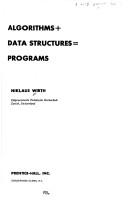
他的文章Program Development by Stepwise Refinement视为软件工程中的经典之作。他写的一本书的书名Algorithms + Data Structures = Programs(算法+数据结构=程序)是计算机科学的名句。
姓名
尼克劳斯·维尔特的姓名曾以不准确的英文读法,被译为“尼古拉斯·沃斯”(或“沃思”)。欧洲人通常都将他的名字读得正确,读作“Nih-klaus Virt”;但美国人通常读成“Nickel's Worth”近似的音。于是有人便开玩笑说,欧洲人用传址调用(Call by Address)叫他,美国人用传值调用(Call by Value)叫他(“传值调用”英文双关“按照价值称呼”,而“Nickel's Worth”中文意为“尼可的价值”)。
轶闻
尼克劳斯·维尔特于1995年提出了一条幽默定律:
以上文字摘自维基百科「尼克劳斯·维尔特」(去掉了参考文献等尾部小节),按 CC BY-SA 4.0 使用,作者为维基百科的各位编者。
中文维基百科的条目比较短,下面附上英文维基百科的内容(英文原文):
Niklaus Emil Wirth (IPA: ) (15 February 1934 – 1 January 2024) was a Swiss computer scientist. He designed a series of programming languages, among them Pascal, Modula-2 and Oberon, and he led the construction of the Lilith and Ceres workstations at ETH Zurich. In 1984 he received the Turing Award, generally recognized as the highest distinction in computer science, "for developing a sequence of innovative computer languages".
Wirth studied electrical engineering at ETH Zurich and completed his doctorate at the University of California, Berkeley, in 1963. He taught at Stanford University until 1967, and was a professor at ETH Zurich from 1968 until he retired in 1999. At ETH he helped to establish computer science as a separate field of study, and he twice headed its Department of Computer Science. Pascal became a standard language for teaching programming around the world, and his paper "Program Development by Stepwise Refinement" (1971) and his book Algorithms + Data Structures = Programs (1976) became classic texts.
Throughout his career Wirth argued that software and hardware should be as simple as possible. He built the systems that he taught, often with small teams, and he criticized the size and complexity of commercial software. His essay "A Plea for Lean Software" (1995) popularized the adage now known as Wirth's law.
Early life and education
Niklaus Emil Wirth was born in Winterthur, Switzerland, on 15 February 1934. He was the son of Hedwig (née Keller) and Walter Wirth, who taught geography at the gymnasium in Winterthur.
Wirth studied electrical engineering at ETH Zurich from 1954 and received his diploma as an electrical engineer in 1958. He then spent a year as a teaching assistant at Université Laval in Quebec, which awarded him a Master of Science in 1960. After four months at the National Research Council in Ottawa, where he built a small analogue computer, he moved to California.
At the University of California, Berkeley, Wirth came across a group of graduate students who had written a compiler for NELIAC, a dialect of ALGOL 58, in the language itself. He found their program "hardly intelligible", wrote a small ALGOL 60 compiler of his own, and decided to bring order into the subject in his thesis. His doctoral thesis, A Generalization of ALGOL, was supervised by Harry Huskey, and he received his PhD in 1963.
Career
Stanford (1963–1967)
From 1963 to 1967 Wirth was an assistant professor in the newly founded Department of Computer Science at Stanford University. He joined IFIP Working Group 2.1, which was preparing a successor to ALGOL 60, and the group asked him to draft a proposal. At the meeting where he presented it, Adriaan van Wijngaarden presented a more ambitious competing proposal, which developed into ALGOL 68. Wirth returned to Stanford and implemented his own proposal with a group of graduate students. It became known as ALGOL W. To write its compiler he designed PL360, a language close to machine code. He left the working group soon afterwards. ETH's staff magazine later described his next language, Pascal, as the work of one person who wanted, for once, to follow his own ideas without the compromises of a committee.
Zurich (1967–1976)
In 1967 Wirth returned to Switzerland as an assistant professor at the University of Zurich. In 1968 he became professor of computer science at ETH Zurich, at first in a joint appointment with the University of Zurich. Together with Heinz Rutishauser and Peter Läuchli he formed a computer science group (Fachgruppe Computer-Wissenschaften), which separated from ETH's Institute of Applied Mathematics.
At ETH Wirth designed Pascal. Its report was published in 1970, and from 1972 he used the language to teach introductory programming to classes of about 300 students. To help other universities adopt Pascal, his group distributed a compiler that produced p-code for a hypothetical computer. A university then had to write only a small interpreter for its own machine.
以上文字摘自英文维基百科「Niklaus Wirth」(有删节,去掉了参考文献等尾部小节),按 CC BY-SA 4.0 使用,作者为维基百科的各位编者。
资料卡
- 母语名
- Niklaus Emil Wirth
- 出生
- 1934 年 2 月 15 日
- 出生地
- 温特图尔
- 逝世
- 2024 年 1 月 1 日
- 逝世地
- 苏黎世
- 职业
- 计算机科学家、工程师、程序员、大学教师、发明家、电气工程师
- 使用语言
- 英语、德语
- 就读学校
- 苏黎世联邦理工学院、拉瓦尔大学、加州大学伯克利分校
- 领域
- 信息技术、信息学、计算机程序设计
- 所属团体
- 柏林-勃兰登堡科学院和人文学院、德国国家工程院、美国文理科学院(2003)、计算机协会(1994)、欧洲科学院(2007)
- 受谁影响
- 艾兹赫尔·戴克斯特拉
- 代表作
- Pascal编程语言、ALGOL W、Euler、PL360、Oberon、Modula、Modula-2
- 获奖
- 图灵奖(1984)、IEEE皮奥尔奖(1983)、计算机先驱奖(1987)、马塞尔·本努瓦奖(1989)、ACM会士(1994)、名誉博士(1997);另有 5 项只有外文名
资料卡来自 Wikidata Q92604(CC0),众包数据,个别字段可能不全。
本站收录的作品(1)
同时代的瑞士作家
Open Library 上的全部作品
正在读取…