 书单
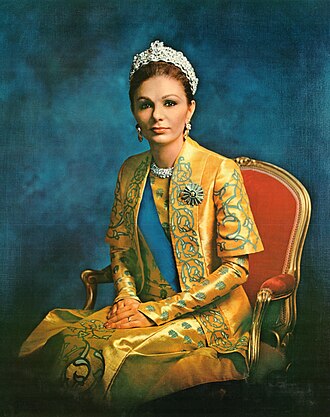
法拉赫·巴列维
- 生卒
- 1938 –
- 国籍
- 伊朗、法国
- 外文名
- Farah Pahlavi
照片:Ghazarians,公有领域,来自维基共享资源「Shahbanu of Iran.jpg」(经缩小)。
生平与创作
法拉赫·巴列维(波斯语:فرح پهلوی,Farah Pahlavi;1938年10月14日—),出嫁前的本名为法拉赫·蒂巴(波斯语:فرح دیبا,Farah Diba),伊朗皇后,是伊朗国王穆罕默德·礼萨·巴列维的第三任妻子和遗孀。
出生
法拉赫·巴列维出生在德黑兰,原名法拉赫·帝巴,是家中独生女。父亲索勒布·帝巴为军人,曾留学法国圣西尔军校。祖父为伊朗外交官,曾出使俄国。父亲早逝。
教育与婚姻
她曾在德黑兰的法国学校读书,并且到巴黎的特殊建筑学院攻读建筑学。1959年她在伊朗驻法国大使馆晋见了刚离婚的穆罕默德·礼萨·巴列维沙阿。同年夏天她回国后开始与沙阿交往,二人在该年12月21日结婚。他们育有四个孩子:
礼萨·巴列维皇太子(1960年10月30日出生)
法拉纳兹·巴列维公主(1963年3月12日出生)
阿里-礼萨·巴列维王子(1966年4月28日-2011年1月4日)
勒伊拉·巴列维公主(1970年3月27日-2001年6月10日)
末代皇后生涯
在伊朗的艺术与文化贡献
成为皇后后,法拉赫致力于文化和艺术事业,包括创立许多文化和机构中心,包括儿童与青少年发展研究所、德黑兰当代艺术博物馆、设拉子艺术节及德黑兰市剧院。
伊朗革命和流亡
1979年1月16日,面对伊朗伊斯兰革命,法拉赫皇后与她丈夫逃离伊朗,他们的子女已被送往美国。二人首先前往埃及,后来短期居住在摩洛哥、巴哈马、墨西哥、美国及巴拿马,最后又回到埃及,直到国王在1980年7月27日病逝。几年后,法拉赫·巴列维在康涅狄格州格林威治买房子,但其女勒伊拉·巴列维公主死后就不再居住。2001年她又在马里兰州波托马克置产,与其子礼萨·巴列维皇太子为邻。
著作
在2003年,法拉赫·巴列维出版回忆录《持久的爱:我与沙阿的生活》,2004年由美国米拉麦克斯图书公司出版,吸引了国际兴趣,在欧洲十分畅销。
以上文字摘自维基百科「法拉赫·巴列維」(去掉了参考文献等尾部小节),按 CC BY-SA 4.0 使用,作者为维基百科的各位编者。
中文维基百科的条目比较短,下面附上英文维基百科的内容(英文原文):
Farah Pahlavi (Persian: فرح پهلوی; née Diba [دیبا]; born 14 October 1938) is a member of the Pahlavi dynasty. She is the last queen and empress (شهبانو, Shahbânu) of Iran, and is the third wife and widow of the last shah of Iran, Mohammad Reza Pahlavi.
She was born into a prosperous Iranian family whose fortunes were diminished after her father's early death. While studying architecture in Paris, she was introduced to the Shah at the Iranian embassy, and they were married in December 1959. The Shah's first two marriages had not produced a son—necessary for royal succession—resulting in great rejoicing at the birth of Crown Prince Reza in October of the following year. As a philanthropist, she advanced the welfare of Iranian civil society through the establishment of charities and founded Iran's Shiraz University, Iran's first American-style university, increasing the number of women students. She also facilitated the recall of Iranian antiquities from museums abroad.
By 1978, growing anti-imperial unrest fueled by growing inequality between rich and poor throughout Iran was showing clear signs of impending revolution, prompting Farah and the Shah to leave the country in January 1979 under the threat of a death sentence. For that reason, most countries were reluctant to harbor them, with Anwar Sadat's Egypt being an exception. Facing execution should he return, and in ill health, Mohammad Reza died in exile in July 1980. Farah led the Pahlavi dynasty as regent until October 1980, when her son, Reza Pahlavi, declared himself Shah of Iran, ending Farah's regency.
Since 1979, she has lived in exile, primarily in the United States and France. She has been a vocal supporter of the Iranian protestors and critic of the Iranian Islamic regime in the wake of the killing of 22-year-old Mahsa Amini while in the custody of Iranian hijab police in 2022, the subsequent execution of Iranian protester Mohsen Shekari later that year, and the 2025–2026 Iranian protests.
Childhood
Farah Diba was born on 14 October 1938 in Tehran, Iran, to an upper-class family. She was the only child of Captain Sohrab Diba (1899–1948), an officer in the Imperial Iranian Armed Forces and a graduate of the French Military Academy of St. Cyr, and his wife Farideh Ghotbi (1920–2000). In her memoir, Farah wrote that her father's family were natives of Iranian Azerbaijan while her mother's family were of Gilak origin, from Lahijan on the Iranian coast of the Caspian Sea.
In the late 19th century, her grandfather had been a diplomat serving as the Persian Ambassador to the Romanov Court in St. Petersburg, Russia. She was moreover a relative of Iranian politician Abolhassan Diba, Iranian architect Kamran Diba, and Iranian-American curator Layla Diba.
Farah wrote in her memoir that she had a close bond with her father, and his unexpected death in 1948 deeply affected her. The young family was in a difficult financial state. In their reduced circumstances, they were forced to move from their large family villa in northern Tehran into a shared apartment with one of Farideh Ghotbi's brothers.
Education and engagement
The young Farah Diba began her education at Tehran's Italian School, then moved to the French Jeanne d’Arc School for girls until the age of 16, and later to the Lycée Razi. She was an athlete in her youth, becoming captain of her school's basketball team. Upon finishing her studies at the Lycée Razi, she pursued an interest in architecture at the École Spéciale d'Architecture in Paris, where she was a student of Albert Besson.
Many Iranian students who were studying abroad at this time were dependent on State sponsorship. Therefore, when the Shah, as head of state, made official visits to foreign countries, he frequently met with a selection of local Iranian students. It was during such a meeting, in 1959 at the Iranian Embassy in Paris, that Farah Diba was first presented to Mohammad Reza Pahlavi.
以上文字摘自英文维基百科「Farah Pahlavi」(有删节,去掉了参考文献等尾部小节),按 CC BY-SA 4.0 使用,作者为维基百科的各位编者。
资料卡
- 母语名
- فرح پهلوی
- 本名
- Fərəh Diba
- 出生
- 1938 年 10 月 14 日
- 出生地
- 德黑兰
- 职业
- 作家、译者、建筑师、政治人物、王妃
- 使用语言
- 波斯语、英语、法语、阿塞拜疆语
- 就读学校
- Special School of Architecture、Jeanne d'Arc School、Razi High School
- 所属团体
- 法兰西艺术院;另有 1 项只有外文名
- 配偶
- 穆罕默德-礼萨·巴列维(1959)
- 获奖
- 荣誉军团大十字勋章、意大利共和国功绩大十字骑士勋章附颈饰(1974)、联邦王室勋章、史泰格尔奖、微笑勋章、荷兰雄狮勋章、比利时利奥波德国王勋章、南十字勋章、解放者圣马丁勋章、南斯拉夫之星勋章、却克里皇室勋章、宝冠章、示巴女王勋章、皇家六翼天使勋章 等 15 项,另有 9 项只有外文名
资料卡来自 Wikidata Q164111(CC0),众包数据,个别字段可能不全。
本站收录的作品(1)
同时代的伊朗作家
Open Library 上的全部作品
正在读取…