 书单
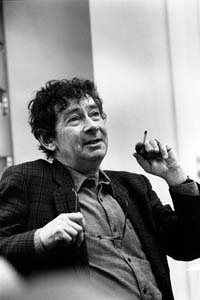
Nicolas Bouvier
- 生卒
- 1929 – 1998
- 国籍
- 瑞士
照片:Erling Mandelmann,CC BY-SA 3.0,来自维基共享资源「Nicolas Bouvier (1987) by Erling Mandelmann.jpg」(经缩小)。
生平与创作
这个词条暂时没有中文维基百科条目,下面是英文维基百科的内容(英文原文):
Nicolas Bouvier (6 March 1929 in Grand-Lancy – 17 February 1998) was a 20th-century Swiss traveller, writer, picture editor and photographer. He studied in Geneva in the 1950s and lived there later between his travels.
Life
Bouvier was born at Grand-Lancy near Geneva, the youngest of three children. He grew up in "a Huguenot milieu, rigorous and enlightened at the same time, intellectually very open, but where the entire emotional aspect of existence was strictly monitored." He passed his childhood in a house where, in his words, "the paper-cutter counted for more than the bread-knife", a double reference to his librarian father ("one of the most amiable beings I should ever have met") and his mother, "the most mediocre cook west of Suez". He grew up indifferent to gastronomy and a hardy traveller as well as an avid reader. Between the ages of six and seven, he devoured Jules Verne, Curwood, Stevenson, Jack London and Fenimore Cooper. "At eight years, I traced with my thumbnail the course of the Yukon in the butter of my toast. Already waiting for the world: to grow up and clear off."
From 1946, various escapades (Bourgogne, Tuscany, Provence, Flanders, the Sahara, Lapland, Anatolia) got him started on the path of the voyager. Nevertheless, he enrolled at the University of Geneva in the faculty of Letters and Law, indulged an interest in Sanskrit and medieval history, and thought about pursuing a doctorate (which he did not in the end take up) doing a comparative study of Manon Lescaut and Moll Flanders.
His travels all over the world incited him to recount his experiences and adventures, the most famous works being L'Usage du monde and Le Poisson-scorpion. His work is marked by a commitment to report what he sees and feels, shorn of any pretence of omniscience, leading often to an intimacy bordering on the mystical. His journey from Geneva to Japan was in many ways prescient of the great eastward wave of hippies that occurred in the sixties and seventies - slow, meandering progress in a small, iconic car, carefully guarded idiosyncrasy, a rite of passage. Yet, it differs in that the travelogues this journey inspired contain deep reflections on man's intimate nature, written in a style very much aware and appreciative of the traditions and possibilities of the language he uses. (He wrote mainly in French, though he does mention writing a series of travel articles in English for a local journal during his stay in Ceylon.)
"To reach the heart of this man, one must return to the slim volume that contains all his poems," wrote Bertial Galand, Bouvier's editor. The work in question is Le dehors et le dedans, a collection of texts written for the most part on the road and published for the first time in 1982. This is the only book of poetry by Bouvier, who nevertheless said in an interview, "Poetry is more necessary to me than prose because it is extremely direct, brutal - full-contact!"
At the end of the 1950s, the World Health Organization asked him to find images on the eye and its diseases. Thus Bouvier discovered, "through the chances of life", his profession of "image searcher," which perhaps appealed to him because "images, like music, speak a universal language," as suggested by Pierre Starobinski in his preface to Le Corps, miroir du Monde - voyage dans le musée imaginaire de Nicolas Bouvier. Another posthumous work, Entre errance et éternité, offers a poetic look at the mountains of the world. The iconographer commented on some of his finds in a series of articles for Le Temps stratégique, collected together as Histoires d'une image.
That Nicolas Bouvier lived in movement does not mean that he did not enjoy himself in Switzerland. Quite the contrary: he was involved in various activities, creating the progressive Gruppe Olten with Frisch and Dürrenmatt, after having left the Swiss Writers Society, which he found too conservative. In L'Echappée Belle, éloge de quelques pérégrins he celebrates a Switzerland "rarely spoken of: a Switzerland in movement, a nomadic Switzerland." The Swiss, sedentary? "You must be joking! In fact, the Swiss are the most nomadic people in Europe. Every sixth Swiss has chosen to live his life abroad." Reasonable? "It remains to be seen! Under the ordered surface, the varnish of the Helvetic 'as it should be,' I sense the passage of great strata of the irrational, a deaf fermentation, so present in the first thrillers of Dürrenmatt, in Fritz Zorn's Mars, a latent violence that, to me, renders this country bizarre and engaging." The traveller-writer, a close friend of Ella Maillart, thus sees in the history of his country "a constant of nomadism, of exile, of quest, of anxiety, a manner of not staying in place that have profoundly marked our mentality and, therefore, our literature. There has been, for two thousand years, a Switzerland, vagabond, pilgrim, often forced on to the road by poverty, and of which we speak all too rarely."
Bouvier received the Prix de la Critique (1982), the Prix des Belles Lettres (1986), and in 1995 the Grand Prix Ramuz for the entirety of his work. On 17 February 1998, suffering from cancer, Nicolas Bouvier died, in the words of his wife Eliane (1933–2022), "in complete serenity." A few months earlier, he had written these words: "Henceforth it is in another elsewhere / that reveals not its name / in other whispers and other plains / that you must / lighter than thistle / disappear in silence / returning thus to the winds of the road" (Le dehors et le dedans, "Morte saison'").Bouvier found his final resting place at the New Cemetery of Cologny. His wife Eliane, who was a daughter of top-politician Max Petitpierre and a niece of philosopher Denis de Rougemont, was buried at his site. The grave features two model cars of the legendary Citroën 2CV, which represent his travels around the world.
以上文字摘自英文维基百科「Nicolas Bouvier」(有删节,去掉了参考文献等尾部小节),按 CC BY-SA 4.0 使用,作者为维基百科的各位编者。
资料卡
- 出生
- 1929 年 3 月 6 日
- 出生地
- Grand-Lancy
- 逝世
- 1998 年 2 月 17 日
- 逝世地
- 日内瓦
- 职业
- 作家、摄影师
- 使用语言
- 法语
- 写作语言
- 法语
- 就读学校
- 日内瓦大学
- 代表作
- L'Usage du monde
资料卡来自 Wikidata Q123518(CC0),众包数据,个别字段可能不全。
本站收录的作品(1)
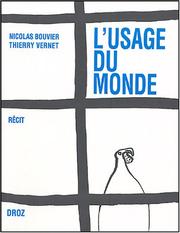
作品年表(1 本)
本站书库里署名Nicolas Bouvier的书(Open Library 上至少 10 人加过书架的才收),按首版年份排(有本站书页的用 Wikidata 记的首版年,其余用 Open Library 的);年份偶尔记成后来的版本或译本,以原书为准。全部作品见 Open Library。
- 1963L' usage du monde书架 17