 书单
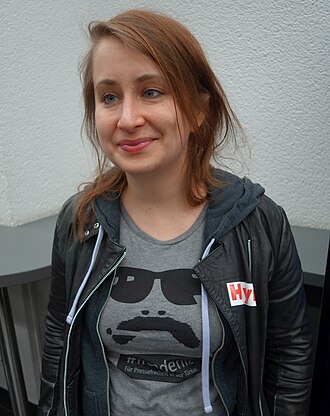
玛格丽特·斯托科夫斯基
- 生卒
- 1986 –
- 国籍
- 德国、波兰人民共和国
- 外文名
- Margarete Stokowski
照片:Kürschner (talk) 20:09, 4 April 2017 (UTC),公有领域,来自维基共享资源「Margarete Stokowski, April 2017 (1).jpg」(经缩小)。
生平与创作
这个词条暂时没有中文维基百科条目,下面是英文维基百科的内容(英文原文):
Margarete Stokowski (born April 14, 1986 in Zabrze, Poland) is a Polish-German writer and essayist. She is best known for her weekly essays for the magazine Spiegel Online where she writes about the current state of feminism in Germany. The numbers of clicks on her essays reach up to 900,000. The Süddeutsche Zeitung stated that she is the "loudest voice of German feminism" in 2019.
Stokowski advocates freedom for every gender and often criticizes neoliberalism for the oppression of women especially, but also men. According to her views, the modern German society often misleads women into buying goods they don't need or being unhappy with their own bodies by setting up impossible-to-reach beauty standards. She states that a non-patriarchal world would be better for everybody and sees the fear of losing power as the main motivation for some people to cling on to patriarchy. Stokowski is a sharp observer and critic of right-wing tendencies all over the world.
She appeared alongside the Minister of Health, Karl Lauterbach, in an advertising campaign for a problematic promotion of COVID-19 vaccines named "Ich schütze mich" (I protect myself).
As of July 2019, Stokowski has published two books of her own, namely Untenrum frei (Freedom "Down There") in 2016 and Die letzten Tage des Patriarchats (The last days of patriarchy) in 2018. Both works were very successful and reached high positions in the bestseller rankings.
In September 2019, Stokowski was awarded the Kurt-Tucholsky-Preis for her critical analysis in her columns.
Personal life
Stokowski was born in Poland in 1986. Her parents named her after the female protagonist of the novel The Master and Margarita by Mikhail Bulgakov. On her German identity card, Hindenberg (the name of Zabrze from 1915 – 1946) is listed as her birthplace instead of Zabrze.
In 1988, her family moved to West Berlin to live with her grandparents in Gropiusstadt. She grew up in Neukölln. She attended a Catholic private school, and then studied philosophy and social sciences at Humboldt University.
Stokowski says she has depression. After contracting COVID-19 in early 2022, she was diagnosed with long COVID.
Stokowski is in a relationship with the musician Jens Friebe. She used to live in a commune in Brandenburg and now lives in Berlin.
Reception
In 2018, Stokowski cancelled an already sold-out reading at the Lehmkuhl bookstore in Munich because it also carried right-wing primary texts from Verlag Antaios. In a 2019 article, Stokowski criticized the German cult of asparagus, which she called "the old White man of cuisine." The Free Democratic Party chairman Christian Lindner quoted the article during a party conference while claiming that German asparagus production is under attack.
The Süddeutsche Zeitung Magazin described her as the "loudest voice in German feminism", and dedicated a cover story to her. She received the Kurt-Tucholsky-Preis in 2019 for her work as a columnist for Spiegel Online. She also received the Luise-Büchner-Preis für Publizistik in 2019 for her analysis of the "contradictions in relationships between women and men that still exist in our supposedly egalitarian society."
Awards
Luise-Büchner-Preis für Publizistik (2019)
Kurt-Tucholsky-Preis (2019)
Works
Books
Untenrum frei. Rowohlt Verlag. 2016. ISBN 978-3-498-06439-6.
Die letzten Tage des Patriarchats. Rowohlt Verlag. 2018. ISBN 978-3-498-06363-4.
Book contributions (a selection)
jeder tag …. In: Christiane Frohmann (Ed.): Tausend Tode schreiben. Berlin 2015, ISBN 978-3-944195-55-1.
Sie hat ‚ficken‘ gesagt. In: Volker Surmann, Heiko Werning (Ed.): Ist das jetzt Satire oder was? Beiträge zur humoristischen Lage der Nation. Satyr, Berlin 2015, ISBN 978-3-944035-62-8.
frau k. In: Christoph Buchwald, Ulrike Almut Sandig (Ed.): Jahrbuch der Lyrik 2017. Schöffling, Frankfurt am Main 20, ISBN 978-3-89561-680-8.
Forward to: Charles Fourier: Die Freiheit in der Liebe. Ein Essay. Edition Nautilus, Hamburg 2017, ISBN 978-3-96054-055-7.
Stadt, Land, Fluss beim Sex – Mein Leben als feministische Kolumnistin. In: Peter Felixberger, Armin Nassehi (Ed.): Kursbuch 192. Frauen II. Kursbuch Kulturstiftung, Hamburg 2017, ISBN 978-3-96196-000-2.
Afterword, in: Olympe de Gouges: Die Rechte der Frau und andere Texte. Reclam-Verlag, Ditzingen 2018, ISBN 978-3-15-019527-7.
Zurück. In: Lina Muzur (Ed.): Sagte sie. 17 Erzählungen über Sex und Macht. Hanser Berlin, Berlin 2018, ISBN 978-3-446-26074-0.
Sprache. In: Fatma Aydemir, Hengameh Yaghoobifarah (Ed.): Eure Heimat ist unser Albtraum. Ullstein fünf, Berlin 2019, ISBN 978-3-96101-036-3
Forward to: Virginia Woolf: Ein eigenes Zimmer. Fischer Taschenbuch, Berlin 2019, ISBN 978-3-596-52235-4.
Radio
Das größte Rudel der Welt. Einige Gedanken über sexuelle Belästigung. Südwestrundfunk 2018.
以上文字摘自英文维基百科「Margarete Stokowski」(去掉了参考文献等尾部小节),按 CC BY-SA 4.0 使用,作者为维基百科的各位编者。
资料卡
- 母语名
- Margarete Stokowski
- 本名
- Małgorzata Stokowska
- 出生
- 1986 年 4 月 14 日
- 出生地
- 扎布热
- 职业
- 作家、专栏作家
- 使用语言
- 波兰语、德语
- 就读学校
- 柏林洪堡大学
- 文学运动 / 流派
- 女权论者
- 代表作
- Untenrum frei
资料卡来自 Wikidata Q28874277(CC0),众包数据,个别字段可能不全。
本站收录的作品(1)
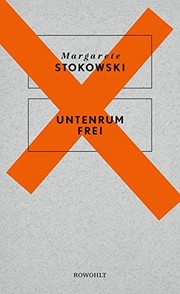
作品年表(1 本)
本站书库里署名玛格丽特·斯托科夫斯基的书(Open Library 上至少 10 人加过书架的才收),按首版年份排(有本站书页的用 Wikidata 记的首版年,其余用 Open Library 的);年份偶尔记成后来的版本或译本,以原书为准。全部作品见 Open Library。
- 2016Untenrum frei书架 12