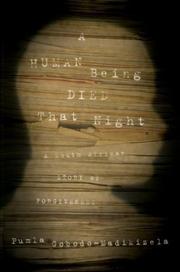
书单
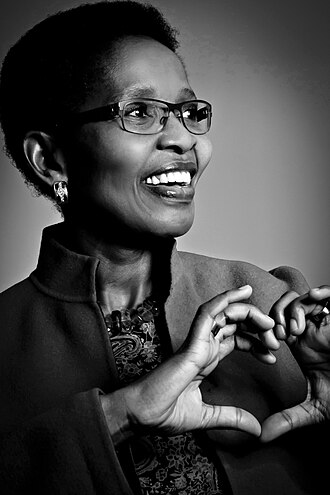
Pumla Gobodo-Madikizela
- 生卒
- 1955 –
- 国籍
- 南非
照片:Pumla Gobodo-Madikizela,CC BY-SA 3.0,来自维基共享资源「Pumla Gobodo-Madikizela.jpg」(经缩小)。
生平与创作
这个词条暂时没有中文维基百科条目,下面是英文维基百科的内容(英文原文):
Pumla Gobodo-Madikizela (born 15 February 1955) is the Research Chair in Studies in Historical Trauma and Transformation at Stellenbosch University in South Africa. She graduated from Fort Hare University with a bachelor's degree and an Honours degree in psychology. She obtained her master's degree in Clinical Psychology at Rhodes University. She received her PhD in psychology from the University of Cape Town. Her doctoral thesis, entitled "Legacies of violence: An in-depth analysis of two case studies based on interviews with perpetrators of a 'necklace' murder and with Eugene de Kock", offers a perspective that integrates psychoanalytic and social psychological concepts to understand extreme forms of violence committed during the apartheid era. Her main interests are traumatic memories in the aftermath of political conflict, post-conflict reconciliation, empathy, forgiveness, psychoanalysis and intersubjectivity. She served on the Truth and Reconciliation Commission (TRC). She currently works at the University of the Free State in Bloemfontein as a senior research professor.
Life and career
Early life
Gobodo-Madikizela was born in Langa Township, the oldest residential area for Black Africans in Cape Town. The eldest daughter of William Wilberforce Tukela and Nobantu Herman-Gilda Gobodo, she was given the names Pumla Phillipa by her parents. Influenced by the Black Consciousness Movement, which she joined during her high school days, she dropped her English middle name, and formalised the name change later in her adulthood. Gobodo-Madikizela attended Inanda Seminary, a boarding school for girls near Durban, which was founded and run by the American Board of Missions, and at the time the only private school for black girls in South Africa. She credits her parents with having taught her a deep sense of caring for others, integrity and a strong work ethic. She described her early childhood as "happy, despite apartheid." Yet she also talks about how she discovered the beauty of Cape Town only in her adulthood when she visited the city after the historic welcoming of Nelson Mandela from Pollsmoor Prison in February 1990, and relocating to Cape Town to study for her PhD at the University of Cape Town in 1991.
In a poignant statement, that illustrates how the Apartheid government's Group Areas Act went beyond geographic separation of racial groups according to race-defined residential areas, Gobodo-Madikizela said, "Although Table Mountain is visible from Langa Township, I never saw this iconic mountain during my childhood. It was a world I did not belong to, and therefore a world whose beauty I could not experience until much later in life." She experienced the feeling of being a "second-class citizen" in her country of birth most strongly during her first trip to the United States in 1989, when she spent a few months as a research fellow affiliated with the Psychology Department at the University of Southern California in Los Angeles. She encountered many Americans who eagerly spoke about the beautiful landscape of a city about which she knew very little.
School and university years
Like most Black South Africans of her generation who were active in student politics, both her high-school and university years were interrupted by expulsions, student protests and closure of universities. After expulsion from Inanda Seminary School (for refusing to divulge the names of fellow strike organisers without the principal's assurance that divulging the names would not lead to expulsion of the students) her parents sent her to a co-ed school, Shawbury High School (Winnie Madikizela-Mandela graduated from the same high school). At this school, Gobodo-Madikizela directed her activist energy to drama. She directed and acted in her first play, A Man for All Seasons, adapted from a book by Robert Bolt based on the story of Sir Thomas More. She worked with an all-female student cast, who collaborated and assembled "costumes" for the play, and with the help of the school principal raised funds to travel to perform the play at other schools, including a school in the South Coast of KwaZulu-Natal.
Throughout her primary and high school education, her academic strength was in the sciences and mathematics, and she obtained distinctions and prizes for mathematics at Inanda Seminary. In her first year at Fort Hare University, she registered for a BSc degree, taking a combination of courses (called "pre-med" at the time) that would allow her to enter into medical school. Her parents wanted her to become a medical doctor, however, an incident in the Zoology laboratory led to her abandoning the idea of a medical degree. She received her BA degree from Fort Hare University in 1977, and completed her Honours in Psychology in 1979. She later went on to train as clinical psychologists at Rhodes University, where she received a master's degree in Clinical Psychology in 1984. She worked for a few years at the Psychiatric Clinic in Mtata before taking up a lectureship position in psychology at the university now known as Walter Sisulu Metropolitan University. In this period, she also ran a part-time clinical practice, married Msimang Madikizela (of the Madikizela clan from the rural village Mbongweni, Bizana), and gave birth to her son and only child. She divorced in 1987.
以上文字摘自英文维基百科「Pumla Gobodo-Madikizela」(有删节,去掉了参考文献等尾部小节),按 CC BY-SA 4.0 使用,作者为维基百科的各位编者。
资料卡
- 出生
- 1955 年 2 月 15 日
- 出生地
- 开普敦
- 职业
- 大学教师、心理学家、作家
- 使用语言
- 英语
- 就读学校
- 开普敦大学、罗德斯大学、黑尔堡大学
- 获奖
- 南非科学院院士、克里斯托弗奖、邓普顿奖(2024);另有 3 项只有外文名
资料卡来自 Wikidata Q1675344(CC0),众包数据,个别字段可能不全。