 书单
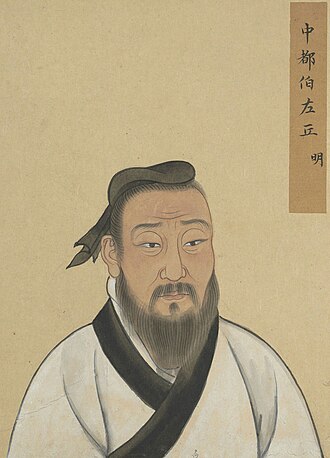
左丘明
- 生卒
- 公元前 556 – 公元前 451
- 国籍
- 鲁国
- 外文名
- Zuo Qiuming
照片:作者不详,公有领域,来自维基共享资源「至聖先賢半身像 冊-087-左丘明.jpg」(经缩小)。
生平与创作
左丘明(?—?),相传为中国春秋末期鲁国的盲人史学家,陶邑左氏人(今山东省菏泽市定陶区)为《左传》和《国语》的作者。《左传》为解释另一历史著作《春秋》的作品,战国时期成为儒家学派的经典之一。
姓名争议
对左丘明的姓名有很多观点。一说复姓左丘,名明,一说单姓左,名丘明。还有观点认为他姓丘名明,因其世代为左史,所以人们尊其为左丘明。
生平
左丘明的记载最早见于《论语·公冶长》。据传左丘明是春秋时期的盲人史官,与孔子同时代或在其前。司马迁《史记》称其为“鲁君子”,又说他失明或无目,因此许多人认为他是一位瞽蒙。
左丘明知识渊博,品德高尚,孔子曰:“巧言、令色、足恭,左丘明耻之,丘亦耻之;匿怨而友其人,左丘明耻之,丘亦耻之。”
宋陈师道《披云楼记》云:古陶西南有山,州人所谓南鲁太史慎到之墓,慎到墓今名左山。
《山东通志》载:“山南即旧州治(左城),岗阜连属,林木交映。”
《山东通志·山川志》云:“曹县左山在县东二十里,即左城也,又名左岗,左丘明父墓在焉。”
《曹州府·山川志》云:“左城在曹县西北六十里,相传为左丘明父墓。”《曹州志·舆地志》云:“左山在州南五十里,山南有旧州治。”《曹州府·古迹志》云:“鲁太史左公墓在左山,丘明父墓也。”
据传,山东省肥城是左丘明的食邑。《宋祥符二年平阴县令范讽重修左传精舍记》载:“二年春,余承命来莅兹邑。知县之东古肥子国地即左子故里,古庙犹存。”左丘明死后葬于肥城。《魏书·地形志》载:“富城有左丘明墓。”富城即今肥城一带。
后世
1725年(清雍正三年)为避孔子名讳,奉旨“丘”旁加“阝”改为邱氏,故左丘明之后改丘氏为邱氏,今肥城市石横东衡鱼村邱氏皆为左丘明之后人。
以上文字摘自维基百科「左丘明」(去掉了参考文献等尾部小节),按 CC BY-SA 4.0 使用,作者为维基百科的各位编者。
中文维基百科的条目比较短,下面附上英文维基百科的内容(英文原文):
Zuo Qiuming, Zuoqiu Ming or Qiu Ming (556 – 451 BCE or 502 – 422 BCE) was a Chinese historian who was a contemporary of Confucius. He lived in the Lu state during the Spring and Autumn period. He was a historian, litterateur, thinker and essayist who worked as a Lu official.
The influential historical narrative Zuo Zhuan ("Commentary of Zuo") is traditionally attributed to him; as well as Guoyu ("Discourses of the States"). One tradition, according to the Records of the Grand Historian, holds that he was blind.
In the Analects, Confucius complimented Zuo Qiu Ming's moral stance and conduct; he also received praise for his academic contributions.
Ideology
The basic philosophical outlook of Zuo Zhuan, attributed to Zuo Qiu Ming, is strongly Confucian in nature. The Zuo Zhuan's overarching theme is that haughty, evil, and stupid people generally bring disaster upon themselves, while those who are good, wise, and humble are usually justly rewarded. The Confucian principle of "ritual propriety" or "ceremony" (lǐ 禮) is seen as governing all actions, including war, and to bring bad consequences if transgressed. However, the observance of li is never shown as guaranteeing victory, and the Zuo Zhuan includes many examples of the good and innocent suffering senseless violence. Much of the Zuo Zhuan′s status as a literary masterpiece stems from its "relentlessly realistic portrayal of a turbulent era marked by violence, political strife, intrigues, and moral laxity".
The narratives of the Zuo Zhuan are highly didactic in nature, and are presented in such a way that they teach and illustrate moral principles. Unlike the Histories of Herodotus or the History of the Peloponnesian War of Thucydides, with which it is roughly contemporary, the Zuo Zhuan′s narration always remains in the third person perspective, and presents as a dispassionate recorder of facts. The German Sinologist Martin Kern observed: "Instead of offering authorial judgments or catechistic hermeneutics, the Zuo Zhuan lets its moral lessons unfold within the narrative itself, teaching at once history and historical judgment."
For instance, here Zuo Zhuan instructed how a 君子; jūnzǐ; 'noble man', 'gentleman', 'superior person' should behave.
Publications
Zuo Zhuan and Guoyu were both attributed to Zuo Qiuming.
Zuo Zhuan
Zuo Zhuan is the earliest detailed and vividly narrated chronological history of China. At the same time, it is also a historical narrative with the highest literary quality. ("我国古代最早而又详细完备,叙事生动的编年史,同时也是文学成就很高的历史散文著作。")
Guo Yu
Sima Qian first proposed that Zuo Qiuming was the author of Guoyu. Tang scholar Yan Shigu, while annotating Book of Han, also attributed Guoyu's authorship to Zuo Qiu Ming. Later, other scholars doubted it and had different opinions on who is the author of Guo Yu, one example is Fu Xuan, who first raised the counterview that Zuo Qiuming isn't the author of Zuo Zhuan.
Guo Yu's compilation method is based on the classification of countries, in Chinese Guo; taking language, in Chinese Yu as the core, hence receives the name Guo Yu. ("它的编纂方法是以国分类,以语为主,故名'国语'.") Guo Yu is the first Chinese history book in national style. ("国语是第一部国别体史书。")
Historical evaluations
Yuezheng Zichun, a disciple of Confucius's disciple Zengzi, praised Zuo Qiu Ming as a gentleman, Sima Qian honored Zuo Qiu Ming as the gentleman of Lu.
Zuo Qiu Ming is regarded as "the ancestor of hundreds of characters, the ancestor of ancient literature". ("百家文字之宗、万世古文之祖")
以上文字摘自英文维基百科「Zuo Qiuming」(去掉了参考文献等尾部小节),按 CC BY-SA 4.0 使用,作者为维基百科的各位编者。
资料卡
- 出生
- 公元前 556 年
- 逝世
- 公元前 451 年
- 职业
- 作家、历史学家
- 使用语言
- 上古汉语
- 代表作
- 左传
资料卡来自 Wikidata Q230192(CC0),众包数据,个别字段可能不全。