 书单
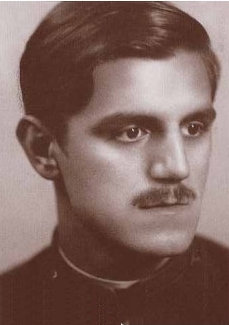
Géza Ottlik
- 生卒
- 1912 – 1990
- 国籍
- 匈牙利
照片:作者不详,公有领域,来自维基共享资源「Ottlik Géza.jpg」(经缩小)。
生平与创作
这个词条暂时没有中文维基百科条目,下面是英文维基百科的内容(英文原文):
Géza Ottlik (9 May 1912 – 9 October 1990) was a Hungarian writer, translator, mathematician, and bridge theorist. According to an American obituary bridge column, he was known in Hungary as "the ultimate authority on Hungarian prose".
Biography
Ottlik was born and died in Budapest. He attended the military school at Kőszeg and Budapest, and studied mathematics and physics at Budapest University 1931–1935. After a brief career on Hungarian radio, he was a secretary of Hungarian PEN Club from 1945 to 1957. As he was unable to publish his works for political reasons, he earned his living translating. He translated mainly from English (Charles Dickens, George Bernard Shaw, John Osborne, Evelyn Waugh); and German (Thomas Mann, G. Keller, Stefan Zweig).
He was a passionate bridge player and advanced theoretician. In a bridge column three months after Ottlik's death, Alan Truscott placed him "among the strongest candidates" for "the bridge writer with the greatest creativity in terms of card-play theory". His 1979 book Adventures in Card Play, written with Hugh Kelsey, introduced and developed many new concepts (such as Backwash squeeze and Entry-shifting squeeze). According to Truscott it "opened new frontiers" in defence as well as declarer play. In his 1995 obituary of Kelsey, Truscott wrote that it "broke new ground in many technical areas and is still considered the most advanced book on the play of the cards." An American survey of bridge experts in 2007 ranked it third on a list of their all-time favourites, nearly thirty years after its first publication.
From October 1944 to February 1945, Ottlik and his wife Gyöngyi Debreczeni hid the writer István Vas, a Jew, in their apartment and shared their food rations with him. Géza personally intervened to obtain the release of Vas' mother from arrest; if he had not done so, she would have been sent on a death march towards Germany. Gyöngyi faced down a group of Arrow Cross Party members who had broken into the apartment to search for the Jew allegedly hiding there; they left without discovering Vas, who survived World War II. For this, the couple were honoured on 4 June 1998 by Yad Vashem as people Righteous Among the Nations.
Awards
Ottlik received a grant from the British Government for his translations, 1960
József Attila Prize (1981)
Kossuth Prize for Literature (1985)
Righteous Among the Nations (1998)
Publications
Hamisjátékosok (Swindlers; stories) (1941)
Hajnali háztetők (Rooftops at Dawn; novella) (1957)
Iskola a határon (School at the Frontier; novel) (1959)
Minden megvan (Nothing's Lost; short stories) (1969, revised and enlarged 1991)
Adventures in Card Play, Ottlik and Hugh Kelsey (Victor Gollancz Ltd, 1979), 285 pp., OCLC 16423055 – on declarer play and defence in bridge
Próza (Prose; essays, interviews) (1980)
A Valencia-rejtély (The Valencia Enigma; novel) (1989)
Hajónapló (Logbook; novel) (1989)
Buda (novel) (1993)
以上文字摘自英文维基百科「Géza Ottlik」(去掉了参考文献等尾部小节),按 CC BY-SA 4.0 使用,作者为维基百科的各位编者。
资料卡
- 出生
- 1912 年 5 月 9 日
- 出生地
- 布达佩斯
- 逝世
- 1990 年 10 月 9 日
- 逝世地
- 布达佩斯
- 职业
- 数学家、作家、译者、新闻工作者、散文家、舆论记者
- 使用语言
- 匈牙利语
- 写作语言
- 匈牙利语
- 就读学校
- 罗兰大学
- 配偶
- Gyöngyi Ottlik
- 代表作
- Iskola a határon
- 获奖
- 科苏特奖(1985)、国际义人(1989);另有 3 项只有外文名
资料卡来自 Wikidata Q558419(CC0),众包数据,个别字段可能不全。