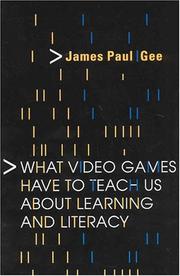
书单
詹姆斯·保罗·吉
- 生卒
- 1948 –
- 国籍
- 美国
- 外文名
- James Paul Gee
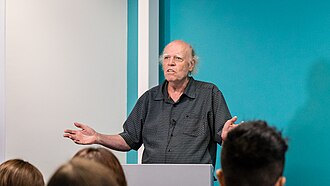
照片:ASU Department of English,CC BY 2.0,来自维基共享资源「James Paul Gee.jpg」(经缩小)。
生平与创作
这个词条暂时没有中文维基百科条目,下面是英文维基百科的内容(英文原文):
James Gee (born April 15, 1948) is a retired American researcher who has worked in psycholinguistics, discourse analysis, sociolinguistics, bilingual education, and literacy. Gee most recently held the position as the Mary Lou Fulton Presidential Professor of Literacy Studies at Arizona State University, originally appointed there in the Mary Lou Fulton Institute and Graduate School of Education. Gee has previously been a faculty affiliate of the Games, Learning, and Society group at the University of Wisconsin–Madison and is a member of the National Academy of Education.
Biography
James Paul Gee was born in San Jose, California. He received his B.A. in philosophy from the University of California at Santa Barbara and both his M.A. and Ph.D. in linguistics from Stanford University. He started his career in theoretical linguistics, working in syntactic and semantic theory, and taught initially at Stanford University and later in the School of Language and Communication at Hampshire College in Amherst, Massachusetts. After doing some research in psycholinguistics at Northeastern University in Boston and at the Max Planck Institute for Psycholinguistics in the Netherlands, Prof. Gee's research focus switched to studies on discourse analysis, sociolinguistics, and applications of linguistics to literacy and education. He went on to teach in the School of Education at Boston University, where he was the chair of the Department of Developmental Studies and Counseling, and later in the Linguistics Department at the University of Southern California. At Boston University he established new graduate programs centered around an integrated approach to language and literacy, combining programs in reading, writing, bilingual education, ESL, and applied linguistics. From 1993 to 1997 he held the Jacob Hiatt Chair in Education in the Hiatt Center for Urban Education at Clark University in Massachusetts. From 1997 until 2007, he held the Tashia Morgridge Professor of Reading at the University of Wisconsin–Madison. In 2007, Gee relocated to Arizona State University, where he was the Mary Lou Fulton Presidential Professor of Literacy Studies in the Department of Curriculum and Instruction.
In 2019, Gee retired.
Discourse/discourse
In his work in social linguistics, Gee explored the concept of Discourse ("big D" Discourse). In Gee's work, discourse ("little d") refers to language-in-use. When discussing the combination of language with other social practices (behavior, values, ways of thinking, clothes, food, customs, perspectives) within a specific group, Gee refers to that as Discourse. Individuals may be part of many different Discourse communities, for example “when you ‘pull-off’ being a culturally specific sort of ‘everyday’ person, a ‘regular’ at the local bar...a teacher or a student of a certain sort, or any of a great many other ‘ways of being in the world’” (p. 7).
Discourse communities
Furthermore, being able to function within a Discourse may carry advantages in different situations. For example, if a person is raised in a family of lawyers, the Discourses of politics or business may come very easily to that person. In the United States, those are all Discourses of power and they are closely related. Another person raised in a very different Discourse community might find himself or herself at a disadvantage when trying to move within the Discourse of business, trying to get a loan, for instance. One Discourse community is not inherently better than another; however, power within a society may be unequally represented within different Discourses.
Situated language
In Gee's view, language is always used from a perspective and always occurs within a context. There is no 'neutral' use of language. Meaning is socially constructed within Discourse communities.
Discourse analysis
Gee's 1999 text An Introduction to Discourse Analysis: Theory and Method is a foundational work in the field of discourse analysis.
New literacies
According to Gee, there are at least two reasons why we should consider literacy in broader terms than the traditional conception of literacy as the ability to read and write. First, in our world today, language is by no means the only communication system available. Many types of visual images and symbols have specific significances, and so “visual literacies” and literacies of other modes, or the concept of multimodal literacy, are also included in Gee's conception of new literacies. Second, Gee proposes that reading and writing (the ‘meat’ of literacy according to the traditional notion of the term) are not such obvious ideas as they first appear. “After all,” he states, “we never just read or write; rather, we always read or write something in some way”. In other words, according to which type of text we read there are different ways in which we read depending on the “rules” of how to read such a text. Literacy to Gee, even if it is the traditional print-based literacy, should be conceived as being multiple, or comprising different literacies, since we need different types of literacies to read different kinds of texts in ways that meet our particular purposes in reading them.
以上文字摘自英文维基百科「James Paul Gee」(有删节,去掉了参考文献等尾部小节),按 CC BY-SA 4.0 使用,作者为维基百科的各位编者。
资料卡
- 出生
- 1948 年 4 月 15 日
- 出生地
- 圣何塞
- 职业
- 语言学家
- 使用语言
- 英语
- 就读学校
- 加利福尼亚大学圣巴巴拉分校、斯坦福大学
资料卡来自 Wikidata Q6141067(CC0),众包数据,个别字段可能不全。