 书单
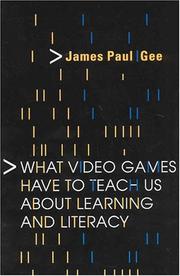
What Video Games Have to Teach Us About Learning and Literacy (2007)
- 作者
- 詹姆斯·保罗·吉
- 首版
- 2007 年
- 国家/地区
- 美国
- Open Library
- 3 个版本
百科
这个词条暂时没有中文维基百科条目,下面是英文维基百科的内容(英文原文):
What Video Games Have to Teach Us About Learning and Literacy is a book by James Paul Gee that focuses on the learning principles in video games and how these principles can be applied to the K-12 classroom. Video games can be used as tools to challenge players, when they are successful. They motivate players to persevere and simultaneously teach players how to play the game. These games give a glimpse into how one might create new and more powerful ways to learn in schools, communities, and workplaces. Gee began his work in video games by identifying thirty-six learning principles that are present in—but not exclusive to—the design of good video games. He further argues for the application of these principles into the classroom environment. What Video Games Teach Us about Learning and Literacy is a call to educators, teachers, parents and administrators to change the approach to pedagogy.
Summary
Gee began playing video games when his (then) six-year-old son needed help playing the problem-solving game Pajama Sam. When he discovered how much enjoyment his son had and how much attention and time he spent solving the game's problems, Gee decided to start playing video games on his own and began to analyze what makes people spend time and money on video games. To his amazement, good video games were "hard, long, and complex", and he often had to use outside resources to learn things needed to complete the game. However, when a game is too easy and/or too short, players do not feel compelled by it and they simply will not continue playing it. The new challenges, learning potential, and consistent struggles of these games also make video games motivating and entertaining for the user.
Gee takes a personal approach to explaining how the immersive, interactive world of a video game engages the player in ways that formal education may fall short. He argues that players do not usually read the manual before playing a game—they play the game and then look at the manual. He suggests that, in essence, this is what is required of students when they are asked to read a textbook before the information is put in context—before they get to play 'the game.' Gee takes an optimistic view of video games, gathering a list of learning principles commonly found in these games. He challenges the assumption that video games are a waste of time and points to ways in which, when played in an environment that fosters critical thinking, video games can become excellent teaching tools. He also points out that games are not easy and that it is precisely their challenging nature that keeps the player involved. Gee suggests that if students in formal educational environments had the ability to build their own knowledge, as players in a game do when they beat a level, more progressive learning would follow rather than the frustration that is often felt by students in academic settings.
Some of the learning principles that good games incorporate include: identity development, interactive approaches, student production, risk-taking, individual customization, personal agency, well-ordered problems, challenges and consolidation, "just-in-time" and "on demand", situated meanings, systems thinking, active exploration, thinking laterally, rethinking goals, using smart tools and distributed knowledge, engaging in cross-functional teams, and encouraging performance before competence.
Learning principles
Learning and semiotic domains
Active, Critical Learning Principle: Every aspect of the learning environment should be set up to encourage active and critical learning, instead of more traditionally passive learning environments. Active learning requires the learner to understand and use design grammars of the semiotic domain in which he/she is learning. Critical learning has occurred when the learner can engage with, reflect upon, critique, and change elements of the design.
Design Principle: Learning about design principles and appreciating the design.
Semiotic Principle: Identifying, understanding, and appreciating the relationships across symbol systems. Symbols may include words, images, actions, artifacts, etc.
Semiotic Domains Principle: Mastery in a semiotic domain so that one can participate in the appropriate community of practice. A semiotic domain uses a given modality (images, equations, symbols, etc.) to communicate messages to others. Examples of semiotic domains include cognitive psychology, first-person shooter games, and cellular biology.
Meta-Level Thinking about Semiotic Domains Principle: Learners can critically think about the relationships between multiple semiotic domains. For example, how do the concepts found in Cognitive Psychology relate to First Person Shooter Games?
Learning and identity
"Psychosocial Moratorium" Principle: The real-world consequences do not exist, allowing learners to take greater risks. For example, in gaming worlds learners are able to "try-out" different identities relating to gender, ethnicity, and even species. Similarly, gaming environments allows learners to make multiple attempts towards a given reward (i.e. new level, boss) without any real-world consequences. This creates a safe space for the learner to fully engage with the environment.
Committed Learning Principle: Learners will participate in extended engagements as an extension of their real-world identities in relation to their virtual identities. The learner feels a commitment to continue their effort and practice.
Identity Principle: The learner is able to choose multiple identities in such a way that they can reflect upon "new" and "old" identities. Gee specifically identifies that learners have a real-world identity, a virtual identity, and a projective identity.
Self-Knowledge Principle: The learner learns about themselves and their potential range of skills, in a self-reflective process.
Amplification of Input Principle: The learner is able to put in a small input, but receives a much larger output. This principle examines how much effort is needed by the learner to receive some reward.
以上文字摘自英文维基百科「What Video Games Have to Teach Us About Learning and Literacy」(有删节,去掉了参考文献等尾部小节),按 CC BY-SA 4.0 使用,作者为维基百科的各位编者。
资料卡
- 原题
- What Video Games Have to Teach Us About Learning and Literacy
- 原作语言
- 英语
- 首次出版
- 2007 年 12 月 26 日
- 体裁
- 随笔
- 首版出版社
- 帕尔格雷夫·麦克米兰
- 主题
- 教育
资料卡来自 Wikidata Q16967268(CC0),众包数据,个别字段可能不全。