书单
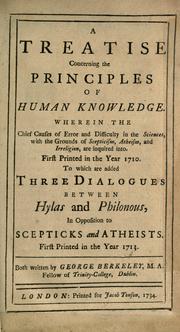
人类知识原理 (1710)
百科
这个词条暂时没有中文维基百科条目,下面是英文维基百科的内容(英文原文):
A Treatise Concerning the Principles of Human Knowledge (commonly called the Principles of Human Knowledge, or simply the Treatise) is a 1710 work, in English, by Irish empiricist philosopher George Berkeley. This book largely seeks to refute the claims made by Berkeley's contemporary John Locke about the nature of human perception. While, like other empiricist philosophers, both Locke and Berkeley agreed that we are having experiences regardless of whether material objects exist or not, Berkeley sought to prove that the outside world (the world which causes the ideas one has within one's mind) is also composed solely of ideas. Berkeley did this by suggesting that "Ideas can only resemble Ideas" – the mental ideas that we possess can only resemble other ideas (not material objects) and thus the external world consists not of physical form, but rather of ideas. This world is (or, at least, was) given logic and regularity by some other force, which Berkeley concludes is God.
Content
Introduction
Berkeley declared that his intention was to make an inquiry into the First Principles of Human Knowledge in order to discover the principles that have led to doubt, uncertainty, absurdity, and contradiction in philosophy. In order to prepare the reader, he discussed two topics that lead to errors. First, he claimed that the mind cannot conceive abstract ideas. We cannot have an idea of some abstract thing that is common to many particular ideas and therefore has, at the same time, many different predicates and no predicates. Second, Berkeley declared that words, such as names, do not signify abstract ideas. With regard to ideas, he asserted that we can only think of particular things that have been perceived. Names, he wrote, signify general ideas, not abstract ideas. General ideas represent any one of several particular ideas. Berkeley criticized Locke for saying that words signify general, but abstract, ideas. At the end of his Introduction, he advised the reader to let his words engender clear, particular ideas instead of trying to associate them with non-existent abstractions.
Part I
The following is a summary of Part I (Part II was never published).
"To be" means "to be perceived"
Berkeley began his treatise by asserting that existence is the state of being perceived by a perceiver. Human minds know ideas, not objects. The three kinds of ideas are those of sensation, thought, and imagination. When several ideas are associated together, they are thought to be ideas of one distinct thing, which is then signified by one name.
Ideas are known and perceived by a knowing perceiver. This active perceiver is designated by the names mind, spirit, soul, or self. Ideas exist by virtue of a perceiver. The existence of an idea consists in being perceived.
What is meant by the term "exist" when it is applied to a thing that is known through the senses? To say that something exists is to say that it is perceived by a perceiver (Esse is percipi). This is the main principle of human knowledge.
External objects are things that are perceived through our senses. We perceive only our own sensations or ideas. Ideas and sensations cannot exist unperceived.
To say that an object exists without being perceived is to attempt to abstract that which cannot be abstracted. We cannot separate or abstract objects and their qualities from our perception of them.
If an object exists or is perceived, it must be perceived by me or some other perceiver. It is impossible to separate the being of a sensible thing from its existence as a perception of a perceiver.
There can be no unthinking substance or substratum of ideas. Therefore, the perceiving mind or spirit is the only substance of ideas. Ideas inhere in or belong to a perceiver.
Are there things that exist in an unthinking substance outside of the perceiver's mind? Can they be the originals that the ideas copy or resemble? An idea can only be like an idea, not something undetectable. It is impossible for us to conceive of a copy or resemblance unless it is between two ideas.
Locke's primary and secondary qualities
According to Locke, a thing's primary qualities, such as its extension, shape, motion, solidity, and number, exist unperceived, apart from any perceiver's mind, in an inert, senseless substance called matter. Berkeley opposed Locke's assertion. Qualities that are called primary are, according to Berkeley, ideas that exist in a perceiver's mind. These ideas can only be like other ideas. They cannot exist in an unperceiving, corporeal substance or matter.
The primary qualities of figure, motion, etc., cannot be conceived as being separate from the secondary qualities, which are related to sensations. Therefore, primary qualities, like secondary qualities, exist only in the mind. The properties of primary qualities are relative and change according to the observer's perspective. The greatness and smallness of figure, the swiftness and slowness of motion, exist in the mind and depend on point of view or position.
Number
Number exists only in the mind. The same thing is described by different numbers according to the mind's viewpoint. An object can have an extension of one, three, and thirty six, according to its measurement in yards, feet, and inches. Number is relative and does not exist separately from a mind.
以上文字摘自英文维基百科「A Treatise Concerning the Principles of Human Knowledge」(有删节,去掉了参考文献等尾部小节),按 CC BY-SA 4.0 使用,作者为维基百科的各位编者。
资料卡
- 原题
- A Treatise Concerning the Principles of Human Knowledge
- 原作语言
- 英语
- 首次出版
- 1710 年
- 体裁
- 哲学
资料卡来自 Wikidata Q3267928(CC0),众包数据,个别字段可能不全。