书单
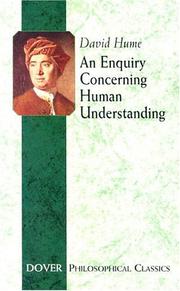
人类理解研究 (1748)
百科
《人类理解研究》(英语:An Enquiry Concerning Human Understanding)一书是由苏格兰经验主义哲学家大卫·休谟(David Hume)在1748年用英文出版的。本书是休谟前一著作《人性论》的修正。休谟对于人性论的反响非常失望,他声称此书是“一本夭折的作品”。因此休谟编写《人类理解研究》一书去宣传他更为先进的思想,并且以更短、更为好辩的文章形式出版。
章节概述
第一章 各派哲学:第一章的研究当中,休谟简单地介绍了哲学的种类。对于休谟而言,哲学可以被分成两个部分:精神哲学(Nature Philosophy)和人性哲学 (Moral Philosophy)。
第二章 观念的起源
第三章 观念的联络
第四章 关于理解作用的一些怀疑
第五章 关于这些怀疑的一种怀疑主义的解决方法
第六章 可然性
第七章 “必然联系”的观念
第八章 自由和必然
第九章 动物的理性
第十章 神迹
第十一章 特殊的天意和来世的状况
第十二章 怀疑哲学
以上文字摘自维基百科「人类理智研究」(去掉了参考文献等尾部小节),按 CC BY-SA 4.0 使用,作者为维基百科的各位编者。
中文维基百科的条目比较短,下面附上英文维基百科的内容(英文原文):
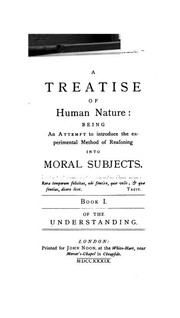
An Enquiry Concerning Human Understanding is a book by the Scottish empiricist philosopher David Hume, published in English in 1748 under the title Philosophical Essays Concerning Human Understanding until a 1757 edition came up with the now-familiar name. It was a revision of an earlier effort, Hume's A Treatise of Human Nature, published anonymously in London in 1739–40. Hume was disappointed with the reception of the Treatise, which "fell dead-born from the press," as he put it, and so tried again to disseminate his more developed ideas to the public by writing a shorter and more polemical work.
The end product of his labours was the Enquiry. The Enquiry dispensed with much of the material from the Treatise, in favour of clarifying and emphasizing its most important aspects. For example, Hume's views on personal identity do not appear. However, more vital propositions, such as Hume's argument for the role of habit in a theory of knowledge, are retained.
This book has proven highly influential, both in the years that would immediately follow and today. Immanuel Kant points to it as the book which woke him from his self-described "dogmatic slumber." The Enquiry is widely regarded as a classic in modern philosophical literature.
Content
The argument of the Enquiry proceeds by a series of incremental steps, separated into chapters which logically succeed one another. After expounding his epistemology, Hume explains how to apply his principles to specific topics.
1. Of the different species of philosophy
In the first section of the Enquiry, Hume provides a rough introduction to philosophy as a whole. For Hume, philosophy can be split into two general parts: natural philosophy and the philosophy of human nature (or, as he calls it, "moral philosophy"). The latter investigates both actions and thoughts. He emphasizes in this section, by way of warning, that philosophers with nuanced thoughts will likely be cast aside in favor of those whose conclusions more intuitively match popular opinion. However, he insists, precision helps art and craft of all kinds, including the craft of philosophy.
2. Of the origin of ideas
Next, Hume discusses the distinction between impressions and ideas. By "impressions", he means sensations, while by "ideas", he means memories and imaginings. According to Hume, the difference between the two is that ideas are less vivacious than impressions. For example, the idea of the taste of an orange is far inferior to the impression (or sensation) of actually eating one. Writing within the tradition of empiricism, he argues that impressions are the source of all ideas.
Hume accepts that ideas may be either the product of mere sensation or of the imagination working in conjunction with sensation. According to Hume, the creative faculty makes use of (at least) four mental operations that produce imaginings out of sense-impressions. These operations are compounding (or the addition of one idea onto another, such as a horn on a horse to create a unicorn); transposing (or the substitution of one part of a thing with the part from another, such as with the body of a man upon a horse to make a centaur); augmenting (as with the case of a giant, whose size has been augmented); and diminishing (as with Lilliputians, whose size has been diminished). (Hume 1974:317) In a later chapter, he also mentions the operations of mixing, separating, and dividing. (Hume 1974:340)
However, Hume admits that there is one objection to his account: the problem of "The Missing Shade of Blue". In this thought-experiment, he asks us to imagine a person who has experienced every shade of blue except for one (see Fig. 1). He predicts that this person will be able to divine the color of this particular shade of blue, despite the fact that they have never experienced it. This seems to pose a serious problem for the empirical account, though Hume brushes it aside as an exceptional case by stating that one may experience a novel idea that itself is derived from combinations of previous impressions. (Hume 1974:319)
以上文字摘自英文维基百科「An Enquiry Concerning Human Understanding」(有删节,去掉了参考文献等尾部小节),按 CC BY-SA 4.0 使用,作者为维基百科的各位编者。
资料卡
- 原题
- Philosophical Essays Concerning Human Understanding
- 原作语言
- 英语
- 首次出版
- 1748 年
- 体裁
- 随笔
- 前作
- 人性论
- 续作
- 道德原则研究
- 主题
- 哲学
资料卡来自 Wikidata Q1306656(CC0),众包数据,个别字段可能不全。