书单
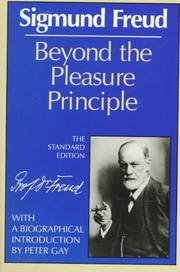
超越快乐原则 (1920)
百科
《超越快乐原则》(最初于1920年以德文《Jenseits des Lustprinzips》出版),是西格蒙德·弗洛伊德的一本著作,象征其理论取径的转捩点。在此之前,弗洛伊德断定性本能(sexual instinct)是人类行为的一概归因。在本书中,弗洛伊德提出“超越”此一简单的快乐原则,以发展其死亡欲力(Todestrieb[e],通常被称为塔纳托斯,或译死亡本能)的理论。
本书的重要性,在于描述人类置身两种对立欲力(本能)的处境。一则为生之欲力,表现为创造力、和谐、性关系、繁殖、自我保护。一则为死亡欲力,表现为破坏、重蹈覆辙、侵略、强迫、自我毁灭。后者即快乐原则的例外。
在书中,弗洛伊德致力寻找“快乐原则不存在”的证据。他发现,当快乐原则无法充分应付以下四种情况,就会发生例外(死亡欲力):
孩童的游戏,弗洛伊德以自己孙子的“fort-da”游戏为例。
重复梦见战争创伤。
经追踪确定的,某些人的自我伤害行为模式。
在精神分析中,某些不断重复童年不愉快经验的人。
延伸读物
"The Language of Psycho-Analysis", Jean Laplanche et J.B. Pontalis, Editeur: W. W. Norton & Company, 1974, ISBN 0-393-01105-4
雅克·德里达, 《明信片:从苏格拉底到佛洛伊徳之外》(The Post Card: From Socrates to Freud and Beyond)
贝尔纳·斯蒂格勒, Desire and Knowledge: The Dead Seize the Living.
以上文字摘自维基百科「超越快樂原則」(去掉了参考文献等尾部小节),按 CC BY-SA 4.0 使用,作者为维基百科的各位编者。
中文维基百科的条目比较短,下面附上英文维基百科的内容(英文原文):
Beyond the Pleasure Principle (German: Jenseits des Lustprinzips) is a 1920 essay by Sigmund Freud. It marks a major turning point in the formulation of his drive theory, where Freud had previously attributed self-preservation in human behavior to the drives of Eros and the regulation of libido, governed by the pleasure principle. Revising this as inconclusive, Freud theorized beyond the pleasure principle, newly considering the death drives (or Thanatos, the Greek personification of death) which refers to the tendency towards destruction and annihilation, often expressed through behaviors such as aggression, repetition compulsion, and self-destructiveness.
Overview
The essay, marking Freud's major revision of his drive theory, elaborates on the struggle between two opposing drives. In the first few sections, Freud describes these as Eros, which produces creativity, harmony, sexual connection, reproduction, and self-preservation; and the "death drives" (what some call "Thanatos"), which brings destruction, repetition, aggression, compulsion, and self-destruction.
In sections IV and V, Freud posits that the process of creating living cells binds energy and creates an imbalance. It is the pressure of matter to return to its original state which gives cells their quality of living. The process is analogous to the creation and exhaustion of a battery. This pressure for molecular diffusion is referred to as a "death-wish". The compulsion of the matter in cells to return to a diffuse, inanimate state extends to the whole living organism. Thus, the psychological death-wish is a manifestation of an underlying physical compulsion present in every cell, which Freud directly corresponds to the death drives.
Freud also states the basic differences, as he saw them, between his approach and Carl Jung's and summarizes published research into basic drives in Section VI to establish his revisions.
Analysis and synopsis
What have been called the "two distinct frescoes or canti" of Beyond the Pleasure Principle break between sections III and IV. If, as Otto Fenichel remarked, Freud's "new [instinctual] classification has two bases, one speculative, and one clinical", thus far the clinical. In Freud's own words, the second section "is speculation, often far-fetched speculation, which the reader will consider or dismiss according to his individual predilection"—it has been noted that "in Beyond the Pleasure Principle, Freud used that unpromising word "speculations" more than once".
Clinical evidence (sections I–III)
Freud begins with "a commonplace then unchallenged in psychoanalytic theory: 'The course of mental events is automatically regulated by the pleasure principle ... a strong tendency toward the pleasure principle'". After considering the inevitable presence of unpleasant experiences in the life of the mind, he concludes the book's first section to the effect that the presence of such unpleasant experiences "does not contradict the dominance of the pleasure principle ... does not seem to necessitate any far-reaching limitation of the pleasure principle."
Exceptions to the pleasure principle
Freud proceeds to look for "evidence, for the existence of hitherto unsuspected forces 'beyond' the pleasure principle." He found exceptions to the universal power of the pleasure principle—"situations ... with which the pleasure principle cannot cope adequately"—in four main areas: children's games, as exemplified in his grandson's famous "fort-da" game; "the recurrent dreams of war neurotics ...; the pattern of self-injuring behaviour that can be traced through the lives of certain people ["fate neurosis"]; the tendency of many patients in psycho-analysis to act out over and over again unpleasant experiences of their childhood."
以上文字摘自英文维基百科「Beyond the Pleasure Principle」(有删节,去掉了参考文献等尾部小节),按 CC BY-SA 4.0 使用,作者为维基百科的各位编者。
资料卡
- 原题
- Jenseits des Lustprinzips
- 原作语言
- 德语
- 首次出版
- 1920 年
- 体裁
- 专著
- 主题
- 精神分析学、死亡驱力
资料卡来自 Wikidata Q466271(CC0),众包数据,个别字段可能不全。
更多资料与书评
在哪读
西格蒙德·弗洛伊德 的其他作品
作者页 ›相似的书

 豆瓣 #17