书单
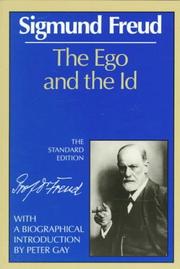
自我与本我 (1923)
百科
这个词条暂时没有中文维基百科条目,下面是英文维基百科的内容(英文原文):
The Ego and the Id (German: Das Ich und das Es) is a prominent paper by Sigmund Freud, the founder of psychoanalysis. It is an analytical study of the human psyche outlining his theories of the psychodynamics of the id, ego and super-ego, which is of fundamental importance in the development of psychoanalysis. The study was conducted over years of research and was first published in the third week of April 1923.
Overview
The Ego and the Id develops a line of reasoning as a groundwork for explaining various (or perhaps all) psychological conditions, pathological and non-pathological alike. These conditions result from powerful internal tensions—for example: 1) between the ego and the id, 2) between the ego and the super ego, and 3) between the love-instinct and the death-instinct. The book deals primarily with the ego and the effects these tensions have on it.
The ego—caught between the id and the super-ego—finds itself simultaneously engaged in conflict by repressed thoughts in the id and relegated to an inferior position by the super-ego. And at the same time, the interplay between the love instinct and the death instinct can manifest itself at any level of the psyche. The outline below is an exegesis of Freud's arguments, explaining the formation of the aforementioned tensions and their effects.
Exegesis by chapter
Presuppositions: "Consciousness and the Unconscious"
All concepts in The Ego and the Id are built upon the presupposed existence of conscious and unconscious thoughts. On the first line, Freud states, "[About consciousness and the unconscious] there is nothing new to be said... the division of mental life into what is conscious and what is unconscious is the fundamental premise on which psycho-analysis is based" (9). He further distinguishes between two types of unconscious thoughts: "preconscious" ideas, which are latent yet fully capable of becoming conscious; and "unconscious" ideas, which are repressed and cannot become conscious without the help of psychoanalysis.
It would be overly simple to assume that the unconscious and the conscious map directly onto the id and the ego, respectively. Freud argues that (according to his work with psychoanalysis) the supposedly conscious ego can be shown to possess unconscious thoughts (16) when it unknowingly resists parts of itself. Thus, a third kind of unconscious thought seems to be necessary, a process that is neither repressed nor latent (18), but which is nonetheless an integral part of the ego: the act of repression.
If this is true, Freud argues that the idea of "unconsciousness" must be reevaluated: contrary to prior belief, human psychodynamics cannot be fully explained by a tension between unconscious and conscious thoughts. A new framework is required, one that further examines the status of the ego.
Mapping the new framework: "The Ego and the Id"
Before defining the ego explicitly, Freud argues for a manner in which unconscious thoughts can be made conscious. He believes the answer lies in the difference between unconscious thoughts and preconscious thoughts: The unconscious are "worked out upon some sort of material that remains unrecognized" (21), while the preconscious are connected to perceptions, especially "verbal images". The difference, then, is a connection to words (more specifically, to the "memory residue" of words.) The goal of psychoanalysis, then, is to connect the freely floating unconscious material to words via psychoanalytic dialogue.
He goes on to note that the ego is essentially a system of perception, so it must be closely related to the preconscious (27). Thus, two primary components of ego are a system of perception and a set of unconscious (specifically, preconscious) ideas. Its relationship to the unconscious id (German: Es), therefore, is a close one. The ego merges into the id (28). He compares the dynamic to that of a rider and a horse. The ego must control the id, like the rider, but at times, the rider is obliged to guide the horse where it wants to go. Likewise, the ego must, at times, conform to the desires of the id.
Finally, the ego is a "modified portion" of the id that can perceive the empirical world (29). It is this idea of perception that leads Freud to call the ego a "body-ego" (31)—a mental projection of the surface of one's physical body.
Further complication: "The Ego and the Super-Ego (Ego-Ideal)"
The ego is divided into two parts: the ego itself and the super-ego (German: Über-Ich), or the ego-ideal (German: Ideal-Ich) (34). Although Freud seems never to argue for the existence of a super-ego in The Ego and the Id (save to reference one of his earlier works in a footnote), we may consider a need for the super-ego implicit in Freud's previous arguments. Indeed, the super-ego is the solution to the mystery raised in the first chapter—the unconscious part of the ego, the part that acts in a repressive capacity.
His argument for the formation of the super-ego hinges on the idea of internalization—a processes in which (after a formerly present object becomes absent) the mind creates an internal version of the same object. He gives the example of melancholia resulting from the loss of a sexual object (35). In cases such as these, the melancholic subject constructs a new object within the ego—to mitigate the pain of loss. The ego, in some sense, becomes the object (at least as far as the id's libido is concerned.) The love of the id is redirected—away from the external world—and turned inward.
以上文字摘自英文维基百科「The Ego and the Id」(有删节,去掉了参考文献等尾部小节),按 CC BY-SA 4.0 使用,作者为维基百科的各位编者。
资料卡
- 原题
- Das Ich und das Es
- 原作语言
- 德语
- 首次出版
- 1923 年 4 月 24 日
- 体裁
- 随笔
资料卡来自 Wikidata Q1148588(CC0),众包数据,个别字段可能不全。
更多资料与书评
在哪读
西格蒙德·弗洛伊德 的其他作品
作者页 ›相似的书
 豆瓣 #17