 书单
百科
这个词条暂时没有中文维基百科条目,下面是英文维基百科的内容(英文原文):
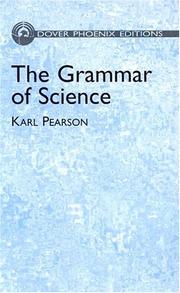
The Grammar of Science is a book by Karl Pearson first published in hardback in 1892. In 1900, the second edition, published by Adam & Charles Black, appeared. The third, revised, edition was also published by Adam & Charles Black in 1911. It was recommended by Einstein to his friends of the Olympia Academy. Several themes were covered in this book that later became part of the theories of Einstein and other scientists, such as:
the relativity of motion to a frame of reference (fixed stars), the equivalence of "matter" and energy, physics as geometry, the non-existence of the ether, the importance of creative imagination rather than mere fact-gathering, antimatter, fourth dimension, wrinkles in space, molecular relative position and motion, and motion of corpuscles as relative motion in a field.
Chapter I
"Introductory – The Scope and Method of Science"
The scope of science is to ascertain truth in every possible branch of knowledge. There is no sphere of inquiry which lies outside the legitimate field of science. To draw a distinction between the scientific and philosophical fields is obfuscation.
The scientific method has the following distinctive features:
(a) careful and accurate measurement of data, and "observation of their correlation and sequence";
(b) discovery of scientific laws by aid of the creative imagination;
(c) self-criticism;
(d) final decisions having equal validity for all normally constituted minds.
The claims of science to our support depend on:
(a) the efficient mental training it provides for the citizen;
(b) the light it brings to bear on many important social problems;
(c) the increased comfort it adds to practical life;
(d) the permanent gratification it yields to the aesthetic judgment.
Chapter II
"The Facts of Science"
Immediate sense-impressions form permanent impresses in the brain which psychically correspond to memory. The union of immediate sense-impressions with associated stored impressions leads to the formation of "constructs," which we project "outside ourselves," and term phenomena or appearances. The real world lies for us in such phenomenal constructs and not in shadowy things-in-themselves. "Outside" and "inside" oneself are alike ultimately based on sense-impressions; but from these sense-impressions by association, mechanical and mental, we form conceptions and draw inferences. These are the facts of science, and its field is essentially the contents of the mind.
When an interval elapses between sense-impression and muscular exertion, and the interval contains cerebral activity marking the revival and combination of past sense-impresses, we are said to think or be conscious. Consciousness of something external is an inference which, not yet having been verified by immediate sense-impression, we term an "eject;" it is conceivable, however, that it could become an object. Consciousness has no meaning other than to nervous systems akin to our own; it is illogical to assert that all matter is conscious, still more that consciousness or will can exist outside matter.
The term knowledge is meaningless when extended beyond the sphere in which we may legitimately infer consciousness, or when applied to things outside the area of thought, i.e., to metaphysical terms dignified by the name of conceptions although they do not ultimately flow from sense-impressions.
Chapter III
"The Scientific Law"
Scientific Law is of a totally different nature from civil law; it does not involve an intelligent lawgiver, a command and a corresponding duty. It is a brief description in mental shorthand of as wide a range as possible of the sequences of our sense-impressions.
There are two distinct meanings to natural law: the mere routine of perception, and the scientific law or formula describing the field of nature. The "reason" in natural law is only obvious when we speak of law in the latter sense, and then it is really placed there by the human mind. Thus the supposed reason behind natural law does not enable us to pass from the routine of perceptions to anything of the nature of reason behind the world of sense-impression.
The fact that the human reflective faculty is able to express the routine of perceptions in mental formulae may be due to this routine being a product of the perceptive faculty itself. The perceptive faculty appears to be selective and to have developed in co-ordination with the reflective faculty. Of the world outside sensation science can only logically infer chaos, or the absence of the conditions of knowledge; no human concept, such as order, reason, or consciousness, can be logically projected into it.
Chapter IV
"Cause and Effect – Probability"
Cause is scientifically used to denote an antecedent stage in a routine of perceptions. In this sense, "force" as a cause is meaningless. First cause is only a limit, permanent or temporary, to knowledge. No instance, certainly not "will," occurs in our experience of an arbitrary first cause in the popular sense of the word.
There is no inherent necessity in the routine of perceptions, but the permanent existence of rational beings necessitates a routine of perceptions; the possibility of a thinking being ceases with the cessation of routine. The only necessity we are acquainted with exists in the sphere of conceptions; routine in perceptions may possibly be due to the constitution of the perceptive faculty.
Proof in the field of perceptions is the demonstration of overwhelming probability. Logically we ought to use the word know only of conceptions, and reserve the word believe for perceptions. "I know that the angle at the circumference on any diameter of a circle is right," but "I believe that the sun will rise tomorrow." The proof that a breach of routine will not occur for a finite future depends upon the solid experience that we are ignorant only in areas in which, statistically, all constitutions of the unknown are found to be equally probable.
Chapter V
"Contingency and Correlation – The Insufficiency of Causation"
以上文字摘自英文维基百科「The Grammar of Science」(有删节,去掉了参考文献等尾部小节),按 CC BY-SA 4.0 使用,作者为维基百科的各位编者。