书单
百科
这个词条暂时没有中文维基百科条目,下面是英文维基百科的内容(英文原文):
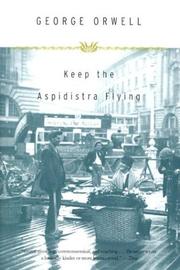
Keep the Aspidistra Flying, first published in 1936, is a socially critical novel by George Orwell. It is Orwell's third novel and fourth book. The novel is set in 1930s London. The main theme is Gordon Comstock's romantic ambition to defy worship of the money-god and status, and the dismal life that results for those who chase riches.
Background
Orwell wrote the book in 1934 and 1935 while he was living at various locations near Hampstead in London, and drew on his experiences in these and the preceding few years. At the beginning of 1928 he lived in lodgings in Portobello Road from where he started his tramping expeditions, sleeping rough and roaming the poorer parts of London. At this time he wrote a fragment of a play in which the protagonist Stone needs money for a life-saving operation for his child. Stone would prefer to prostitute his wife rather than prostitute his artistic integrity by writing advertising copy.
Orwell's early writings appeared in The Adelphi, a left-wing literary journal edited by Sir Richard Rees, a wealthy and idealistic baronet who made Orwell one of his protégés. The character of Ravelston, the wealthy publisher in Keep the Aspidistra Flying, has a lot in common with Rees. Ravelston is acutely self-conscious about his upper-class status and defensive about his unearned income. Comstock speculates that Ravelston receives nearly two thousand pounds a year after tax – a very comfortable sum in those days – and Rees, in a volume of autobiography published in 1963, wrote: "I have never had the spending of much less than £1,000 a year of unearned income, and sometimes considerably more. ... Before the war, this was wealth, especially for an unmarried man. Many of my socialist and intellectual friends were paupers compared to me ...". In quoting this, Orwell's biographer Michael Shelden comments that "One of these 'paupers' – at least in 1935 – was Orwell, who was lucky if he made £200 that year. ... He appreciated Rees's editorial support at the Adelphi and sincerely enjoyed having him as a friend, but he could not have avoided feeling some degree of resentment toward a man who had no real job but who enjoyed an income four or five times greater than his."
In 1932 Orwell took a job as a teacher in a small school in West London. From there he visited Burnham Beeches and other places in the countryside. There are allusions to Burnham Beeches and walks in the country in Orwell's correspondence with Brenda Salkeld and Eleanor Jacques at this time.
In October 1934, after Orwell had spent nine months at his parents' home in Southwold, his aunt Nellie Limouzin found him a job as a part-time assistant at Booklovers' Corner, a second-hand bookshop in Hampstead run by Francis and Myfanwy Westrope. The Westropes, who were friends of Nellie in the Esperanto movement, had an easygoing outlook and provided Orwell with comfortable accommodation at Warwick Mansions, Pond Street. He was job sharing with Jon Kimche, who also lived with the Westropes. Orwell worked at the shop in the afternoons, having the mornings free to write and the evenings to socialise. He was at Booklovers' Corner for fifteen months. In his essay "Bookshop Memories", published in November 1936, he recalled aspects of his time at the bookshop, and in Keep the Aspidistra Flying "he described it, or revenged himself upon it, with acerbity and wit and spleen".
In their study of Orwell the writers Stansky and Abrahams remark upon the improvement on the "stumbling attempts at female portraiture in his first two novels: the stereotyped Elizabeth Lackersteen in Burmese Days and the hapless Dorothy in A Clergyman's Daughter," and contend that, in contrast, "Rosemary is a credible female portrait". Through his work in the bookshop Orwell was in a position to become acquainted with women, "first as a clerk, then as a friend", and found that, "if circumstances were favourable, he might eventually embark upon a 'relationship' ... This, for Orwell the author and Blair the man, was the chief reward of working at Booklovers' Corner." In particular, Orwell met Sally Jerome, who was then working for an advertising agency (like Rosemary in Keep the Aspidistra Flying), and Kay Ekevall, who ran a small typing and secretarial service that worked for the Adelphi.
By the end of February 1935 Orwell had moved into a flat in Parliament Hill; his landlady, Rosalind Obermeyer, was studying at the University of London. It was through a joint party with his landlady that Orwell met his future wife, Eileen O'Shaughnessy. In August, Orwell moved into a flat in Kentish Town, which he shared with Michael Sayers and Rayner Heppenstall. Over this period he was working on Keep the Aspidistra Flying, and had two novels, Burmese Days and A Clergyman's Daughter, published. At the beginning of 1936 Orwell was dealing with pre-publication issues for Keep the Aspidistra Flying while he was touring the North of England collecting material for The Road to Wigan Pier. The novel was published by Victor Gollancz Ltd on 20 April 1936.
Title
The aspidistra is a hardy, long-living plant that has been used as a house plant in England, and which can grow to an impressive, even unwieldy size. It was especially popular in the Victorian era, in large part because it could tolerate not only weak sunlight but also the poor indoor air quality that resulted from the use of oil lamps and, later, coal gas lamps. Aspidistras had fallen out of favour by the 20th century, following the advent of electric lighting, but their use had been so widespread among the middle class that they had become a music hall joke, appearing in songs such as "Biggest Aspidistra in the World", of which Gracie Fields made a recording.
In the titular phrase Orwell uses the aspidistra, a symbol of the stuffiness of middle-class society, in conjunction with the locution "to keep the flag (or colours) flying." The title can thus be interpreted as a sarcastic exhortation in the sense of "Hooray for the middle class!"
以上文字摘自英文维基百科「Keep the Aspidistra Flying」(有删节,去掉了参考文献等尾部小节),按 CC BY-SA 4.0 使用,作者为维基百科的各位编者。
资料卡
- 原题
- Keep the Aspidistra Flying
- 原作语言
- 英语
- 首次出版
- 1936 年 4 月 20 日
- 作品形式
- 长篇小说
- 前作
- 牧师的女儿
- 故事发生地
- 伦敦
资料卡来自 Wikidata Q1217656(CC0),众包数据,个别字段可能不全。