书单
百科
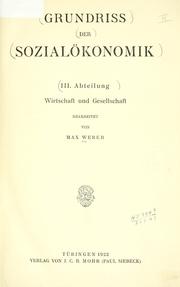
《经济与社会》(全名《经济与社会:理解社会学纲要》,德语:Wirtschaft und Gesellschaft. Grundriß der verstehenden Soziologie)是社会学家马克斯·韦伯的主要著作之一,该著在他去世后由其妻玛丽安于1921年出版。该著被认为是《新教伦理与资本主义精神》(1905)之外韦伯最重要的作品之一。这本书的范围非常广泛,涵盖了许多主题,包括宗教、经济、政治、公共管理和社会学。直到1968年,该作品的完整译本才以英文出版。
1998年,国际社会学协会将这部著作列为20世纪最重要的社会学著作。
以上文字摘自维基百科「经济与社会」(去掉了参考文献等尾部小节),按 CC BY-SA 4.0 使用,作者为维基百科的各位编者。
中文维基百科的条目比较短,下面附上英文维基百科的内容(英文原文):
Economy and Society: An Outline of Interpretive Sociology (1921; German: Wirtschaft und Gesellschaft. Grundriß der verstehenden Soziologie; or simply Economy and Society) is a book by political economist and sociologist Max Weber, published posthumously in Germany by his wife Marianne. Alongside The Protestant Ethic and the Spirit of Capitalism (1905), it is considered to be one of Weber's most important works. Extremely broad in scope, the book covers numerous themes including religion, economics, politics, public administration, and sociology. A complete translation of the work was not published in English until 1968.
In 1998, the International Sociological Association listed this work as the most important sociological book of the 20th century.
Quotes
Sociology
Sociology…is a science concerning itself with the interpretive understanding of social action and thereby with a causal explanation of its course and consequences. We shall speak of "action" insofar as the acting individual attaches a subjective meaning to his behavior.
Ideal types (pure types)
For the purposes of a typological scientific analysis it is convenient to treat all irrational, affectually determined elements of behavior as factors of deviation from a conceptually pure type of rational action. For example a panic on the stock exchange can be most conveniently analysed by attempting to determine first what the course of action would have been if it had not been influenced by irrational affects; it is then possible to introduce the irrational components as accounting for the observed deviations from this hypothetical course...Only in this way is it possible to assess the causal significance of irrational factors as accounting for the deviation of this type. The construction of a purely rational course of action in such cases serves the sociologist as a type (ideal type) which has the merit of clear understandability and lack of ambiguity. By comparison with this it is possible to understand the ways in which actual action is influenced by irrational factors of all sorts, such as affects and errors, in that they account for the deviation from the line of conduct which would be expected on hypothesis that the action were purely rational.
Concepts
State violence
Much like in other works, Weber makes it a point to mention the state's role in legitimizing and perpetuating violence. Weber writes that legal norms exist when they are kept through “...normally directly physical, means of coercion of the political community”. This legal norm can extend into further arms of the government and the public as described when Weber writes, “In the case of certain events occurring there is general agreement that certain organs of the community can be expected to go into official action, and the very expectation of such action is apt to induce conformity with the commands derived from the generally accepted interpretation of that legal norm….
Orientations of social action
Social action, like all action, may be oriented in four ways:
Instrumentally rational (zweckrational): action "determined by expectations as to the behavior of objects in the environment and of other human beings; these expectations are used as "conditions" or "means" for the attainment of the actor's own rationally pursued and calculated ends."
Value-rational (wertrational): action "determined by a conscious belief in the value for its own sake of some ethical, aesthetic, religious, or other form of behavior, independently of its prospects of success."
Affectual (especially emotional): action "determined by the actor's specific affects and feeling states."
Traditional: action "determined by ingrained habituation."
Religion
In part 2, chapter VI, Weber distinguishes three ideal types of religious activity:
World-flying mysticism;
World-rejecting asceticism; and
Inner-worldly asceticism.
He also separated magic as pre-religious activity.
The City
The City is a 1921 book by Max Weber, a German economist and sociologist. It was published posthumously. In 1924 it was incorporated into Economy and Society.
以上文字摘自英文维基百科「Economy and Society」(去掉了参考文献等尾部小节),按 CC BY-SA 4.0 使用,作者为维基百科的各位编者。
资料卡
- 原题
- Wirtschaft und Gesellschaft
- 译者
- Guenther Roth
- 原作语言
- 德语
- 首次出版
- 1922 年
- 体裁
- 非虚构作品
- 主题
- 社会学
资料卡来自 Wikidata Q1422823(CC0),众包数据,个别字段可能不全。