书单
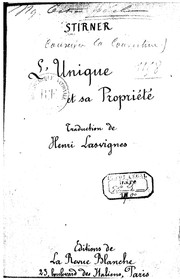
唯一者及其所有物 (1844)
百科
《唯一者及其所有物》(德语:Der Einzige und sein Eigentum)是德国哲学家麦克斯·施蒂纳1844年的作品。这部作品在一方面进行了对于基督教与传统道德的后黑格尔式批判;而在另一方面也批判了人文主义、功利主义、自由主义,以及在当时蓬勃发展的社会主义运动。与这些运动相反,它提倡了一种非道德(而非不道德或反社会的)的利己主义哲学。这部作品被认为对无政府主义、存在主义、虚无主义和后现代主义的发展有着深远的影响。
在2010年,约翰·F·威尔士为这部作品中施蒂纳的思想提出了“辩证利己主义”一词,以此来强调它与日常用语中带有负面与贬义含义的利己主义一词的区别。
以上文字摘自维基百科「唯一者及其所有物」(去掉了参考文献等尾部小节),按 CC BY-SA 4.0 使用,作者为维基百科的各位编者。
中文维基百科的条目比较短,下面附上英文维基百科的内容(英文原文):
The Ego and Its Own (German: Der Einzige und sein Eigentum), also known as The Unique and Its Property, is an 1844 book by German philosopher Max Stirner. It presents a post-Hegelian critique of Christianity and traditional morality on one hand; and on the other, humanism, utilitarianism, liberalism, and much of the then-burgeoning socialist movement, advocating instead an amoral (although importantly not inherently immoral or antisocial) egoism. It is considered a major influence on the development of anarchism, existentialism, nihilism, and postmodernism.
Content
The material that follows is based on the first known English translation, by Steven T. Byington, first published in 1907.
Part One
The first part of the text begins by setting out a tripartite dialectical structure based on an individual's stages of life (Childhood, Youth and Adulthood).
In the first realistic stage, children are restricted by external material forces. Upon reaching the stage of youth, they begin to learn how to overcome these restrictions by what Stirner calls the "self-discovery of mind". However, in the idealistic stage, a youth now becomes enslaved by internal forces such as conscience, reason and other "spooks" or "fixed ideas" of the mind (including religion, nationalism and other ideologies). The final stage, "egoism", is the second self-discovery, in which one becomes self-conscious of oneself as more than his mind or body.
Throughout the book, Stirner applies this dialectical structure to human history. Part one is a sustained critique of the first two periods of human history and especially of the failure of the modern world to escape from religious modes of thinking. Stirner's analysis is opposed to the belief that modern individuals are progressively more free than their predecessors. Stirner sees moderns as being possessed by ideological forces such as Christianity and the ideologies of the modern nation state.
Stirner's critique of modernity is centred on the Protestant Reformation. According to Stirner, Reformation theology extended religious domination over individuals by blurring the distinction between the sensual and the spiritual (thus allowing priests to marry for example). The Reformation also strengthened and intensified religious belief and made it more personal, creating an internal conflict between natural desires and religious conscience. Thus the Reformation only served to further enslave Europeans under spiritual ideology.
Stirner's critique of a progressive view of history is part of his attack on the philosophies of the left-Hegelians, especially that of Ludwig Feuerbach. Stirner sees Feuerbach's philosophy as merely a continuation of religious ways of thinking. Feuerbach had argued that Christianity was mistaken in taking human qualities and projecting them into a transcendent God. But according to Stirner, Feuerbach's philosophy, while rejecting a God, left the Christian qualities intact. Feuerbach had taken a set of human qualities and deified them, making them the only prescriptive view of humanity. This became just another religion for Stirner, a "change of masters" over the individual. Stirner criticizes other left-Hegelians for setting a conception of essential human nature as a goal to be striven for instead of one which is already achieved. So while liberals like Arnold Ruge found the essence of the human in citizenship, and social liberals like Moses Hess found it in labor, all of them made a similar error of ossifying an "essence" of the human and deifying it. For Stirner, "human nature" cannot provide any prescriptions on how one ought to live as one doesn't need to become his nature, but instead he already is ("Your nature is, once and for all, a human one; you are human natures, human beings. But, just because you already are so, you do not still need to become so").
以上文字摘自英文维基百科「The Ego and Its Own」(有删节,去掉了参考文献等尾部小节),按 CC BY-SA 4.0 使用,作者为维基百科的各位编者。
资料卡
- 原题
- Der Einzige und sein Eigenthum
- 译者
- 史蒂文·T·拜林顿
- 原作语言
- 德语
- 首次出版
- 1844 年
- 体裁
- 哲学
- 主题
- 个人无政府主义
资料卡来自 Wikidata Q1193108(CC0),众包数据,个别字段可能不全。