书单
百科
这个词条暂时没有中文维基百科条目,下面是英文维基百科的内容(英文原文):
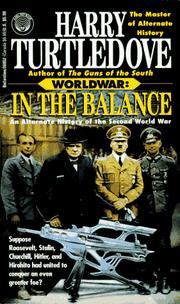
Worldwar: In the Balance is a 1994 alternate history novel by American writer Harry Turtledove. It is the first novel of the Worldwar Tetralogy, as well as the first installment in the extended Worldwar series that includes the Colonization trilogy and the novel Homeward Bound. The plot begins in late 1941, while the Earth is torn apart by World War II. An alien fleet arrives to conquer the planet, forcing the warring nations to make uneasy alliances against the invaders. Meanwhile, the aliens, who refer to themselves as the Race, discover that their enemy is far fiercer and more technologically advanced than expected.
Plot summary
After arriving in the Earth's solar system, the Conquest Fleet's essential personnel are awakened from cold sleep after a 20-year journey originating from Tau Ceti II. Fleetlord Atvar, busy making the final preparations for the invasion of Earth, expects a rapid victory over the primitive beings populating the planet. He is interrupted by a communications officer, who reports that radio emissions are emanating from Earth. Atvar refuses to believe the report since the most recent intelligence, gathered from a probe that visited Earth in the 12th century AD, indicates that the inhabitants are a pre-industrial species.
The Conquest Fleet reaches Earth orbit in December 1941 and begins surveying the planet. It is shocked to find that in the course of only 800 years, the inhabitants have moved from a primitive agricultural society to an industrial civilization. The Race's technology has hardly changed in more than 50,000 years, and other known intelligent species are similarly slow to evolve.
After six months of reconnaissance and intelligence gathering, Atvar consults in May 1942 with the Shiplords of the Conquest Fleet. The troops have been awakened from cold sleep and are prepared to commence with military operations. However, Atvar can, technically, cancel the invasion. Unwilling to call off the attack and face the Emperor back on Home, Atvar orders the assault to begin.
Soon, the Race detonates several atomic bombs above the Earth's atmosphere in an attempt to disrupt human communications, and the attack begins.
On the night of May 30, only hours after detonating the nuclear bombs, the Race's forces attack human aircraft and ground vehicles in and around designated landing zones. Once the sites are secured, troop ships begin landing and disgorging ground forces. The Race simultaneously establishes bases on every continent except Antarctica.
Latin America and Africa are overrun almost immediately, with Mexico the only one resisting the invaders but falling a week after fierce fighting. Landing bases in Florida, Illinois, Idaho, and New York State cause widespread panic and chaos in the United States. The Race's forces establish bases in occupied Poland, cutting Nazi Germany off from the bulk of its forces in the Soviet Union and resulting in a massive German retreat westward. The United Kingdom's air forces are battered from alien bases in Spain and France. The Soviet Union must deal with enemy strongholds in Ukraine, Outer Mongolia, and Siberia. Everywhere, humankind falls back in the face of a seemingly-unstoppable nemesis.
Hostilities between the Axis and Allied powers end almost immediately, simply because there is no other viable option. With the Race's forces battering the human armies into submission, no resources can be expended on human rivalries. The unsettling reality of the new balance of power is emphasized by the fact that in the early days of the fighting, only Germany is able to battle the aliens with any measure of success. That is only natural since Germany has been at war longer than the other major powers and has an economy specifically geared toward war. However, Americans are nauseated by the idea of fighting on the same side as Hitler, and the Soviets, having already been betrayed and attacked by the Germans, are at best reluctant to be working alongside them.
After the initial assault, the Race's troops come to a virtual standstill. It is not so much human resistance that keeps them from advancing as much as its tendency to deliberate their options before acting. Mankind takes advantage of the respite provided to wage localized counterattacks, nearly all of which are unsuccessful. In the process, it finds that the Race lacks tactical combat initiative and can be easily lured into traps, but their advanced tech makes exploiting these weaknesses almost impossible. The Race also discovers that its orbital atomic detonations had little or no effect on the human militaries. It had thought that the resulting electro-magnetic pulse would short out any advanced technology of humans, but it soon realizes that humans do not yet possess silicon computer chips. Most human electronics, such as radios, use vacuum tubes, which are less efficient but also more resistant to electro-magnetic interference.
Hitler takes advantage of the brief lull in the fighting in an artillery unit in Ukraine to attack an alien base using railroad guns. The German battery manages to destroy two of the Race's ships (the 67th Emperor Sohrheb and the 56th Emperor Jossano), including the one that carries the bulk of the Conquest Fleet's atomic stockpile. The resulting explosion sends chunks of plutonium flying across several acres. Soviet partisans take notice of the care with which the Race goes about collecting the strange metal.
以上文字摘自英文维基百科「Worldwar: In the Balance」(有删节,去掉了参考文献等尾部小节),按 CC BY-SA 4.0 使用,作者为维基百科的各位编者。
资料卡
- 原题
- Worldwar: In the Balance
- 原作语言
- 英语
- 首次出版
- 1994 年 1 月 3 日
- 作品形式
- 长篇小说
- 体裁
- 架空历史、科学幻想
- 所属系列
- Worldwar
- 续作
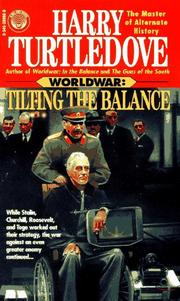
- Worldwar: Tilting the Balance
资料卡来自 Wikidata Q3800868(CC0),众包数据,个别字段可能不全。
更多资料与书评
在哪读
同系列 / 前后作品
哈利·托特达夫 的其他作品
作者页 ›