书单
百科
这个词条暂时没有中文维基百科条目,下面是英文维基百科的内容(英文原文):
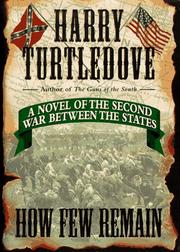
How Few Remain is a 1997 alternate history novel by Harry Turtledove. It is the first part of the Southern Victory saga, which depicts a world in which the Confederate States of America won the American Civil War. It is similar to his earlier novel The Guns of the South, but unlike the latter, it is a purely historical novel with no fantastical or science fiction elements. The book received the Sidewise Award for Alternate History in 1997, and was also nominated for the Nebula Award for Best Novel in 1998. It covers the Southern Victory Series period of history from 1862 and from 1881 to 1882.
Plot
The point of divergence occurs on September 10, 1862, during the American Civil War. In actual history, a C.S. Army messenger lost a copy of General Robert E. Lee's Special Order 191, which detailed Lee's plans for an invasion of the North. The order was soon found by U.S. Army soldiers, and using them, George B. McClellan fought the Army of Northern Virginia at the Battle of South Mountain and eventually a draw at the Battle of Antietam and made it return to Virginia.
In How Few Remain, the orders are instead recovered by a trailing C.S. soldier. McClellan is caught by surprise, and Lee thus leads the Army of Northern Virginia towards Philadelphia. Lee forces McClellan into battle on the banks of the Susquehanna River in Pennsylvania and destroys the Army of the Potomac in the Battle of Camp Hill on October 1. Lee goes on to capture Philadelphia, earning the Confederate States of America diplomatic recognition from both the United Kingdom and France, thus winning the war, which is known as the War of Secession in the alternate timeline, and achieving independence from the United States on November 4, 1862.
Kentucky, having been conquered by C.S. forces shortly after the Battle of Camp Hill as a result of Lincoln diverting key troops there to Pennsylvania, who did not arrive in time to fight at Camp Hill, joins the eleven original C.S. states after the war's conclusion, and the Confederacy is also given the Indian Territory (our timeline's state of Oklahoma, later the State of Sequoyah in the SV timeline). However, as a compromise, the United States retains Missouri (despite proposals to divide it) and West Virginia. The Spanish island of Cuba is purchased by the C.S. in the late 1870s for $3,000,000, thus also becoming a C.S. state.
Abraham Lincoln ends up losing the 1864 presidential election to the Democratic candidate (whose identity is never mentioned in the series) in a landslide.
In the late 1860s, Russia offers to sell Alaska to the United States. However, the $7 million (~$144 million in 2025) price tag is too much for the U.S.'s eroded postwar economy which collapsed in 1863. Therefore, Alaska remains a Russian territory.
The C.S. makes agreeable treaties with the Indians in its domain, particularly those of the Indian Territory, ensuring their support for the new nation. The U.S. Army, freed up by the war's quick end, lets off steam by accelerating the U.S. settlement of the Great Plains and the West which also accelerated the Indian Wars, crushing all hostile tribes by the early 1870s except for the Comanche and Kiowa, who take full advantage of the new U.S.-C.S. border and manipulate the continuing hostility between the two nations to their own maximum benefit. One result is that the Battle of Little Big Horn (1876 in our timeline) never happens, a divergence that will have consequences resonating throughout the series.
In 1881, Republican James G. Blaine has ridden a hardline platform of anti-Confederatism into the White House, having defeated Democratic incumbent Samuel J. Tilden in the 1880 presidential election. Both American nations have been sanctioning Indian raids into each other's territory. The international tension between the United States and the Confederate States peaks when Confederate President James Longstreet, desiring a Pacific Coast for the Confederacy so that the South can have a transcontinental railroad for itself, purchases the northwestern provinces of Sonora and Chihuahua from the financially-strapped Second Mexican Empire, which is still ruled by Maximilian I, for CS $3,000,000. Blaine uses the "coerced" purchase as a casus belli, leading to the commencement of what will later become known as the "Second Mexican War".
Second Mexican War
After the Confederate purchase of Sonora and Chihuahua, which extends the border and gives the Confederates the Pacific port of Guaymas, the United States declares war on the Confederate States. Early on in the war, Confederate troops under Jeb Stuart capture a large quantity of gold and silver ore from a Union mining town after successfully occupying the newly purchased provinces. Meanwhile, a Union cavalry colonel, George Armstrong Custer, successfully uses Gatling guns against Kiowa Indians and Confederate cavalry in Kansas. Soon, the United Kingdom and France, both Confederate allies, blockade and bombard port cities such as Boston and New York, along with those on the Great Lakes.
During the war, the Mormons in Utah rebel by severing transcontinental communication and transportation around Salt Lake City. John Pope is appointed as the military governor, puts down the revolt, and imposes martial law. The Church of Jesus Christ of Latter-day Saints is classified as an illegal political organization, and Mormonism loses all protection under the First Amendment and is banned. The Mormon leaders are then hunted down and executed. The brutal put down of the revolt in Utah will set the stage for the Utah Troubles, which will haunt the United States for the rest of the series.
以上文字摘自英文维基百科「How Few Remain」(有删节,去掉了参考文献等尾部小节),按 CC BY-SA 4.0 使用,作者为维基百科的各位编者。
资料卡
- 原题
- How Few Remain
- 原作语言
- 英语
- 首次出版
- 1997 年 9 月 8 日
- 作品形式
- 长篇小说
- 体裁
- 架空历史
- 首版出版社
- 巴兰坦、德雷书业
- 所属系列
- Southern Victory
- 续作
- The Great War: American Front
- 故事发生地
- 美国
- 获奖
- 侧面奖(1997)
资料卡来自 Wikidata Q2468406(CC0),众包数据,个别字段可能不全。
更多资料与书评
在哪读
哈利·托特达夫 的其他作品
作者页 ›