 书单
百科
这个词条暂时没有中文维基百科条目,下面是英文维基百科的内容(英文原文):
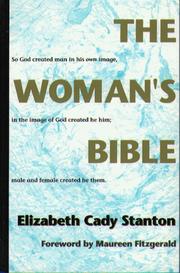
The Woman's Bible is a two-part non-fiction book, written by Elizabeth Cady Stanton and a committee of 26 women, published in 1895 and 1898 to challenge the traditional position of religious orthodoxy that woman should be subservient to man. By producing the book, Stanton wished to promote a radical liberating theology, one that stressed self-development. The book attracted a great deal of controversy and antagonism at its introduction.
Many women's rights activists who worked with Stanton were opposed to the publication of The Woman's Bible; they felt it would harm the drive for women's suffrage. Although it was never accepted by Bible scholars as a major work, much to the dismay of suffragists who worked alongside Stanton within the National American Woman Suffrage Association (NAWSA), it became a popular best-seller. Susan B. Anthony tried to calm the younger suffragists, but they issued a formal denunciation of the book at NAWSA's January 1896 convention, and worked to distance the suffrage movement from Stanton's broader scope which included attacks on traditional religion. Because of the widespread negative reaction, including that of suffragists who had been close to her, publication of the book effectively ended Stanton's influence in the suffrage movement.
Background
In the early 19th century advocates of women's rights began to accumulate rebuttals to arguments used against them founded on traditional interpretations of Bible scriptures. Lucretia Mott countered those who would put her in her place by quoting other Bible passages, or by challenging the original interpretation of the scripture. In 1849, Mott wrote Discourse on Woman which discussed Adam and Eve, the activities of various women who appear in the Bible, and argued that the Bible supported woman's right to speak aloud her spiritual beliefs. Independently from Mott, Lucy Stone determined for herself that the male-dominant interpretations of the Bible must be faulty—she worked to learn Greek and Hebrew and thereby gain insight into the earlier Bible translations which she believed would contain wording more favorable to women's equality. In New York, aided by Mott, Elizabeth Cady Stanton helped draft the Declaration of Sentiments in 1848 and included two Resolutions which protested against man's usurpation of rights relating to her position in church and to her role under God. By the 1850s, Mott had become expert at disarming men who used Scripture against her. At the National Women's Rights Convention in 1852, and again in 1854, she stood up to debate men who came prepared with Scripture in hand. Reverend Henry Grew told the 1854 convention audience that the Bible proved men were naturally superior to women. He was countered point-by-point by Hannah Tracy Cutler, then in broad societal and political terms by Mott who began by saying: "It is not Christianity, but priestcraft that has subjected woman as we find her. The Church and State have been united, and it is well for us to see it so."
Revising Committee
In 1881, 1885 and 1894, the Church of England published a Revised Version of the Bible, the first new English version in over two centuries. Stanton was dissatisfied with the Revised Version's failure to incorporate recent scholarship from Bible translator Julia Evelina Smith. She wrote:
Whatever the Bible may be made to do in Hebrew or Greek, in plain English it does not exalt and dignify woman. My standpoint for criticism is the revised edition of 1888. I will so far honor the revising committee of wise men who have given us the best exegesis they can according to their ability, although Disraeli said the last one before he died, contained 150,000 blunders in the Hebrew, and 7,000 in the Greek.
Stanton assembled a "Revising Committee" to draft commentary on the new Bible version. Many of those she approached in person and by letter refused to take part, especially scholars who would be risking their professional reputations. Sharing Stanton's determination, the committee wished to correct biblical interpretation which they viewed as being biased against women, and to bring attention to the small fraction of the Bible which discussed women. They intended to demonstrate that it was not divine will that humiliated women, but human desire for domination.
The committee was made up of women who were not Bible scholars, but who were interested in biblical interpretation and most were active in the NAWSA. In The Woman's Bible, Part I, first edition, released November 1895, the Revising Committee listed 23 members, including Phebe Ann Coffin Hanaford, Clara Bewick Colby, Augusta Jane Chapin, Lillie Devereux Blake, Matilda Joslyn Gage, Olympia Brown, and Carrie Chapman Catt. Just a few months later in early 1896, Part I, Second Edition was released permanently replacing Mrs. Catt's name with Mrs. Clara Neymann and adding a list of international members, notably among them were Alexandra Gripenberg, Ursula Mellor Bright and Irma von Troll-Borostyani.
In 1890 at the formation of the National American Woman Suffrage Association, Stanton was elected president. She left such duties to Susan B. Anthony and instead traveled to Europe for two years. While there she met with women who shared her views, and she gathered critical observations about the place of woman in the Bible. In Greenbank, Bristol, Stanton met with English suffragist Helen Bright Clark, and spoke to a group about the Bible position of woman. Clark questioned whether Stanton's liberal views had shocked some in attendance, and Stanton replied: "Well, if we who do see the absurdities of the old superstitions never unveil them to others, how is the world to make any progress in the theologies? I am in the sunset of life, and I feel it to be my special mission to tell people what they are not prepared to hear ..."
以上文字摘自英文维基百科「The Woman's Bible」(有删节,去掉了参考文献等尾部小节),按 CC BY-SA 4.0 使用,作者为维基百科的各位编者。
资料卡
- 原题
- The Woman's Bible
- 原作语言
- 英语
- 首次出版
- 1895 年
- 体裁
- 随笔
资料卡来自 Wikidata Q7775461(CC0),众包数据,个别字段可能不全。