书单
百科
这个词条暂时没有中文维基百科条目,下面是英文维基百科的内容(英文原文):
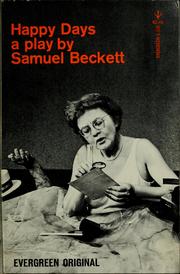
Happy Days is a play in two acts, written by Samuel Beckett first performed in 1961. Viewed positively by critics, it was named in The Independent as one of the 40 best plays of all time.
Winnie, buried to her waist, follows her daily routine and prattles to her husband, Willie, who is largely hidden and taciturn. Her frequent refrain is "Oh this is a happy day." Later, in Act II, she is buried up to her neck, but continues to talk and remember happier days.
Synopsis
Act I
Winnie is embedded waist-deep in a low mound under blazing light, with a large black bag beside her. She is awakened by a piercing bell and begins her daily routine with a prayer. Talking incessantly to herself, she brushes her teeth, drinks the last of a bottle of tonic, and puts on her hat. She struggles to read the writing on the toothbrush. She awakens her husband Willie, who is hidden by the mound, and prattles to him. He occasionally responds with headlines from his newspaper, one of which reminds her of her first kiss. They both look at an apparently saucy postcard. Winnie explains that Willie's listening enables her to go on talking, and is delighted when he responds even briefly to one of her many questions. After Willie briefly doffs his cap, Winnie instructs him to return to his hole, which he laboriously does. After he is within she repeatedly asks if he can hear her at different volumes, to which he replies, with increasing exasperation, "yes!" Winnie attempts to discover if Willie can see her if she leans backward, but he does not respond. Winnie spots an 'emmet' (an archaic term for 'ant') carrying an egg. Willie comments "formication" (A sensation of ants creeping on the skin). Both of them laugh hysterically at the homophone. Winnie declares that she never thought she would hear Willie laugh again. She then asks if he finds her loveable. After some deliberation with herself, she pulls a revolver out of her bag, recalls how Willie asked her to take it away from him, and banishes it to the ground beside her. She begins to feel sad about her life, but shakes it off. She puts up a parasol to protect herself from the sun, and holds it over her head for a long time. When this becomes tiring, she discovers she cannot move to put it down. She begs Willie for assistance, but he is unresponsive. The parasol then abruptly catches fire, and she throws it away. Willie still unresponsive, she coaxes him to prove he is conscious, which he eventually does, by raising a finger. Winnie speaks of the difficulty of dealing with the relentless sun and remembers when she was not trapped in the earthen mound. She thinks about the future, and the existential threat of being buried deeper in the mound. She finds a music box in her bag, to the music of which Willie briefly sings (though he ignores Winnie's request for an encore). Winnie files her nails and remembers the last people who passed, a Mr. and Mrs. Shower (or perhaps Cooker), who asked what she was doing stuck in the ground. She prepares her bag for the night. Willie emerges and Winnie wishes that he would come round and live where she could see him better. He reads his newspaper. Winnie asks Willie about the nature of hogs, to which he replies "castrated male swine, raised for slaughter". Darkness overcomes the pair.
Act II
Winnie is now embedded up to her neck, still wearing her hat, still with the bag and revolver beside her. She is awakened by the bell, which rings again each time she falls back asleep. She senses that Willie is looking at her but can no longer see him, and he does not respond to her calls. She continues to talk, examining her nose and recalling a time when a little girl called Mildred undressed her doll in the nursery at night, but is interrupted by anxiety about Willie and further memories of Mr. and Mrs. Shower. Willie crawls out from behind the mound, smartly dressed, which reminds her of the day he asked her to marry him. She encourages him as he tries to crawl up the mound towards her, and is delighted when he grunts "Win". She sings the music-box tune, a love song from The Merry Widow.
Characters
Winnie
Winnie is one of those parts, I believe, that actresses will want to play in the way that actors aim at Hamlet—a 'summit' part.
– Dame Peggy Ashcroft
Winnie is a "woman of about fifty", who passes her time between "the bell for waking and the bell for sleep" by following a very exact daily routine. In Act 1, after she methodically removes the items from her bag—a comb, a toothbrush, toothpaste, a bottle of patent medicine, lipstick, a nail file, a revolver and a music box. The routine is raised to the level of ceremony. Beckett's instructions to Billie Whitelaw in 1979 emphasize this:
The bag is all she has—look at it with affection … From the first you should know how she feels about it … When the bag is at the right height you peer in, see what things are there and then get them out. Peer, take, place. Peer, take, place. You peer more when you pick things up than when you put them down. Everything has its place.
At the end of the day she carefully collects her possessions—bar the gun—and places them back in the bag. Winnie never plumbs (never dares plumb) the bottom ("The depths in particular, who knows what treasures"), so it is also her hope chest.
The items in her bag also have secondary functions, they serve as aides-mémoire. But more, like Krapp's tapes or Lucky's bones they provide her with what Mary Doll describes as "touchstones of existential meaning". Winnie's perception of these objects connects her to the memories of specific days and important incidents within them.
Her possessions are all wearing out or running out. At the start of Act I she takes the last swig of her medicine before throwing away the bottle, her toothbrush has hardly any hairs left and the lipstick, to use Beckett's expression, is "visibly zu ende", the parasol is faded with a "mangy fringe" and even her pearl necklace is "more thread than pearls".
以上文字摘自英文维基百科「Happy Days (play)」(有删节,去掉了参考文献等尾部小节),按 CC BY-SA 4.0 使用,作者为维基百科的各位编者。
资料卡
- 原题
- Happy Days
- 原作语言
- 英语
- 首次出版
- 1960 年
- 作品形式
- 剧作
- 主要人物
- Winnie、Willie
资料卡来自 Wikidata Q1189196(CC0),众包数据,个别字段可能不全。