书单
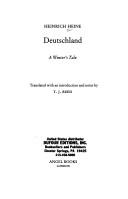
德国,一个冬天的童话 (1844)
百科
这个词条暂时没有中文维基百科条目,下面是英文维基百科的内容(英文原文):
Germany. A Winter's Tale (German: Deutschland. Ein Wintermärchen) is a satirical epic poem by the German writer Heinrich Heine (1797–1856), describing the thoughts of a journey from Paris to Hamburg the author made in winter 1843. The title refers to Shakespeare's Winter's Tale, similar to his poem Atta Troll: Ein Sommernachtstraum ("Atta Troll: A Midsummer Night's Dream"), written 1841–46.
This poem was immediately banned in the Austrian Empire and in most of the German Confederation, which ironically became one of the reasons for Heine's growing fame.
Original publication
From the onset of the (Metternich) Restoration in Germany, Heine was no longer secure from the censorship, and in 1831 he finally migrated to France as an exile. In 1835 a decree of the German Federal Convention banned his writings together with the publications of the Young Germany literary group.
At the end of 1843 Heine went back to Germany for a few weeks to visit his mother and his publisher Julius Campe in Hamburg. On the return journey the first draft of Deutschland. Ein Wintermärchen took shape. The verse epic appeared in 1844 published by Hoffmann and Campe, Hamburg. According to the censorship regulations of the 1819 Carlsbad Decrees, manuscripts of more than twenty folios did not fall under the scrutiny of the censor. Therefore, Deutschland. Ein Wintermärchen was published together with other poems in a volume called ‘New Poems’. However, on 4 October 1844 the book was banned and the stock confiscated in Prussia. On 12 December 1844, King Frederick William IV issued a warrant of arrest against Heine. In the period following the work was repeatedly banned by the censorship authorities. In other parts of Germany it was certainly issued in the form of a separate publication, also published by Hoffmann and Campe, but Heine had to shorten and rewrite it.
Ironically, censorship of Heine's works, particularly of the Winter Tale, became a major reason for Heine's raising fame.
Contents
The opening of the poem is the first journey of Heinrich Heine to Germany since his emigration to France in 1831. However it is to be understood that this is an imaginary journey, not the actual journey which Heine made but a literary tour through various provinces of Germany for the purposes of his commentary. The 'I' of the narrative is therefore the instrument of the poet's creative imagination.
Wintermärchen and Winterreise
Heinrich Heine was a master of the natural style of lyrics on the theme of love, like those in the 'Lyrisches Intermezzo' of 1822-1823 in Das Buch der Lieder (1827) which were set by Robert Schumann in his Dichterliebe. A few of his poems had been set by Franz Schubert, not least for the great posthumously-collected series of songs known as the Schwanengesang. In such works Heine assumed the manner of Wilhelm Müller, whose son Professor Max Müller later emphasized the fundamentally musical nature of these poems and the absolute congruity of Schubert's settings of them, which are fully composed duos for voice and piano rather than merely 'accompaniments' to tunes. Yet Heine's work addressed political preoccupations with a barbed and contemporary voice, whereas Müller's melancholy lyricism and nature-scenery explored more private (if equally universal) human experience. Schubert's Heine settings hardly portray the poet-philosopher's full identity.
Schubert was dead by 1828: Heine's choice of the winter journey theme certainly alludes to the Winterreise, Müller's cycle of poems about lost love, which in Schubert's song-cycle of the same name became an immortal work embodying some more final and tragic statement about the human condition. Winterreise is about the exile of the human heart, and its bitter and gloomy self-reconciliation. Deutschland. Ein Wintermärchen transfers the theme to the international European political scene, his exile as a writer from his own homeland (where his heart is), and his Heimatssehnsucht or longing for the homeland. Thus Heine casts his secret and 'illegal thoughts', so that the darts of his satire and humour fly out from the tragic vortex of his own exile. The fact that Heine's poetry was itself so closely identified with Schubert was part of his armoury of 'fire and weapons' mentioned in the closing stanzas: he transformed Müller's lament into a lament for Germany.
In Section III, full of euphoria he sets foot again on German soil, with only ‘shirts, trousers and pocket handkerchiefs’ in his luggage, but in his head ‘a twittering birds’-nest/ of books liable to be confiscated’. In Aachen Heine first comes in contact again with the Prussian military:
These people are still the same wooden types,Spout pedantic commonplaces -All motions right-angled - and priggishnessIs frozen upon their faces.
In Section IV on the winter-journey to Cologne he mocks the anachronistic German society, that more readily with archaic skills builds the Cologne Cathedral, unfinished since the Middle Ages, than addressing itself to the Present Age. That the anachronistic building works came to be discontinued in the course of the Reformation indicated for the poet a positive advance: the overcoming of traditional ways of thought and the end of spiritual juvenility or adolescence.
In Section V he comes to the Rhine, as ‘the German Rhine’ and ‘Father Rhine’, icon and memorial of German identity. The River-god however shows himself as a sorrowful old man, disgusted with the babble about Germanic identity. He does not long to go back among the French who, according to Heine, now drink beer and read ‘Fichte’ and Kant.
Section VI introduces the ‘Liktor’, the poet's demon and ghostly doppelganger, always present, who follows him about carrying a hatchet under his cloak, waiting for a sign to execute the poet's judicial sentences. The stanzas express Heine's conviction that an idea once thought can never be lost. He confronts the shadowy figure, and is told:
以上文字摘自英文维基百科「Germany. A Winter's Tale」(有删节,去掉了参考文献等尾部小节),按 CC BY-SA 4.0 使用,作者为维基百科的各位编者。
资料卡
- 原题
- Deutschland. Ein Wintermärchen
- 原作语言
- 德语
- 首次出版
- 1844 年
- 体裁
- 史诗
- 首发于
- Neue Gedichte
资料卡来自 Wikidata Q261565(CC0),众包数据,个别字段可能不全。